


Dust Collector Cartridges
In industrial environments, air quality management is not merely a regulatory requirement but a fundamental necessity for equipment longevity and personnel safety. Dust collector cartridges serve as the primary filtration component in dust collection systems, designed to capture airborne particulates from various industrial processes, including metalworking, chemical processing, and pharmaceutical manufacturing. Unlike traditional bag filters, cartridges offer a significantly higher surface area within a compact footprint, utilizing pleated media to achieve high filtration efficiency and lower pressure drops.
Selecting the appropriate dust collector cartridges requires an understanding of the specific dust characteristics, airflow requirements, and the structural demands of the filtration system. For engineers and procurement teams, evaluating these components involves looking beyond initial costs to consider the total cost of ownership, including energy consumption, cleaning efficiency, and replacement frequency.
Engineering Fundamentals of Cartridge Filtration
The performance of dust collector cartridges is dictated by the relationship between the filter media, the pleat geometry, and the structural support. The primary mechanism of filtration in these cartridges is surface loading. As dust-laden air passes through the media, particles are trapped on the surface, forming a "dust cake" that eventually assists in the filtration process before being removed during cleaning cycles.
Pleat Geometry and Airflow
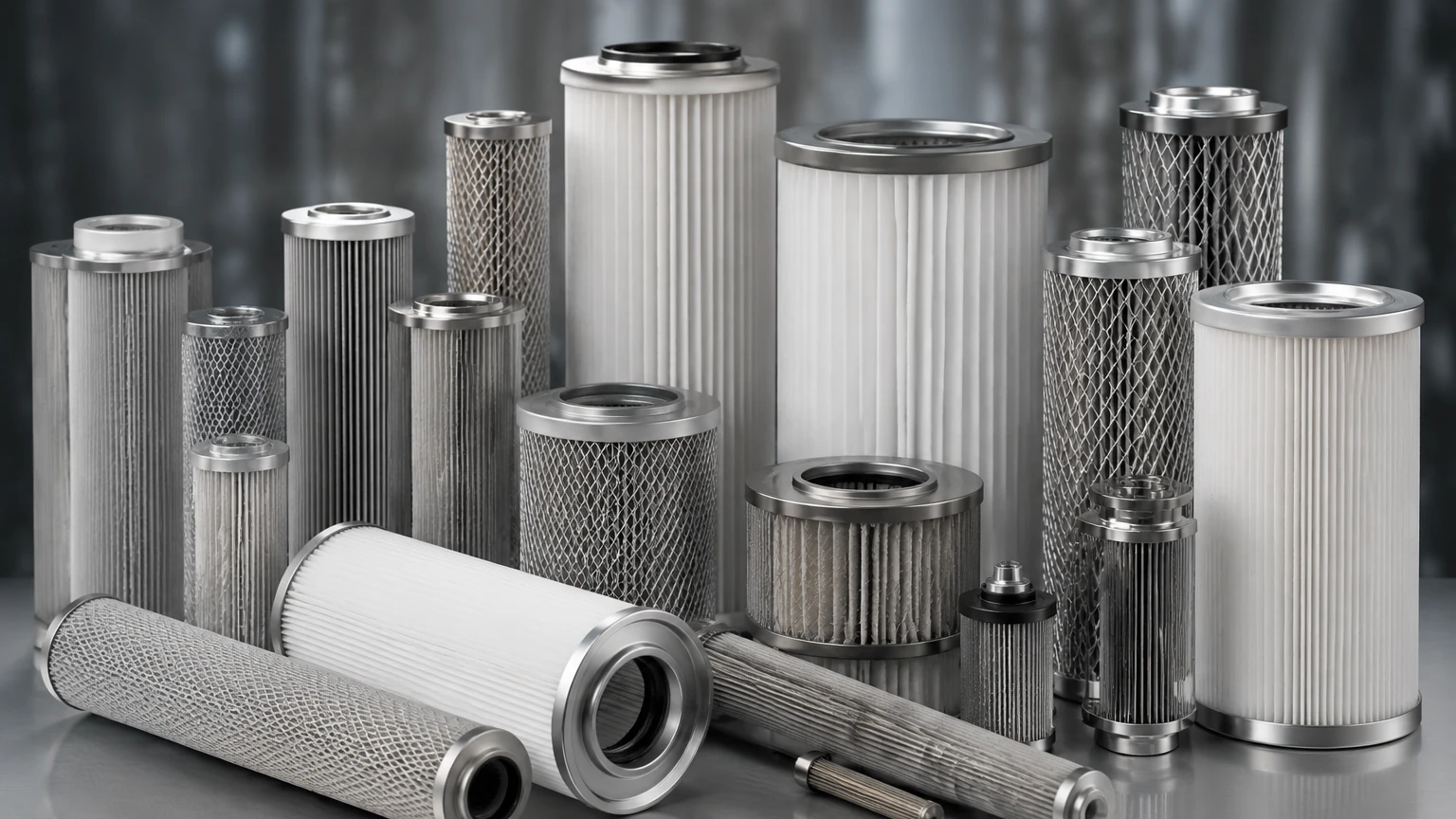
The defining feature of a cartridge is its pleated design. By folding the media, manufacturers can fit a large amount of filtration surface area into a relatively small cylindrical or conical volume. However, pleat density must be carefully engineered. If pleats are packed too tightly, a phenomenon known as "bridging" occurs, where dust becomes trapped deep within the pleat valleys and cannot be dislodged by pulse-jet cleaning. This leads to a rapid increase in pressure drop and reduced filter life. High-quality cartridges maintain uniform pleat spacing, often using specialized beads or structural supports to ensure the media remains open to airflow.
Air-to-Cloth Ratio
The air-to-cloth (A/C) ratio, or filtration velocity, is the volume of air passing through a square foot of filter media per minute (expressed in CFM/ft²). For dust collector cartridges, maintaining a conservative A/C ratio is critical. If the velocity is too high, dust particles are driven deep into the media fibers (depth loading), making them nearly impossible to remove via standard cleaning methods. This results in "blinding" the filter, necessitating premature replacement.
Media Selection and Chemical Compatibility
The choice of media is perhaps the most critical factor in determining the effectiveness of dust collector cartridges. Industrial applications present a wide variety of challenges, from abrasive metallic dust to hygroscopic powders that clump in the presence of moisture.
1. Cellulose and Cellulose Blends: Often the standard for dry, ambient-temperature applications. While cost-effective, pure cellulose is susceptible to moisture and chemical degradation.
2. Polyester Spunbond: Known for its durability and resistance to abrasion. Spunbond media is often used when the dust is heavy or when the filter requires frequent mechanical cleaning. It is also more resistant to moisture than cellulose.
3. PTFE (Polytetrafluoroethylene) Membranes: A thin layer of PTFE is laminated to the surface of the base media. This membrane provides exceptional cake release properties and can capture sub-micron particles. It is ideal for sticky or very fine dusts where standard media would blind quickly.
4. Nano-fiber Coatings: A layer of extremely fine fibers is applied to the surface of the media, creating a very tight mesh that stops particles on the surface. This technology improves initial efficiency and enhances the effectiveness of pulse-jet cleaning.
For specialized industrial applications requiring extreme durability or corrosion resistance, the structural components of the cartridge—such as the inner core and end caps—are often constructed from stainless steel. As a professional manufacturer, Kaifil provides customized filtration solutions that integrate these high-performance materials to withstand demanding chemical and thermal environments. More information on specialized material selection can be found on our Main Page.
Structural Integrity and OEM Customization
Dust collector cartridges must withstand significant mechanical stress. During a pulse-jet cleaning cycle, a high-pressure blast of compressed air is sent down the center of the cartridge to blow dust off the exterior. The cartridge must be rigid enough to resist collapsing during normal operation and robust enough to handle the repeated expansion and contraction of the cleaning pulse.
Core and End Cap Design
The inner core, typically made of expanded metal or perforated stainless steel, provides the primary structural support. A weak core can lead to cartridge collapse, which immediately bypasses the filtration system and can damage downstream equipment like fans or turbines. Similarly, the end caps must provide a perfect seal against the collector housing. Common configurations include:
* Open/Open: Air flows through both ends, often used in vertical hanging arrangements.
* Open/Closed: One end is sealed, forcing air through the media and out the open end.
* Flanged or Bolt-Hole: Specific mechanical interfaces designed to match the mounting hardware of various OEM dust collector brands.
Customization is often necessary when replacing cartridges in older systems or when dealing with unique housing geometries. Engineering teams should confirm the exact dimensions, gasket materials (such as EPDM, Silicone, or Nitrile), and mounting styles to ensure a leak-free installation.
Performance Metrics: MERV Ratings and Pressure Drop
To objectively evaluate dust collector cartridges, engineers rely on standardized metrics. The most common is the MERV (Minimum Efficiency Reporting Value) rating, which scales from 1 to 16. A higher MERV rating indicates the ability to capture smaller particles. For most industrial dust collection, a rating of MERV 11 to MERV 15 is standard, while HEPA-level filtration (MERV 17-20) is reserved for toxic or extremely fine particulates.
Understanding Pressure Drop (ΔP)
Pressure drop is the difference in air pressure between the dirty side and the clean side of the filter. It is a direct indicator of the filter’s resistance to airflow. A high pressure drop means the system's fan must work harder, significantly increasing energy consumption. Monitoring the ΔP across the dust collector cartridges is the most effective way to determine when a cleaning cycle should be triggered or when the filters have reached the end of their functional life.
Maintenance and Total Cost of Ownership
While the purchase price of dust collector cartridges is a visible cost, the total cost of ownership (TCO) includes energy costs, labor for replacement, and the cost of compressed air for cleaning. High-quality cartridges with better cake release properties require fewer cleaning pulses, which saves compressed air and extends the life of the media.
Signs of Failure
Engineers should monitor for the following signs that cartridges require attention:
* Sustained High Pressure Drop: If the ΔP remains high even after multiple cleaning pulses, the media is likely blinded.
* Visible Emissions: Dust appearing at the exhaust stack indicates a leak, often caused by a torn pleat or a failed gasket.
* Reduced Suction at the Source: If the dust collection hoods are no longer capturing dust effectively, the filters may be restricted.
Replacement Cycles
There is no universal timeline for replacing cartridges, as it depends entirely on the dust load and the nature of the material being filtered. However, implementing a scheduled inspection program can prevent catastrophic failures. In many chemical and pharmaceutical applications, stainless steel components are preferred for their ability to be cleaned and reused in certain contexts, or simply for their resistance to the aggressive cleaning agents used in wash-down environments.
Common Risks in Industrial Filtration
One of the most significant risks in operating a dust collector is the potential for fire or explosion, particularly when handling combustible dusts like aluminum, wood, or certain organic powders. In these cases, dust collector cartridges must be equipped with anti-static (conductive) media to prevent the buildup of static electricity, which could act as an ignition source.
Furthermore, chemical incompatibility can lead to rapid filter failure. For example, using standard polyester media in an environment with high moisture and acidic vapors can lead to hydrolysis, where the fibers literally break down and lose their structural integrity. Engineers must provide a full chemical profile of the process gas to the filter manufacturer to ensure the selected materials are compatible.
Selecting the Right Solution
When sourcing dust collector cartridges, the goal is to balance efficiency with durability. A cartridge that provides 99.9% efficiency but blinds every two weeks is not a viable solution for a continuous production line. Conversely, a highly durable filter that allows fine dust to pass through will fail to meet environmental standards and may damage sensitive downstream components.
Before finalizing a purchase, technical professionals should confirm:
* The specific particle size distribution of the dust.
* The operating temperature and presence of moisture or chemicals.
* The required MERV rating for regulatory compliance.
* The mechanical specifications of the existing collector housing.
Kaifil specializes in providing high-performance, customized filtration components that address these complex variables. By focusing on precision engineering and durable materials like stainless steel, we help industrial facilities optimize their filtration performance while reducing long-term operational costs. For a detailed review of product options and technical support for your specific application, visit our Main Page.
