


Electrostatic Dust Collector
In industrial air pollution control, the electrostatic dust collector (ESP) stands as a primary technology for removing fine particulate matter from industrial gas streams. Unlike mechanical filtration systems that rely on physical barriers to intercept particles, an electrostatic dust collector utilizes electrical energy to charge particles and subsequently attract them to collection surfaces. This method is particularly effective for handling high volumes of gas with minimal pressure drop, making it a staple in power generation, cement manufacturing, and chemical processing.
For engineers and procurement teams, understanding the technical nuances of electrostatic precipitation—and how it compares or integrates with stainless steel filtration solutions—is essential for optimizing air quality and operational efficiency. While Kaifil specializes in precision metal filtration, the interplay between electrostatic and mechanical systems often dictates the success of a facility's overall emission control strategy.
The Working Principle of Electrostatic Precipitation
The operation of an electrostatic dust collector is governed by the laws of physics regarding electrical charges. The process generally follows four distinct stages: ionization, charging, collection, and removal.
Ionization and Particle Charging
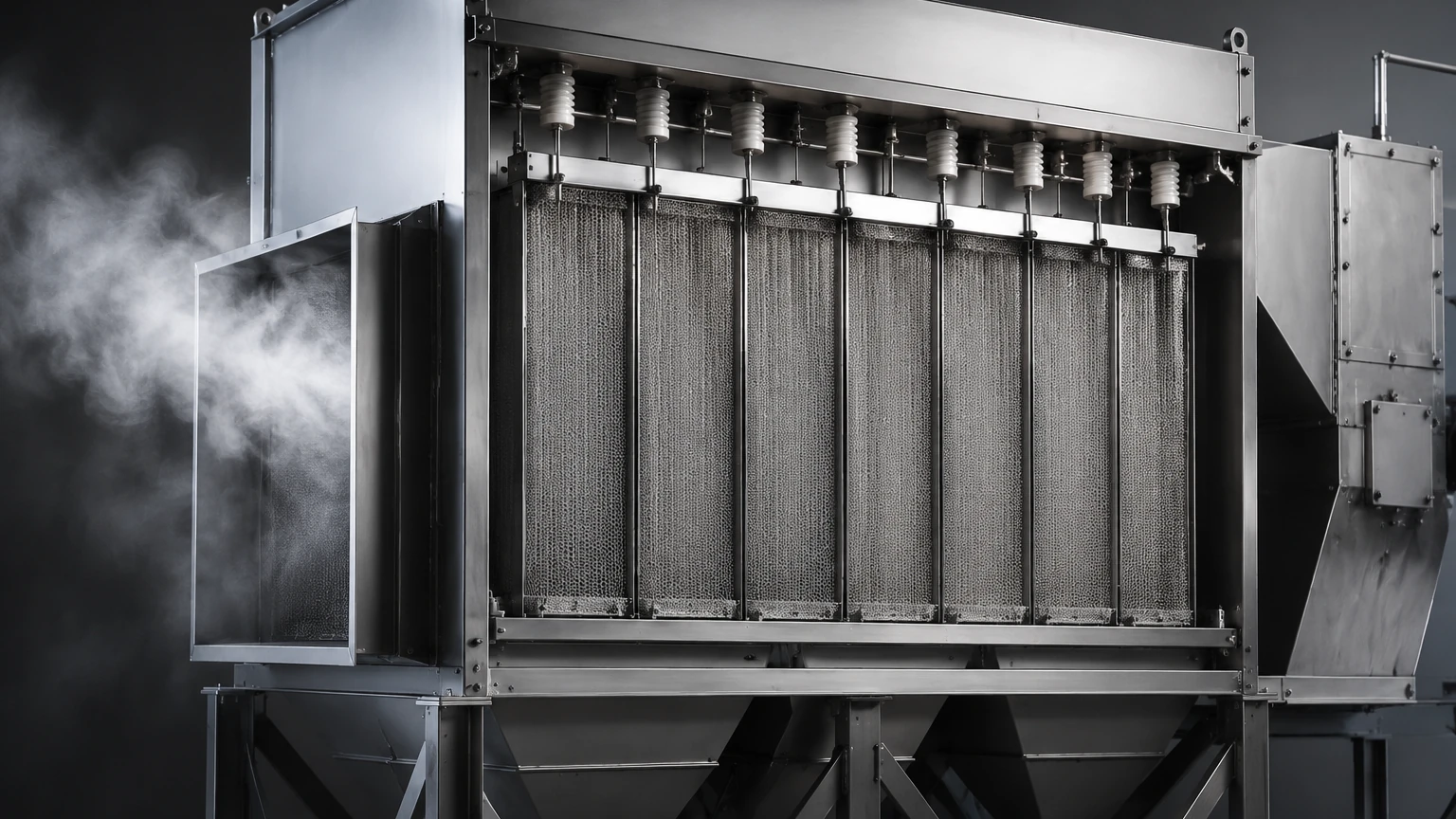
At the core of the system are discharge electrodes, which are typically thin wires or spiked plates. A high-voltage direct current (DC) is applied to these electrodes, creating a strong electric field. When the voltage is high enough, it ionizes the surrounding gas, creating a "corona discharge." As the dust-laden gas passes through this field, the gas ions collide with the dust particles, transferring a negative charge to them.
Particle Collection
Once the particles are negatively charged, they are influenced by the electric field and migrate toward the collection electrodes, which are positively charged or grounded plates. These plates provide a large surface area where the particles adhere. Because the force acting on the particles is electrical rather than pneumatic, the gas flow itself experiences very little resistance, which is a significant advantage over high-pressure-drop fabric filters.
Removal and Disposal
To maintain efficiency, the accumulated dust must be removed from the collection plates. This is typically achieved through a mechanical "rapping" system—a series of hammers or vibrators that strike the plates, causing the dust to fall into hoppers located at the bottom of the unit. In "wet" ESPs, a liquid (usually water) is used to wash the particles from the plates, which is particularly useful for handling sticky or high-resistivity dust.
Key Engineering Components and Design Factors
The efficiency of an electrostatic dust collector is not universal; it is highly dependent on the physical and chemical properties of the gas and the dust. Engineers must evaluate several critical components during the selection process.
Discharge Electrodes and Collection Plates
The geometry and material of the electrodes are vital. Stainless steel is often preferred for these components in corrosive environments due to its durability and resistance to chemical attack. The spacing between the discharge electrodes and the collection plates determines the voltage required to maintain the corona discharge without causing electrical arcing.
Transformer-Rectifier (T-R) Sets
The T-R sets are responsible for converting standard AC power into the high-voltage DC required for the ESP. Modern systems use high-frequency switch-mode power supplies (SMPS) to provide more stable voltage and faster response times to changes in gas conditions, which improves overall collection efficiency.
Specific Collection Area (SCA)
The SCA is the ratio of the total collection plate area to the gas flow rate. A higher SCA generally results in higher collection efficiency but increases the physical footprint and capital cost of the equipment. Calculating the optimal SCA requires a deep understanding of the particle size distribution and the gas velocity.
Comparing ESPs with Mechanical Filtration Systems
While an electrostatic dust collector is efficient for many applications, it is often compared to mechanical filtration methods, such as baghouses or stainless steel filter cartridges. Choosing the right technology depends on the specific demands of the industrial process.
Pressure Drop and Energy Consumption
ESPs are known for their low pressure drop, typically less than 20 mm water gauge. This reduces the load on the induced draft (ID) fans, leading to lower operational energy costs compared to fabric filters, which require significant pressure to force gas through a membrane. However, the ESP itself consumes significant electrical energy to maintain the electrostatic field.
Particle Size and Efficiency
Mechanical filters, particularly those utilizing high-precision wire mesh or sintered metal, are often superior at capturing sub-micron particles that might bypass an ESP if the electrical resistivity of the dust is not ideal. In applications where 100% capture of hazardous fine dust is required, mechanical filtration or a hybrid system may be preferred.
Temperature and Chemical Resistance
Standard fabric filters have strict temperature limits. In contrast, an electrostatic dust collector can operate at much higher temperatures. However, for extreme environments where both high temperature and high pressure are present, custom stainless steel filtration solutions, such as those found on the Main Page of Kaifil’s technical catalog, offer the structural integrity needed to withstand conditions that would degrade electronic components or fabric media.
Integration of Stainless Steel Filter Components
In many modern industrial setups, the electrostatic dust collector does not work in isolation. It is frequently part of a multi-stage filtration train where stainless steel components play a supportive or complementary role.
Pre-filtration and Flow Distribution
Before the gas enters the ESP, it must be evenly distributed across the entire cross-section of the unit. Perforated stainless steel plates or wire mesh screens are often used as distribution baffles. These components ensure that the gas velocity is uniform, preventing "re-entrainment" (where dust is blown off the plates by high-velocity gas streaks).
Post-filtration for Critical Applications
In industries like pharmaceutical manufacturing or food processing, an ESP might serve as a primary collector, followed by high-precision stainless steel filter cartridges. This secondary stage acts as a safety barrier, ensuring that even if the ESP experiences a power flicker or a rapping cycle surge, the final discharge remains within strict regulatory limits.
Material Selection for Longevity
Given that many gas streams contain sulfur oxides (SOx) or other acidic vapors, the internal components of any filtration system are subject to corrosion. Using 304 or 316L stainless steel for internal supports, mesh screens, and even the collection surfaces themselves ensures a longer service life and reduces the total cost of ownership by extending the interval between major overhauls.
Performance Evaluation and Selection Criteria
When evaluating an electrostatic dust collector for a specific project, engineers must look beyond the initial price tag. Several technical factors will determine the long-term viability of the installation.
1. Dust Resistivity: This is perhaps the most critical factor. If the dust has very high resistivity, it can create a "back corona," which significantly reduces efficiency. Conversely, very low resistivity dust can lose its charge too quickly upon hitting the collection plate and be re-entrained into the gas stream.
2. Gas Velocity: The velocity must be low enough to allow the charged particles time to migrate to the plates. Typically, velocities are kept between 0.6 and 1.5 meters per second.
3. Particle Size Distribution (PSD): ESPs are highly effective for particles in the 1 to 10-micron range. For particles smaller than 0.1 microns, the charging mechanism becomes more complex, often requiring specialized designs.
4. Customization Requirements: Every industrial flue gas is unique. Off-the-shelf solutions rarely provide the necessary efficiency. Working with manufacturers who understand custom metal fabrication allows for the creation of internal components tailored to the specific chemistry of the gas stream.
Maintenance and Total Cost Considerations
The maintenance of an electrostatic dust collector is primarily focused on the electrical systems and the mechanical rapping mechanisms. Unlike baghouses, which require periodic and often expensive bag replacements, the primary collection surfaces of an ESP can last for decades if properly maintained and protected from corrosion.
However, the complexity of the high-voltage systems requires specialized personnel for troubleshooting. Furthermore, the buildup of "sticky" dust can lead to electrical tracking and short circuits, necessitating regular internal inspections. In contrast, mechanical stainless steel filters offer a more straightforward maintenance profile—often involving simple cleaning or backwashing—making them an attractive alternative for smaller-scale operations or specific chemical processes where the complexity of an ESP is not justified.
To explore how custom metal filtration components can enhance your industrial air or liquid processing systems, engineers and purchasing teams are encouraged to Review product options and application support to find the most durable and efficient solutions for their specific operational needs.
Conclusion
The electrostatic dust collector remains a powerhouse in industrial emission control, offering a high-capacity, low-pressure-drop solution for large-scale particulate removal. By understanding the electrical principles and engineering constraints of these systems, facilities can better manage their environmental impact. Whether utilizing an ESP as a standalone unit or integrating it with precision stainless steel filtration components, the goal remains the same: achieving reliable, long-term performance in the most demanding industrial environments. Proper material selection, such as the use of high-grade stainless steel for critical internal parts, ensures that these systems continue to operate efficiently even under the stress of chemical exposure and high temperatures.
