


Fabricated Strainers
In industrial fluid handling, the protection of downstream equipment—such as pumps, valves, flow meters, and heat exchangers—is a critical engineering priority. While standard cast strainers are often used for routine applications, complex industrial environments frequently require fabricated strainers. Unlike their cast counterparts, which are produced in fixed molds and standard sizes, fabricated strainers are engineered and welded from plate, pipe, and specialized filtration media. This manufacturing approach allows for a high degree of customization in terms of dimensions, pressure ratings, and material specifications, making them indispensable for large-scale or high-pressure systems in chemical processing, water treatment, and oil and gas industries.
Selecting the right fabricated strainer requires a deep understanding of fluid dynamics, material science, and the specific mechanical requirements of the piping system. For engineers and procurement teams, the decision-making process involves balancing initial capital expenditure with long-term operational efficiency and maintenance requirements. As a specialized manufacturer of stainless steel filtration solutions, Kaifil provides the technical expertise necessary to navigate these complex specifications, ensuring that every component meets the rigorous demands of industrial service.
The Engineering Distinction: Fabricated vs. Cast Strainers
The primary distinction between cast and fabricated strainers lies in the manufacturing process and the resulting flexibility. Cast strainers are limited by the physical constraints of the mold. If a project requires a non-standard face-to-face dimension or a specific nozzle orientation to fit into an existing piping layout, a cast strainer may be impossible to implement.
Fabricated strainers, however, offer virtually unlimited design flexibility. Because they are constructed from individual components—pipe shells, forged flanges, and custom-cut plates—engineers can specify exact dimensions to suit the installation site. This is particularly valuable in retrofit projects where space is at a premium. Furthermore, fabrication allows for the use of high-grade alloys that may be difficult or prohibitively expensive to cast, such as specific grades of stainless steel (304, 316L, or Duplex) that provide superior corrosion resistance in aggressive chemical environments.
From a structural standpoint, fabricated units can be designed to meet specific pressure vessel codes, such as ASME Section VIII, Division 1. This ensures that the strainer can withstand the high-pressure surges and thermal cycling common in heavy industrial applications. For more information on custom filtration engineering, you can visit our Main Page.
Key Design Parameters for Fabricated Strainers
When designing or specifying fabricated strainers, several technical parameters must be evaluated to ensure the component performs reliably over its service life.
1. Pressure Drop and Flow Velocity
The pressure drop ($ΔP$) across a strainer is one of the most critical performance metrics. A high initial pressure drop indicates that the strainer is undersized or that the filtration media is too restrictive for the flow rate. This can lead to cavitation in pumps and reduced system efficiency. Engineers must calculate the "clean" pressure drop and account for the "dirty" pressure drop—the point at which the strainer must be cleaned. Fabricated designs allow for the expansion of the strainer body to increase the effective filtration area, thereby minimizing pressure drop even when using fine mesh screens.
2. Open Area Ratio (OAR)
The Open Area Ratio is the relationship between the internal cross-sectional area of the inlet pipe and the total open area of the strainer element. A standard OAR for industrial strainers is typically 4:1 or 6:1. In applications involving highly viscous fluids or high solids loading, a higher OAR (such as 8:1) may be required to extend the time between cleaning cycles. Fabricated strainers are ideal for achieving high OARs because the housing can be lengthened or widened to accommodate a larger internal basket.
3. Material Compatibility and Traceability
In industries such as pharmaceutical or food and beverage processing, material integrity is non-negotiable. Fabricated strainers allow for precise material selection. Stainless steel 316L is frequently specified for its resistance to pitting and crevice corrosion. Additionally, fabrication allows for full material traceability (MTRs) for every component of the strainer, from the shell to the internal mesh, ensuring compliance with industry standards and safety regulations.
Common Configurations: Y-Type, T-Type, and Basket Strainers
Fabricated strainers are available in several standard configurations, each suited to different operational needs and piping layouts.
Fabricated Y-Strainers
Y-strainers are characterized by their compact design and are typically used in applications with low solids loading. While cast Y-strainers are common in smaller sizes, fabricated Y-strainers are used for large-diameter piping (12 inches and above). They are often installed in steam or gas lines where the amount of debris is minimal. The main advantage of the Y-configuration is that it can be installed in either horizontal or vertical piping runs.
Fabricated T-Strainers
T-type strainers feature a compact, right-angle or straight-through design. They are often used in large-bore piping where space is limited. Fabricated T-strainers are highly customizable; the cover can be designed for quick-opening (hinged or bolted) to facilitate rapid cleaning. Because they have a smaller internal volume than basket strainers, they are often preferred for applications involving expensive fluids where minimizing product holdup is a priority.
Fabricated Basket (Simplex) Strainers
Basket strainers are designed for liquid applications where the debris loading is higher. The "basket" design allows for a significantly larger filtration area compared to Y-types. Fabricated basket strainers can be designed with offset nozzles, allowing for easy integration into complex piping systems. They are commonly used in cooling water systems, chemical intake lines, and fuel oil handling.
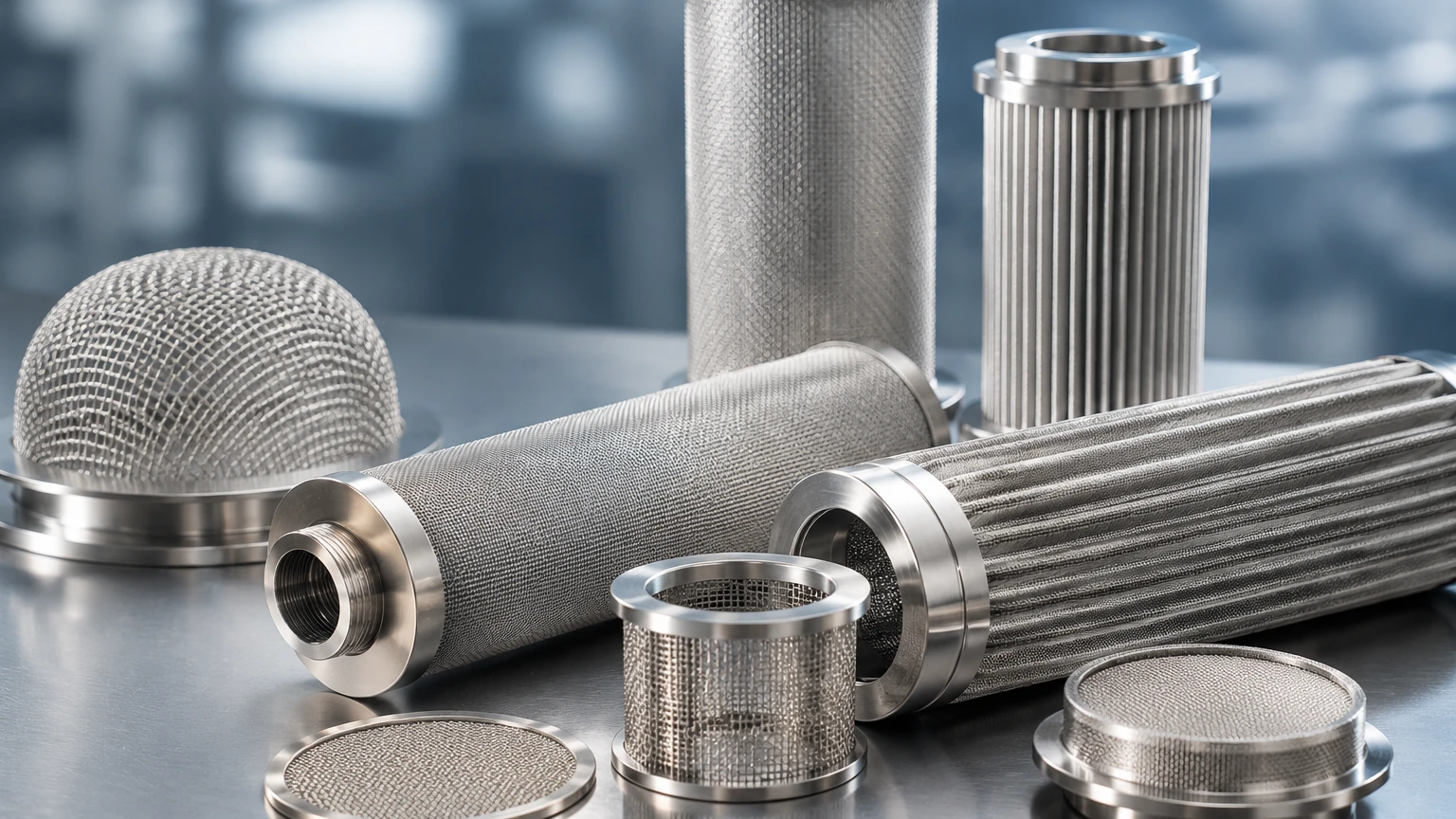
Advanced Filtration Media: Wire Mesh and Perforated Metal
The internal element of a fabricated strainer is what determines its filtration efficiency. Depending on the application, the element may consist of a single layer of perforated metal or a combination of perforated metal and fine wire mesh.
* Perforated Metal: Used for coarse filtration (straining), typically removing particles 1mm or larger. It provides the structural strength required to withstand high differential pressures.
* Wire Mesh: For finer filtration, stainless steel wire mesh is layered over the perforated support. Kaifil specializes in precision wire mesh filters that can achieve filtration ratings down to several microns.
In high-pressure applications, the filtration element must be reinforced to prevent collapse. Engineers must consider the "burst pressure" of the basket, ensuring that if the strainer becomes completely clogged, the internal element will not fail and allow debris to pass downstream.
Evaluating Risks and Ensuring Quality in Fabrication
While fabricated strainers offer many advantages, they also introduce specific risks that must be managed through rigorous quality control. The integrity of the welds is paramount. Incomplete penetration or porosity in a weld can lead to structural failure or leaks under pressure.
At Kaifil, we emphasize the following quality benchmarks for fabricated components:
* Weld Procedures: All welding should be performed by certified technicians following ASME Section IX standards.
* Surface Finish: In hygienic applications, the internal and external surfaces of the strainer must be polished to a specific Ra (Roughness Average) to prevent bacterial growth and ensure ease of cleaning (CIP).
* Non-Destructive Testing (NDT): Depending on the criticality of the application, strainers may undergo X-ray, ultrasonic, or dye-penetrant testing to verify weld integrity.
* Hydrostatic Testing: Every fabricated strainer should be pressure-tested to at least 1.5 times its design pressure to ensure safety before it is deployed in the field.
Total Cost of Ownership (TCO) Considerations
When evaluating fabricated strainers, it is important to look beyond the initial purchase price. The Total Cost of Ownership includes installation, maintenance, and the cost of potential downtime.
1. Maintenance Efficiency: A fabricated strainer with a quick-opening cover may have a higher upfront cost but can save thousands of dollars in labor costs over its lifespan by reducing the time required for cleaning.
2. Durability: Choosing high-quality stainless steel and robust fabrication methods reduces the frequency of replacements. In corrosive environments, a cheap carbon steel strainer may fail in two years, whereas a well-engineered stainless steel unit could last for decades.
3. Pressure Drop Savings: By optimizing the design to minimize pressure drop, companies can reduce the energy consumption of their pumps, leading to significant long-term utility savings.
Technical Checklist for Procurement and Engineering
Before finalizing a purchase order for fabricated strainers, engineers should confirm the following technical details with the manufacturer:
* Fluid Properties: Viscosity, density, and chemical composition (to ensure material compatibility).
* Operating Conditions: Normal and maximum operating pressure, temperature range, and flow rate.
* Filtration Requirement: Target particle size for removal (micron rating) and the allowable pressure drop when clean.
* Connection Standards: Flange type (ANSI, DIN, JIS) or weld-end specifications.
* Space Constraints: Maximum allowable face-to-face and height dimensions for the installation site.
* Special Requirements: Need for differential pressure gauges, vent valves, or drain plugs.
Conclusion
Fabricated strainers are a cornerstone of industrial fluid management, providing the custom-engineered protection necessary for complex and demanding systems. By offering flexibility in design, material selection, and filtration performance, these components allow engineers to optimize their processes for maximum reliability and efficiency.
Whether you are designing a new chemical processing plant or upgrading a water treatment facility, selecting a manufacturer with deep technical expertise is essential. Kaifil remains committed to providing high-performance, custom stainless steel filtration solutions that meet the specific needs of global industrial applications. For technical support and to explore our full range of capabilities, please visit our Main Page.
