


Felt Filter Dust Collector
In industrial air pollution control and material recovery, the felt filter dust collector represents a critical advancement over traditional woven fabric baghouses. While early filtration systems relied on simple woven textiles, modern industrial environments demand higher efficiency, better airflow, and greater durability. Needle-punched felt media has become the industry standard for pulse-jet dust collection systems due to its three-dimensional pore structure and ability to handle high dust loads with lower pressure drops.
For engineers and facility managers, selecting the right felt filter dust collector involves more than just choosing a fabric. It requires a comprehensive understanding of the interaction between the filter media, the dust characteristics, and the structural components—such as stainless steel cages and support frames—that maintain the integrity of the system under rigorous operating conditions.
The Engineering Behind Felt Filter Media
Unlike woven fabrics, which are made by interlacing yarns in a regular pattern, the media used in a felt filter dust collector is produced through a process called needle-punching. In this manufacturing method, synthetic or natural fibers are mechanically entangled to create a dense, non-woven web. This creates a "depth filtration" mechanism rather than the "surface filtration" typical of woven materials.
Depth Filtration vs. Surface Filtration
In a woven filter, the pores are relatively uniform and two-dimensional. Dust particles larger than the pore size are trapped on the surface, while smaller particles may pass through until a dust cake is established. In contrast, needle-punched felt provides a labyrinthine path for air and particles. This structure allows the felt to capture finer particles within the thickness of the material itself.
Key advantages of felt media include:
* Higher Collection Efficiency: Felt filters can often achieve 99.9% efficiency even on sub-micron particles.
* Increased Permeability: Despite their density, felts often allow for a higher air-to-cloth ratio compared to woven fabrics of similar weight.
* Better Dust Release: When treated with singeing or glazing, felt filters release the dust cake more effectively during pulse-jet cleaning cycles.
Material Selection and Chemical Compatibility
The performance of a felt filter dust collector is heavily dependent on the polymer used in the felt. Industrial processes vary widely in temperature, moisture content, and chemical aggressiveness. Selecting an incompatible material leads to premature blinding, fiber degradation, or total system failure.
Common Felt Materials
1. Polyester (PE): The most common choice for dry, ambient temperature applications (up to 275°F/135°C). It offers excellent dimensional stability and good abrasion resistance but is susceptible to hydrolysis in high-moisture, high-heat environments.
2. Polypropylene (PP): Ideal for low-temperature applications where chemical resistance to acids and alkalis is paramount. It is widely used in the chemical processing and pharmaceutical industries.
3. Nomex (Aramid): A high-temperature material capable of operating up to 400°F (204°C). It is frequently used in asphalt plants, metal smelting, and cement kilns.
4. PTFE (Teflon): The gold standard for chemical resistance and high-temperature performance (up to 500°F/260°C). PTFE felt is often used in waste-to-energy plants and hazardous chemical processing.
5. PPS (Ryton): Excellent for coal-fired boilers and applications with high sulfur content, offering superior resistance to acids and oxidation at elevated temperatures.
The Role of Structural Components in Filtration
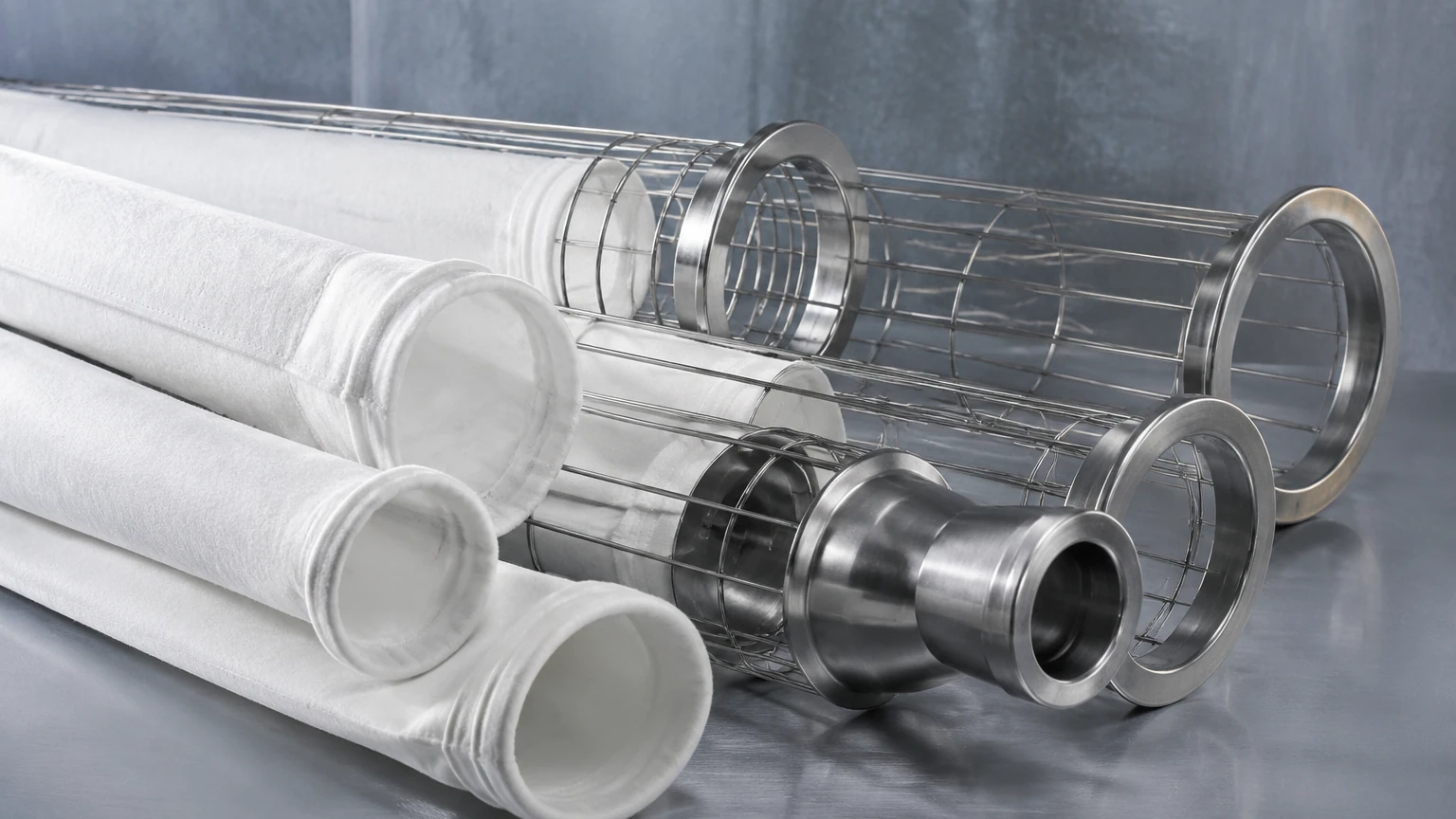
A felt filter dust collector is a mechanical assembly where the filter media is only as effective as the structure supporting it. In pulse-jet systems, the felt bag is slipped over a metal support cage. This cage prevents the bag from collapsing during the filtration cycle when the fan creates a vacuum (negative pressure).
Importance of Stainless Steel Support Cages
For demanding industrial applications, particularly in the chemical, food, and pharmaceutical sectors, the material of the support cage is vital. Stainless steel (Grade 304 or 316L) is often specified over galvanized steel for several reasons:
* Corrosion Resistance: In processes involving acidic gases or high humidity, galvanized cages can rust. This rust creates abrasive surfaces that tear the felt media from the inside out.
* Contamination Prevention: In food and beverage or pharmaceutical applications, stainless steel ensures that no oxidation or metallic flakes contaminate the product being recovered.
* Thermal Stability: Stainless steel maintains its structural rigidity at much higher temperatures than carbon steel, preventing the distortion of the filter bag's shape.
Precision manufacturing of these metal components is essential. Burrs or sharp edges on a support cage can cause immediate mechanical failure of the felt. Manufacturers like Kaifil specialize in these precision metal components, ensuring that the interface between the felt and the metal support is seamless and durable.
Engineering Considerations for System Design
When specifying a felt filter dust collector, engineers must calculate several critical parameters to ensure the system meets environmental regulations and operational goals.
Air-to-Cloth Ratio (G/C Ratio)
The air-to-cloth ratio is the measurement of the volume of air passing through one square foot of filter media per minute (expressed in CFM/ft² or m/min). Felt media typically allows for higher ratios than woven media—often ranging from 3:1 to 6:1 depending on the dust type. A ratio that is too high will drive dust deep into the felt fibers (interstitial blinding), making it impossible to clean via pulse-jet, while a ratio that is too low results in an oversized, unnecessarily expensive housing.
Pressure Drop (Delta P)
Pressure drop represents the resistance to airflow through the system. A well-designed felt filter dust collector should operate within a stable range (typically 2 to 6 inches of water column). If the pressure drop rises continually, it indicates that the cleaning system is not effectively removing the dust cake or that the felt has become blinded. High pressure drop increases energy consumption at the fan and can reduce suction at the source points.
Pulse-Jet Cleaning Dynamics
In a pulse-jet felt filter dust collector, a high-pressure burst of compressed air is injected into the top of the filter bag. This creates a shockwave that travels down the bag, momentarily expanding the felt and dislodging the dust cake. The flexibility and resilience of the felt are crucial here; it must be able to withstand thousands of these "pulses" without losing its shape or developing holes.
Common Risks and Failure Modes
Understanding why a felt filter dust collector fails is essential for long-term maintenance planning. Most failures are not due to the felt wearing out naturally, but rather due to external process factors.
1. Hydrolysis: In high-temperature applications with moisture, polyester fibers can undergo a chemical reaction that breaks the polymer chains, turning the felt brittle. This is common in steam-heavy processes.
2. Blinding: This occurs when fine particles become lodged so deeply in the needle-punched matrix that they cannot be pulsed out. This is often caused by operating the system below the dew point, leading to "mudding" on the filter surface.
3. Mechanical Abrasion: If the dust consists of sharp, heavy particles (like sand or metal grit), it can erode the fibers. In such cases, a protective "wear strip" or a different inlet design may be required to prevent direct impact on the bags.
4. Chemical Attack: Strong oxidizers or specific acids can dissolve certain synthetic fibers. Always confirm the gas stream chemistry before selecting a felt type.
Evaluation Criteria for Purchasing Teams
When sourcing components for a felt filter dust collector, purchasing teams should look beyond the initial price per bag. The total cost of ownership (TCO) is influenced by the lifespan of the filters and the energy efficiency of the system.
* Micron Rating and Efficiency: Ensure the felt is rated for the specific particle size distribution of your process.
* Surface Treatments: Consider if the felt needs a singed finish (to remove fuzz), a glazed finish (for better cake release), or an oleophobic/hydrophobic coating (to repel oil and water).
* Quality of Metal Supports: Verify that the cages are manufactured to tight tolerances. A poorly fitting cage will lead to premature bag wear. For high-performance filtration components, you can Review product options and application support to ensure compatibility between your media and structural supports.
Maintenance and Optimization
To maximize the life of a felt filter dust collector, a proactive maintenance schedule is required.
* Differential Pressure Monitoring: This is the most effective way to track filter health. Sudden drops may indicate a torn bag, while sudden rises suggest a failure in the compressed air cleaning system.
* Leak Detection: Using fluorescent leak detection powder can help identify specific bags that have failed, allowing for targeted replacement rather than changing the entire set.
* Compressed Air Quality: Ensure the air used for pulsing is dry and oil-free. Moisture in the pulse air will lead to localized blinding at the top of the bags.
Conclusion
The felt filter dust collector remains a cornerstone of industrial air management due to its versatility and high efficiency. By selecting the appropriate needle-punched media—whether it be polyester, Nomex, or PTFE—and pairing it with high-quality stainless steel support structures, engineers can ensure reliable performance in even the most demanding environments.
For professionals looking to optimize their filtration systems, focusing on the synergy between the filter media and the precision-engineered metal components is the key to reducing downtime and meeting environmental compliance. For more detailed technical specifications on custom filtration components and stainless steel supports, visit the Kaifil Main Page to explore professional solutions tailored to industrial requirements.
