


Filter Bags for Water Treatment
In industrial water treatment, the selection of filtration media is a critical engineering decision that directly impacts process efficiency, equipment longevity, and product quality. Filter bags for water treatment represent one of the most versatile and cost-effective methods for removing suspended solids from liquid streams. Unlike cartridge filters, which are often used for fine polishing, bag filters are frequently employed for high-flow applications and bulk solids removal across chemical processing, food and beverage production, and municipal water systems.
Understanding the technical nuances of bag filtration—from material science to fluid dynamics—is essential for engineers and procurement teams tasked with optimizing filtration systems. This guide examines the engineering considerations, material specifications, and operational parameters necessary to select and maintain effective filtration solutions.
Technical Principles of Filter Bags for Water Treatment
Filter bags operate on the principle of pressure-driven filtration. The liquid enters the bag from the top or side, passes through the filter media, and exits through the perforated support basket. Contaminants are trapped inside the bag, which simplifies the disposal and replacement process.
There are two primary mechanisms at work in bag filtration: depth filtration and surface filtration.
1. Depth Filtration: Typically achieved using felted materials like polypropylene or polyester. The media consists of a dense network of fibers that trap particles throughout the thickness of the material. This provides a high dirt-holding capacity, making it ideal for water with a broad distribution of particle sizes.
2. Surface Filtration: Usually achieved using monofilament or multifilament meshes, including stainless steel wire mesh. Particles larger than the mesh opening are retained on the surface. This method offers precise micron ratings and is often used when the goal is to recover specific solids or when the filter media needs to be cleaned and reused.
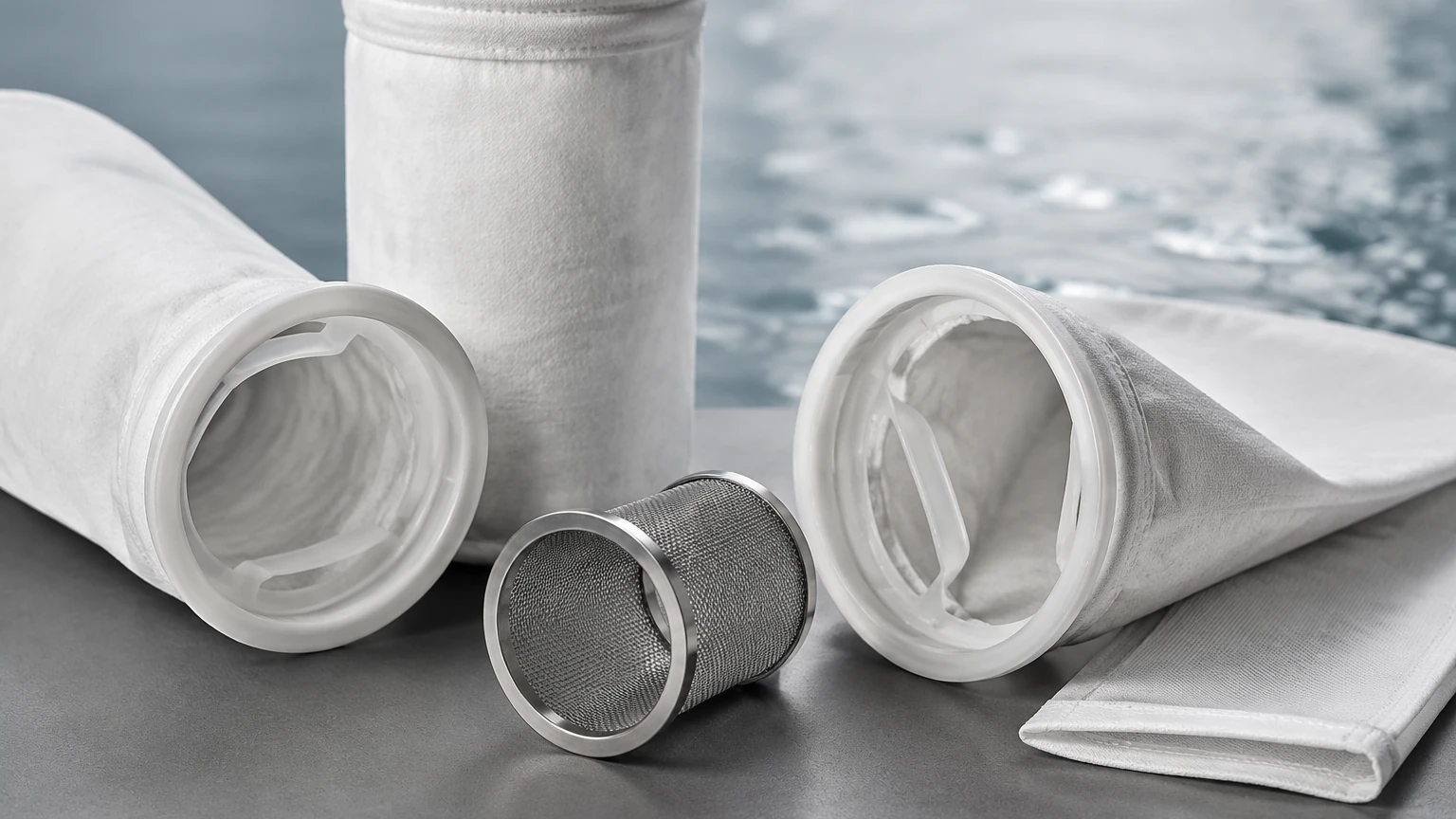
For high-demand industrial environments, the structural integrity of the filter bag and its interface with the housing are paramount. A secure seal at the bag collar—whether using a plastic flange or a metal ring—prevents bypass, ensuring that all fluid passes through the media.
Material Selection and Chemical Compatibility
The chemical and thermal environment of the water treatment process dictates the choice of filter media. Selecting an incompatible material can lead to fiber migration, media degradation, or total system failure.
* Polypropylene (PP): The most common material for water treatment due to its excellent chemical resistance to acids and alkalis. However, it is limited by a maximum operating temperature of approximately 90°C (194°F).
* Polyester (PE): Offers higher temperature resistance (up to 150°C/302°F) and good tensile strength. It is suitable for applications where polypropylene might soften or fail, though it has less resistance to strong alkalis.
* Nylon Monofilament: Excellent for surface filtration where precise aperture sizes are required. It is often used in the food and beverage industry due to its fiber-free construction.
* Stainless Steel (304/316L): In specialized industrial water treatment, stainless steel wire mesh bags are utilized for their extreme durability, high-temperature tolerance, and cleanability. As a manufacturer specializing in precision metal filtration, Kaifil provides these robust alternatives for applications where synthetic bags are prone to tearing or chemical attack. Detailed specifications for these high-performance components can be found on our Main Page.
Engineering Considerations for Sizing and Flow Rates
Properly sizing a bag filtration system involves more than matching the pipe diameter. Engineers must calculate the "Flux Rate"—the volume of liquid passing through a given area of filter media over time (typically expressed in GPM/sq. ft.).
If the flux rate is too high, particles may be forced through the media (breakthrough), or the pressure drop will increase too rapidly, leading to frequent bag changes. Conversely, an oversized system increases the initial capital expenditure and the volume of liquid lost during bag changes.
Key variables to confirm before sizing include:
* Viscosity: Higher viscosity fluids require larger surface areas to maintain flow.
* Solids Loading: The concentration of contaminants (PPM) determines how quickly the bag will reach its maximum dirt-holding capacity.
* Specific Gravity: Impacts the pressure required to move the fluid through the media.
In many water treatment scenarios, a multi-bag housing is preferred over multiple single-bag units to handle high flow rates while maintaining a manageable footprint and simplifying maintenance cycles.
Evaluating Filtration Efficiency and Micron Ratings
One of the most misunderstood aspects of filter bags for water treatment is the micron rating. It is vital to distinguish between "Nominal" and "Absolute" ratings.
* Nominal Rating: An arbitrary value indicating that the filter will retain a majority of particles of a certain size (typically 60% to 80%). Most felt bags are nominally rated.
* Absolute Rating: Refers to the diameter of the largest hard spherical particle that will pass through the filter under specified test conditions. This represents a 99% or higher efficiency. High-precision mesh filters, such as those manufactured by Kaifil, often provide more predictable performance in applications requiring strict adherence to particle size limits.
When specifying filter bags, engineers should request efficiency curves or Beta ratios to understand how the filter performs across different particle sizes, rather than relying solely on a single micron number.
The Role of Support Baskets and Internal Components
A filter bag is only as effective as the basket that supports it. Under pressure, the bag expands and presses against the walls of the support structure. If the support basket has sharp edges, inconsistent perforations, or insufficient open area, it can cause the bag to burst or create localized high-velocity zones that degrade the media.
High-quality stainless steel support baskets are essential for maintaining the geometry of the bag. These components must be precision-engineered to ensure a flush fit with the housing's sealing surface. For custom industrial applications, Kaifil designs and manufactures precision metal filter components that enhance the reliability of bag filtration systems, ensuring that the filter bags for water treatment perform at their theoretical maximum efficiency.
Operational Maintenance and Replacement Cycles
The most effective way to manage a bag filtration system is through differential pressure (ΔP) monitoring. As the bag collects debris, the resistance to flow increases, causing the pressure upstream of the filter to rise relative to the downstream pressure.
* Initial ΔP: The pressure drop across a clean bag. Ideally, this should be between 1 and 3 PSI.
* Terminal ΔP: The pressure at which the bag is considered "full" and must be replaced. For most industrial water applications, this is between 15 and 25 PSI. Operating beyond this point risks bag rupture or "channeling," where the fluid finds a path of least resistance, bypassing the filtration media entirely.
Regular inspection of the O-rings and seals within the housing is also necessary. A degraded seal can allow bypass, which is often mistaken for a failure of the filter bag itself. When replacing bags, operators must ensure the new bag is properly seated in the basket and that the hold-down device is securely engaged.
Total Cost of Ownership (TCO) in Water Filtration
While the unit price of a filter bag is a visible cost, the Total Cost of Ownership (TCO) includes several hidden factors that can significantly impact the operational budget:
1. Labor Costs: The time required for staff to monitor, change, and dispose of filters.
2. Disposal Costs: In some industries, used filter bags are classified as hazardous waste, making disposal more expensive than the purchase price.
3. Product Loss: The volume of liquid contained within the bag and housing that is lost during each change-out.
4. Downtime: The cost of stopping a production line to service the filtration system.
In high-volume or critical applications, moving from disposable synthetic bags to cleanable stainless steel mesh bags can offer a lower TCO over a 24-month period. Although the initial investment is higher, the elimination of disposal costs and the reduction in replacement frequency provide a significant return on investment. For technical guidance on transitioning to durable metal filtration solutions, engineers can review product options and application support on the Main Page.
Conclusion
Filter bags for water treatment are a foundational technology in industrial fluid management. By carefully considering material compatibility, micron efficiency, and the structural integrity of the supporting hardware, facilities can achieve reliable and cost-effective solids removal. Whether utilizing standard synthetic felt or custom-engineered stainless steel mesh, the key to success lies in a deep understanding of the application's specific technical requirements and a commitment to rigorous operational maintenance.
