


Filter Carts
In modern industrial environments, maintaining fluid cleanliness is a critical factor in extending the service life of machinery and ensuring the quality of processed products. Filter carts, also known as portable filtration units or kidney-loop systems, serve as mobile platforms designed to remove contaminants from oils, coolants, and chemical fluids. Unlike stationary filtration systems integrated directly into a machine's primary circuit, filter carts provide the flexibility to perform offline filtration, fluid transfer, and system flushing across multiple locations within a facility.
For engineers and maintenance professionals, selecting the right configuration for filter carts involves more than just choosing a pump and a motor. The efficacy of the system depends heavily on the filtration media, the structural integrity of the filter housing, and the compatibility of the components with the fluid being processed. High-performance stainless steel filtration components, such as those detailed on our Main Page, are often the preferred choice for demanding industrial applications where durability and precision are paramount.
The Role of Filter Carts in Industrial Fluid Management
Filter carts are primarily used for "kidney-loop" filtration, a process where fluid is drawn from a reservoir, passed through a high-efficiency filter, and returned to the same reservoir. This method allows for continuous cleaning without interrupting the operation of the main equipment. It is particularly effective for hydraulic systems, lubrication reservoirs, and chemical storage tanks.
Beyond routine cleaning, filter carts are essential for:
* Fluid Transfer: Moving new fluid from drums or intermediate bulk containers (IBCs) into machine reservoirs. Even new oil often fails to meet the ISO cleanliness standards required by high-pressure hydraulic systems; pre-filtering through a cart ensures that contaminants introduced during transport and storage are removed.
* System Flushing: After a component failure or a system overhaul, filter carts are used to flush the lines and remove metallic debris or sealant residues before the equipment is restarted.
* Off-Line Decontamination: When a system experiences a sudden ingress of water or particulate matter, a dedicated filter cart can be deployed to stabilize the fluid condition rapidly.
Key Engineering Components and Design Considerations
A robust filter cart is comprised of several integrated components, each of which must be specified based on the application's technical requirements.
1. Pump and Motor Assembly
The pump is the heart of the filter cart. For high-viscosity fluids like gear oils, positive displacement pumps (such as gear pumps) are typically used because they provide a consistent flow rate regardless of pressure changes. For lower viscosity fluids or water-based chemicals, centrifugal or vane pumps may be appropriate. The motor must be sized to handle the torque requirements of the pump, especially during cold starts when fluid viscosity is at its peak.
2. Filter Housings and Elements
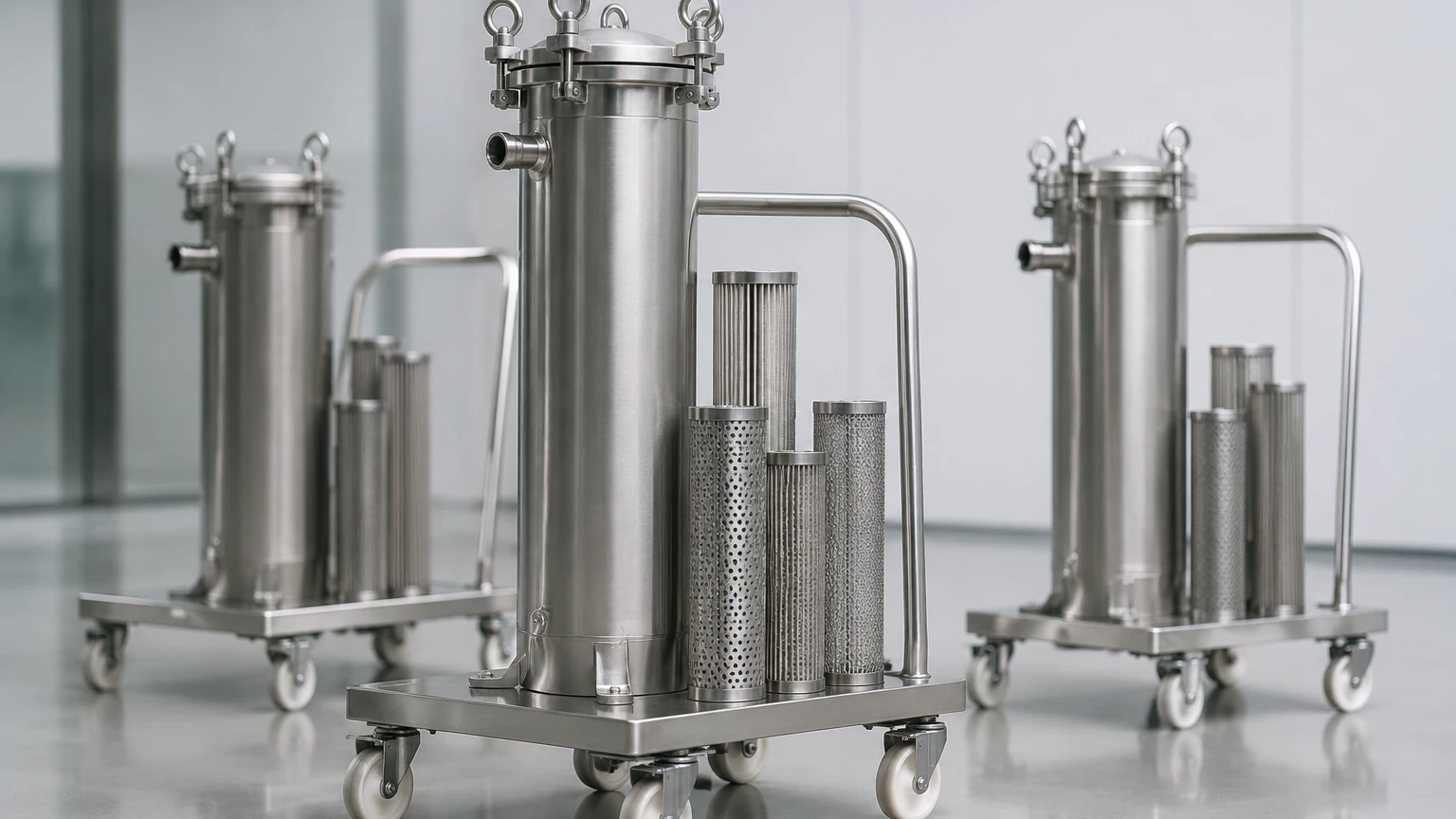
The housing must be rated for the maximum operating pressure of the pump and should be designed for easy element replacement. In industrial settings, the choice of filter element is the most critical decision. While disposable cellulose or glass fiber elements are common for standard oil filtration, applications involving high temperatures, aggressive chemicals, or high-pressure differentials require stainless steel filter cartridges. These metal elements offer superior mechanical strength and can be engineered to specific micron ratings using precision wire mesh.
3. Monitoring Instrumentation
To ensure the filter cart is operating effectively, it should be equipped with differential pressure gauges. These gauges indicate when the filter element is becoming saturated and needs cleaning or replacement. Advanced units may also include particle counters or moisture sensors to provide real-time data on fluid health.
Selecting Filtration Media: The Case for Stainless Steel
When configuring filter carts for specialized industrial processes, the limitations of synthetic or paper-based media become apparent. Stainless steel wire mesh filters and sintered metal components provide several technical advantages that are critical for long-term reliability.
Chemical and Thermal Resistance
In chemical processing or pharmaceutical applications, fluids may be caustic or reach temperatures that would degrade polymer-based filters. Stainless steel (typically Grade 304 or 316L) is inert to many industrial solvents and can withstand temperatures exceeding 500°F (260°C). This makes stainless steel cartridges the standard for filtering hot oils or aggressive chemical baths.
Structural Integrity and Reusability
Unlike disposable media, which can collapse under high differential pressure (ΔP), stainless steel elements are structurally reinforced. They maintain their pore geometry even under heavy contaminant loading. Furthermore, many stainless steel wire mesh filters are cleanable and reusable. In high-volume applications, the ability to ultrasonically clean or backflush a filter element significantly reduces the total cost of ownership compared to the recurring expense of purchasing and disposing of synthetic cartridges.
Precision Filtration Accuracy
Advanced manufacturing techniques allow for the production of stainless steel mesh with highly controlled aperture sizes. This ensures a consistent Beta ratio—a measure of filtration efficiency. Whether the application requires coarse straining at 100 microns or precision filtration at 5 microns, stainless steel provides the predictable performance necessary for protecting sensitive components like servo valves or high-speed bearings.
Performance Metrics: Viscosity, Flow Rate, and Filtration Accuracy
To specify a filter cart correctly, engineers must evaluate the relationship between fluid viscosity, flow rate, and the pressure drop across the filter media.
Viscosity Handling
Fluid viscosity is measured in Centistokes (cSt) or Saybolt Universal Seconds (SUS). As viscosity increases, the resistance to flow through the filter media also increases. If a filter cart is designed for light hydraulic oil (ISO VG 32) but is used for heavy gear oil (ISO VG 460), the high pressure drop may trigger the bypass valve, allowing unfiltered fluid to circulate, or it may cause pump cavitation. It is essential to confirm that the pump and filter element are rated for the highest expected viscosity at the lowest operating temperature.
Flow Rate vs. Efficiency
There is often a trade-off between flow rate and filtration efficiency. Higher flow rates increase the velocity of fluid through the media, which can sometimes push contaminants through or reduce the "dirt-holding capacity" of the element. For optimal results, the filter cart should be sized so that the flow rate allows for multiple "passes" of the reservoir volume per hour while maintaining a low face velocity at the filter media.
ISO Cleanliness Codes
The goal of using filter carts is typically to achieve a specific ISO 4406 cleanliness code (e.g., 16/14/11). This code represents the number of particles at 4µm, 6µm, and 14µm per milliliter of fluid. Achieving these levels requires selecting a filter element with the appropriate micron rating and ensuring the cart is operated long enough to reach a steady-state cleanliness level.
Application-Specific Configurations for Demanding Environments
Filter carts are not one-size-fits-all solutions. Different industries require specific modifications to ensure safety and performance.
* Food and Beverage: Carts used in food processing must utilize food-grade lubricants for the pump and 316L stainless steel for all fluid-contact surfaces to prevent contamination and facilitate rigorous cleaning protocols.
* Hydraulic Systems: These units often require high-efficiency micro-glass or pleated stainless steel elements to protect high-pressure pumps and valves from silt-sized particles.
* Water Treatment: Filter carts used for water or aqueous solutions must be constructed from corrosion-resistant materials. Stainless steel wire mesh filters are ideal here for removing suspended solids and protecting downstream membranes or UV sterilizers.
* Power Generation: In turbine lubrication systems, filter carts are often equipped with coalescing elements to remove both particulate matter and entrained water, which can cause oil oxidation and bearing failure.
Maintenance Protocols and Total Cost of Ownership (TCO)
While the initial purchase price of a filter cart is an important consideration, the total cost of ownership (TCO) is driven by maintenance requirements and the cost of consumables.
Element Replacement Cycles
Using low-quality disposable filters may seem cost-effective initially, but if they require frequent replacement or fail to meet the required cleanliness levels, the long-term costs escalate. High-capacity stainless steel elements, while having a higher upfront cost, often provide a lower TCO due to their durability and cleanability.
Pump and Motor Maintenance
Regularly checking for leaks, inspecting the pump seals, and ensuring the motor is properly ventilated will extend the life of the cart. It is also important to verify that the suction hoses are reinforced to prevent collapse under vacuum and that the discharge hoses are compatible with the fluid's chemical composition.
Verification of Performance
Periodic fluid analysis is the only way to confirm that a filter cart is performing as intended. By taking samples before and after the filtration process, engineers can verify that the target ISO cleanliness codes are being met and adjust the filtration duration or element micron rating accordingly.
Customization and Technical Support
For many industrial applications, standard off-the-shelf filter carts may not meet specific engineering constraints. Customization options often include:
* Alternative Material Grades: Using Duplex stainless steel or Monel for highly corrosive environments.
* Custom Micron Ratings: Engineering specific mesh weaves to capture unique contaminant profiles.
* Integrated Sensors: Adding flow meters, moisture indicators, or automated shut-off valves based on pressure differentials.
As a professional manufacturer specializing in custom stainless steel filtration solutions, Kaifil provides the technical expertise required to design and produce the high-precision components that make filter carts effective. From pleated filter cartridges to specialized wire mesh assemblies, our engineering team works to ensure that every component meets the rigorous demands of industrial fluid management.
Before finalizing a purchase or design for a filtration system, engineers should confirm the chemical compatibility of all seals, the maximum viscosity the pump can handle, and the specific cleanliness targets required for the downstream equipment. For more information on our manufacturing capabilities and to explore our full range of metal filtration products, please visit our Main Page. By focusing on quality materials and precise engineering, industrial operators can ensure their filter carts provide reliable, long-term protection for their most valuable assets.
