


Filter Element
In the landscape of industrial process engineering, the filter element serves as the critical functional component within a filtration system. It is the specific medium responsible for the physical separation of solids from fluids—whether liquid or gas—ensuring that downstream equipment is protected, product purity is maintained, and environmental standards are met. For engineers and procurement specialists, selecting the correct filter element is not merely a matter of finding a compatible size; it requires a deep understanding of material science, fluid dynamics, and the specific rigors of the application environment.
At Kaifil, the focus is on providing high-performance stainless steel filtration solutions that address these complex engineering challenges. By visiting our Main Page, technical teams can explore a wide range of customized wire mesh and sintered metal components designed for demanding industrial roles.
Engineering Fundamentals of Industrial Filter Elements
The performance of a filter element is defined by its ability to capture contaminants while maintaining an acceptable flow rate and pressure drop. Understanding how these components function at a granular level is essential for optimizing system efficiency.
Filtration Mechanisms
Industrial filtration typically occurs through three primary mechanisms: physical sieving (interception), inertial impaction, and diffusion.
1. Interception: This occurs when a particle is larger than the pore size of the filter media and is physically blocked. This is the primary mechanism for stainless steel wire mesh filters.
2. Inertial Impaction: Larger, heavier particles traveling in a fluid stream may fail to follow the fluid's path as it curves around the filter fibers. Their inertia carries them directly into the media, where they become trapped.
3. Diffusion: For very small particles (typically sub-micron), Brownian motion causes them to move erratically, eventually bringing them into contact with the filter surface where they adhere.
Absolute vs. Nominal Ratings
When specifying a filter element, engineers must distinguish between nominal and absolute micron ratings. A nominal rating refers to the ability of the filter to retain a major percentage (e.g., 60% to 90%) of particles of a specific size. In contrast, an absolute rating indicates the diameter of the largest hard spherical particle that will pass through the filter under specified test conditions. For critical applications in the pharmaceutical or chemical sectors, absolute-rated stainless steel elements are often required to ensure consistent output quality.
Material Selection and Chemical Compatibility
The material of construction for a filter element determines its longevity and suitability for specific chemical environments. While polymer-based filters are common in low-temperature, non-corrosive applications, industrial processes often demand the resilience of stainless steel.
Stainless Steel Alloys
Kaifil specializes in utilizing high-grade alloys to meet diverse industrial needs:
* 304 Stainless Steel: Suitable for general industrial use where basic corrosion resistance and high strength are required.
* 316L Stainless Steel: Contains molybdenum, providing superior resistance to chlorides and pitting. The "L" denotes low carbon content, which improves weldability and prevents intergranular corrosion in the heat-affected zones of the filter structure.
* Specialty Alloys: For extreme environments involving high acidity or specialized chemical processing, materials like Hastelloy or Monel may be utilized in the construction of the filter element.
Temperature and Pressure Resilience
Unlike synthetic media, a stainless steel filter element can withstand extreme operating temperatures, often ranging from cryogenic levels up to 600°C (1112°F) or higher, depending on the alloy and structural design. Furthermore, metal elements maintain their structural integrity under high differential pressures, preventing "media migration"—a common failure mode in fiber-based filters where the filter material itself breaks off and contaminates the filtrate.
Structural Design and Performance Metrics
The physical architecture of the filter element significantly influences its dirt-holding capacity and flow characteristics. Engineers must choose between various structural formats based on the specific requirements of their process.
Pleated vs. Cylindrical Elements
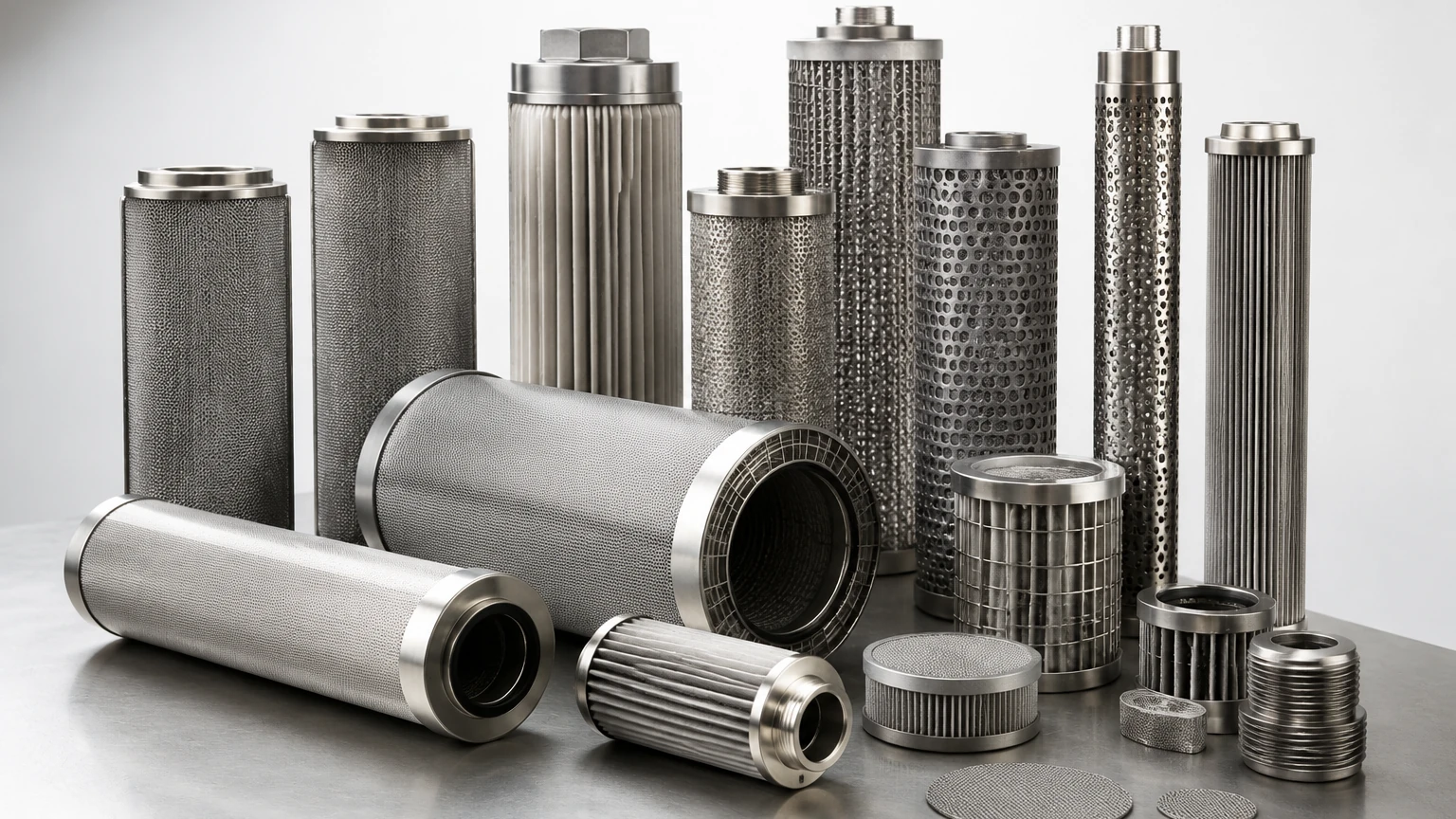
* Cylindrical Elements: These feature a simple, smooth surface. They are typically easier to clean and are ideal for applications with low solids loading or where surface filtration is the primary goal.
* Pleated Elements: By folding the filter media into a series of pleats, the effective surface area is vastly increased within the same footprint. This design allows for higher flow rates, lower initial pressure drops, and a significantly longer service life due to increased dirt-holding capacity. Pleated stainless steel elements are frequently used in hydraulic systems and high-flow liquid processing.
Sintered Metal Media
Sintering is a process where multiple layers of wire mesh or metal fibers are bonded together through heat and pressure without melting. This creates a porous, rigid structure with highly predictable pore sizes. Sintered filter elements are exceptionally robust, making them suitable for high-pressure backwashing and applications where the filter must be cleaned and reused multiple times.
Application-Specific Filter Element Requirements
Different industries impose unique stresses on filtration components. A one-size-fits-all approach often leads to premature failure or inefficient processing.
Chemical and Petrochemical Processing
In these environments, filter elements must resist aggressive solvents and high-pressure fluctuations. Stainless steel cartridges are used to remove catalysts, protect high-pressure pumps, and clarify final products. The ability to withstand chemical cleaning cycles is a major advantage in these sectors.
Food and Beverage Industry
Filtration in this sector requires compliance with strict hygienic standards. Filter elements must be constructed with FDA-approved materials and designed to eliminate "dead zones" where bacteria could proliferate. Stainless steel wire mesh is favored for its ability to be steam-sterilized (SIP) and cleaned-in-place (CIP).
Hydraulic and Lubrication Systems
Hydraulic systems are sensitive to particulate contamination, which can cause catastrophic wear on valves and actuators. High-pressure filter elements with reinforced internal cores are required to handle the surges and high viscosity of hydraulic fluids, ensuring that the system remains within its specified ISO cleanliness codes.
Evaluating Total Cost of Ownership (TCO)
When purchasing a filter element, the initial acquisition cost is only one part of the financial equation. Technical professionals should evaluate the Total Cost of Ownership (TCO), which includes:
1. Service Life: How long does the element last before reaching its terminal differential pressure? Pleated designs often offer a lower TCO by extending the time between change-outs.
2. Cleanability: Can the element be cleaned and reused? Stainless steel elements, while higher in initial cost than disposable plastic filters, often pay for themselves through multiple reuse cycles, particularly in high-volume applications.
3. Downtime Costs: The labor and lost production time associated with changing a filter can be substantial. Choosing a high-capacity element reduces the frequency of these interruptions.
4. Disposal Costs: Disposable filters create waste streams that may be subject to environmental regulations and disposal fees. Permanent metal elements significantly reduce the environmental footprint of the filtration process.
Customization and OEM Specification
Many industrial systems require non-standard dimensions or unique performance characteristics. Working with a manufacturer that offers OEM and customized solutions is vital for ensuring a perfect fit and optimal performance. When specifying a custom filter element, engineers should be prepared to provide the following data:
* Fluid Properties: Viscosity, density, and chemical composition.
* Operating Conditions: Maximum temperature, operating pressure, and maximum allowable differential pressure.
* Contaminant Profile: Particle size distribution and concentration (PPM or mg/L).
* Physical Constraints: Connection types (e.g., DOE, 222, 226, or threaded), outer diameter, and overall length.
Kaifil provides comprehensive support in the design and manufacturing of these bespoke components, ensuring that every filter element meets the specific mechanical and filtration requirements of the client's equipment.
Maintenance and Replacement Strategies
To ensure the longevity of both the filter element and the downstream equipment, a proactive maintenance strategy is required. The primary indicator of a filter’s condition is the differential pressure ($ΔP$)—the difference in pressure between the inlet and the outlet of the filter housing.
As the filter element captures particles, the pores become restricted, and the $ΔP$ increases. Most systems are designed with a "clean" $ΔP$ and a "terminal" $ΔP$. Reaching the terminal pressure indicates that the element is fully loaded and must be either cleaned or replaced. Ignoring a high differential pressure can lead to element collapse, bypassing of unfiltered fluid, or damage to upstream pumps.
For cleanable stainless steel elements, ultrasonic cleaning, chemical baths, or high-pressure backwashing are common methods used to restore the media. It is essential to follow manufacturer guidelines for cleaning to avoid damaging the delicate wire mesh or sintered structure.
Conclusion
The selection of a filter element is a foundational decision in industrial system design. By focusing on material integrity, structural suitability, and the specific demands of the application, engineers can achieve a balance between filtration efficiency and operational economy. Stainless steel filtration solutions, such as those offered on our Main Page, provide the durability and precision required for the world's most demanding industrial environments. Whether for chemical processing, food production, or hydraulic protection, the right filter element ensures process stability and long-term reliability.
