


Filter Elements
In industrial processing, the efficiency and reliability of a filtration system depend almost entirely on the performance of its internal components. Filter elements are the functional core of these systems, responsible for the physical separation of contaminants from liquids or gases. For engineers and procurement specialists, selecting the correct filter element is not merely a matter of finding a part that fits; it is an engineering decision that impacts equipment longevity, product purity, and total operational costs.
Industrial filter elements must withstand diverse challenges, including high differential pressures, corrosive chemical environments, and extreme temperatures. Stainless steel has emerged as the preferred material for demanding applications due to its mechanical strength and chemical resistance. As a specialized manufacturer, Kaifil focuses on providing precision-engineered stainless steel filter elements that meet the rigorous standards of the chemical, pharmaceutical, and food and beverage industries.
Engineering Considerations for Filter Element Selection
When specifying filter elements for industrial applications, several technical parameters must be evaluated to ensure the component performs as intended within the system’s hydraulic or pneumatic circuit.
Filtration Rating and Efficiency
The filtration rating is typically defined in microns (µm). It is essential to distinguish between nominal and absolute ratings. A nominal rating refers to the ability of the filter to retain a major percentage of particles of a specific size, whereas an absolute rating indicates the diameter of the largest spherical particle that will pass through the filter under laboratory conditions. For critical applications, such as pharmaceutical processing or fine chemical production, absolute-rated filter elements are required to ensure consistent output quality.
Flow Rate and Differential Pressure
The relationship between flow rate and differential pressure (ΔP) is a primary design constraint. Every filter element introduces a degree of resistance to the flow. As the element captures contaminants, the resistance increases, leading to a higher pressure drop. Engineers must calculate the initial clean pressure drop to ensure the pump or compressor system can maintain the required flow throughout the filter's service life. Selecting an element with a larger surface area, such as a pleated design, can help lower the initial ΔP and extend the time between cleaning or replacement cycles.
Temperature and Chemical Compatibility
Unlike polymer-based filters, stainless steel filter elements are capable of operating in temperatures exceeding 300°C (572°F) and are resistant to a wide range of solvents, acids, and alkalis. However, the specific grade of stainless steel—typically 304 or 316L—must be matched to the chemical composition of the fluid. 316L is generally preferred for marine environments or processes involving chlorides due to its superior pitting resistance.
Materials and Construction of Metal Filter Elements
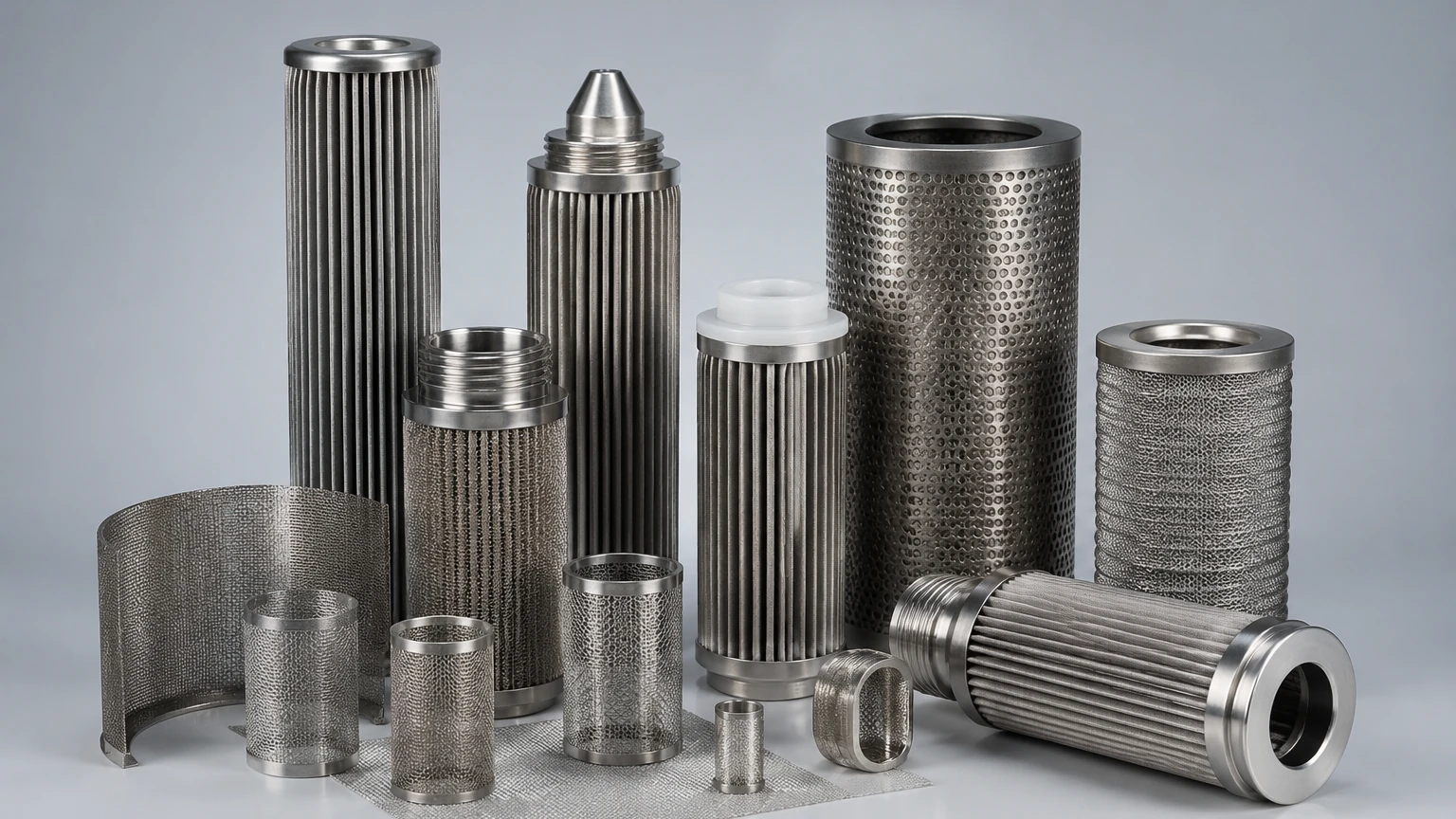
The construction method of a filter element determines its mechanical integrity and filtration characteristics. Kaifil utilizes various stainless steel structures to meet specific industrial needs.
Woven Wire Mesh
Stainless steel wire mesh is a versatile material used for surface filtration. It consists of wires woven into specific patterns, such as plain weave, twill weave, or Dutch weave. Dutch weave patterns, in particular, provide a dense structure that allows for high-precision filtration while maintaining excellent mechanical strength. Wire mesh elements are easily cleaned and are often used in applications where the recovery of the filtered cake is necessary.
Sintered Metal Mesh
Sintering involves bonding multiple layers of wire mesh together using heat and pressure without the use of binders. This process creates a robust, integrated structure that combines the filtration accuracy of fine mesh with the mechanical strength of heavier support layers. Sintered filter elements are ideal for high-pressure applications where the filter must resist deformation or migration of the filter media.
Perforated Metal Supports
In many designs, the primary filtration media is supported by a perforated metal core or outer shroud. This provides the necessary structural rigidity to withstand high collapse pressures. The alignment and open area of the perforations are calculated to minimize flow restriction while maximizing support for the mesh or fiber layers.
Structural Designs and Customization Options
Industrial systems often require bespoke filtration solutions that standard off-the-shelf products cannot provide. Customization of filter elements involves modifying the geometry, end-cap configurations, and structural reinforcement.
Cylindrical vs. Pleated Designs
Cylindrical filter elements are the simplest form, offering a direct flow path and ease of cleaning. However, for applications requiring high flow rates or long service intervals, pleated filter elements are used. Pleating significantly increases the effective filtration surface area within the same footprint, which reduces the face velocity of the fluid and increases the dirt-holding capacity.
End-Cap Configurations
The interface between the filter element and the housing is critical for preventing bypass. Common end-cap designs include:
* DOE (Double Open End): Used with gaskets for simple compression sealing.
* SOE (Single Open End): Often featuring an O-ring seal (such as 222 or 226 configurations) and a bayonet or fin end for secure positioning.
* Threaded Connections: NPT or BSP threads are used for high-pressure or permanent installations where a leak-proof mechanical bond is required.
OEM and Bespoke Development
Many original equipment manufacturers (OEMs) require filter elements designed to fit proprietary housings. Customization extends to the selection of specialized alloys, unique dimensions, and specific reinforcement techniques to handle pulsating loads or back-pulsing cleaning cycles. For more information on tailored filtration components, you can visit the Main Page to review product options and application support.
Performance Evaluation and Quality Control
To ensure reliability in the field, filter elements must undergo rigorous testing. These tests verify that the elements meet the specified filtration accuracy and structural integrity requirements.
Bubble Point Test
The bubble point test is a non-destructive method used to determine the pore size of a filter element. By submerging the element in a liquid and gradually increasing air pressure, the pressure at which the first stream of bubbles appears (the bubble point) can be correlated to the maximum pore size. This is a standard quality control measure for ensuring the integrity of the filter media and the welds.
Dirt-Holding Capacity (DHC)
DHC refers to the total amount of a standard test dust that a filter element can retain before the pressure drop reaches a predetermined terminal level. A higher DHC indicates a longer service life and lower operational costs, as it reduces the frequency of maintenance interventions.
Multi-Pass Testing
Multi-pass testing is used to determine the Beta Ratio (β), which is the ratio of particles of a given size upstream of the filter to the particles of the same size downstream. This provides a clear picture of the filter's efficiency across different particle sizes under dynamic flow conditions.
Maintenance, Cleaning, and Total Cost of Ownership
One of the primary advantages of stainless steel filter elements is their cleanability. While disposable polymer filters represent a lower initial capital expenditure, the ability to reuse metal elements often results in a lower total cost of ownership (TCO) over the life of the equipment.
Cleaning Methodologies
Depending on the nature of the contaminant, stainless steel elements can be cleaned using several methods:
* Backwashing: Reversing the flow of the fluid to dislodge particles from the surface of the media.
* Ultrasonic Cleaning: Using high-frequency sound waves in a cleaning solvent to remove fine particles trapped deep within the mesh or sintered structure.
* Chemical Cleaning: Using acids, alkalis, or specialized solvents to dissolve organic or inorganic deposits.
* Burn-off/Pyrolysis: For polymer or organic residues, controlled heating can be used to carbonize and remove the contaminants.
Replacement Cycles
Despite their durability, filter elements eventually reach a point where cleaning no longer restores the pressure drop to acceptable levels. Monitoring the "clean" pressure drop after each cleaning cycle is essential. A steady increase in the post-cleaning ΔP indicates that the media is becoming permanently fouled or that the structural integrity is degrading, signaling the need for replacement.
Industry-Specific Applications
Filter elements are utilized across a broad spectrum of industries, each with unique performance requirements.
Chemical Processing
In the chemical industry, filter elements must handle aggressive fluids and maintain integrity under high temperatures. They are used for catalyst recovery, monomer filtration, and the removal of impurities from corrosive acids and bases.
Food and Beverage
Filtration in this sector requires compliance with food-safety standards. Stainless steel elements are ideal because they do not shed fibers and can withstand the Steam-In-Place (SIP) and Clean-In-Place (CIP) sterilization processes used in breweries, wineries, and juice production.
Hydraulic and Lubrication Systems
Precision filter elements protect sensitive hydraulic components, such as valves and pumps, from wear-inducing particles. High-strength metal elements are necessary to handle the high-pressure spikes and cold-start conditions common in industrial hydraulic circuits.
Conclusion
Selecting the right filter elements is a critical factor in the success of industrial filtration processes. By understanding the technical requirements of the application—including filtration rating, material compatibility, and structural design—engineers can optimize system performance and minimize downtime. Stainless steel elements offer a robust, cleanable, and high-performance solution for the most demanding environments. For technical assistance or to explore a range of custom filtration solutions, professionals are encouraged to consult with experienced manufacturers to ensure their specific operational needs are met with precision.
