


Filter Flasks
In the realm of industrial research, chemical processing, and quality control, the filter flask—also known as a Büchner flask or vacuum flask—serves as a fundamental tool for liquid-solid separation. While industrial-scale operations often rely on high-capacity stainless steel filtration systems, the laboratory-scale filter flask remains the primary instrument for process development, pilot testing, and bench-top purification. Understanding the technical specifications, material limitations, and engineering principles behind filter flasks is essential for any technical professional tasked with scaling up filtration processes from the lab to the factory floor.
Filter flasks are designed specifically to withstand the pressure differentials required for vacuum-assisted filtration. Unlike standard Erlenmeyer flasks, which are intended for mixing and heating at atmospheric pressure, filter flasks feature reinforced walls and a specialized side-arm to facilitate the evacuation of air. This article explores the engineering considerations of filter flasks, their role in industrial R&D, and the critical transition from laboratory-scale testing to industrial filtration solutions.
Understanding Filter Flask Design and Functionality
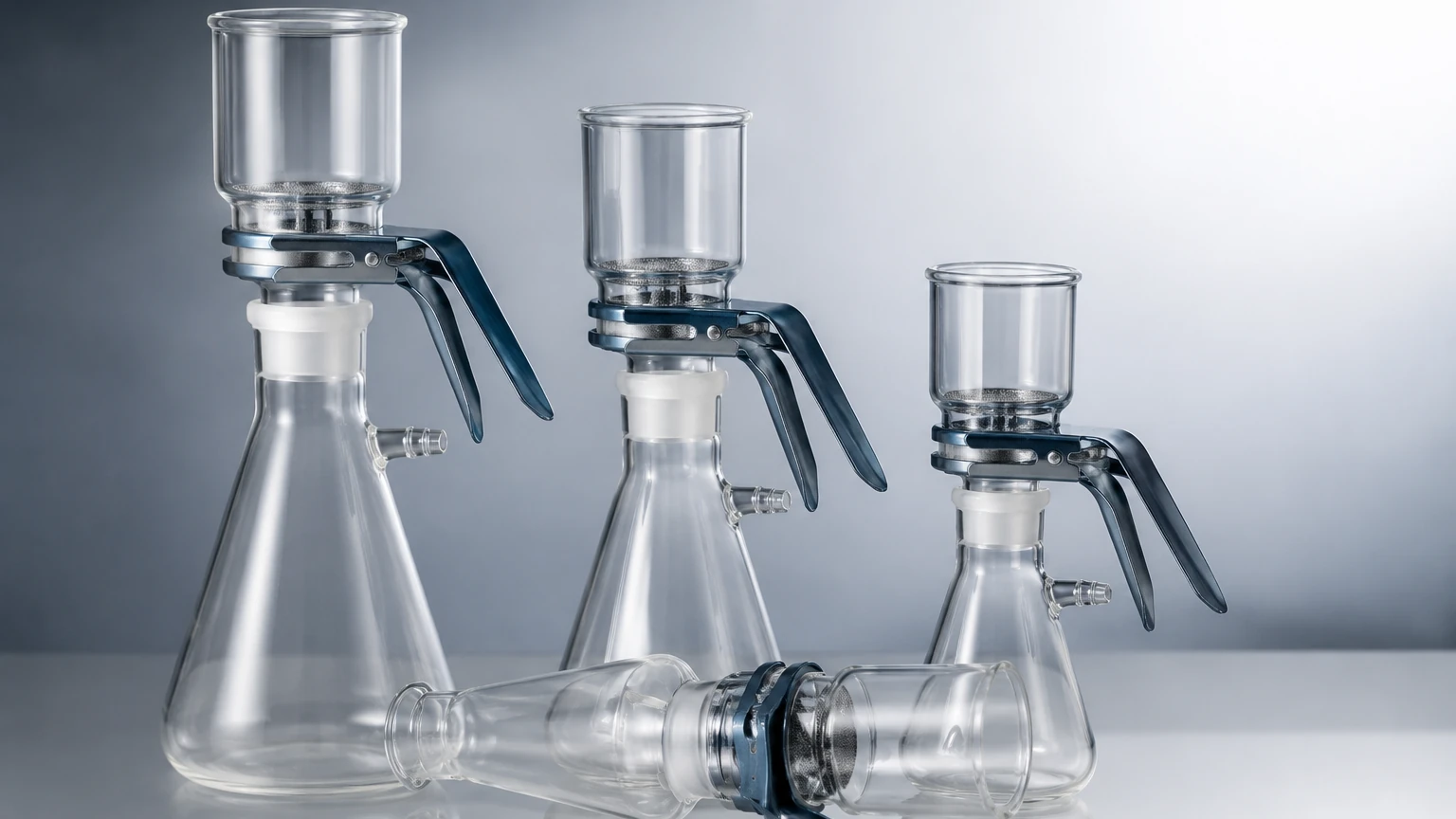
The primary distinguishing feature of filter flasks is their heavy-walled construction. Because vacuum filtration creates a significant pressure differential between the interior of the flask and the external atmosphere, the glass must be thick enough to resist implosion. Standard laboratory glassware is often too thin for this application; therefore, engineers and lab managers must ensure that any flask used for vacuum work is specifically rated for such environments.
At the neck of the flask, a side-arm—often referred to as a hose barb—is integrated into the glass structure. This barb allows for the attachment of heavy-walled vacuum tubing, which connects the flask to a vacuum pump or a water aspirator. When a vacuum is applied, air is drawn out of the flask, creating a low-pressure zone beneath the filter medium. This pressure differential forces the liquid through the filter at a much higher rate than gravity alone would allow, significantly reducing the time required for separation.
In industrial applications, filter flasks are frequently paired with Büchner funnels. These funnels contain a perforated plate that supports the filter medium, which may consist of filter paper, membranes, or even fine wire mesh discs. The seal between the funnel and the flask is maintained by a rubber stopper or a specialized Gootch crucible adapter, ensuring that the vacuum remains concentrated on the filter bed.
Material Selection: Borosilicate Glass vs. Alternatives
For most industrial and laboratory applications, the material of choice for filter flasks is Type 3.3 borosilicate glass. This material is preferred due to its low coefficient of thermal expansion and its exceptional resistance to chemical attack. In a B2B context, where flasks may be exposed to aggressive solvents, concentrated acids, or high-temperature filtrates, the durability of the glass is a primary safety and performance concern.
Borosilicate glass provides several engineering advantages:
* Thermal Shock Resistance: It can withstand rapid temperature changes without cracking, which is vital when filtering hot solutions or when the filtration process generates heat.
* Chemical Inertness: It does not leach contaminants into the filtrate, ensuring the purity of the sample—a critical requirement in pharmaceutical and specialty chemical industries.
* Transparency: Unlike opaque plastic alternatives, glass allows for visual monitoring of the filtrate level and clarity, providing immediate feedback on the success of the filtration process.
While plastic filter flasks (typically made of polypropylene) are available and offer high impact resistance, they generally lack the chemical and thermal range of borosilicate glass. Plastic flasks are often reserved for educational settings or specific aqueous-based processes where the risk of breakage outweighs the need for chemical versatility. For professional industrial R&D, heavy-walled borosilicate remains the industry standard.
The Mechanics of Vacuum Filtration in Laboratory Environments
The efficiency of a filter flask setup depends on the interaction between the vacuum source, the filter medium, and the viscosity of the fluid. In a vacuum filtration system, the atmospheric pressure (approximately 14.7 psi at sea level) acts as the driving force. By evacuating the flask, the pressure inside drops, allowing the external atmosphere to push the liquid through the filter.
Engineers must consider the "cake" formation during this process. As solids accumulate on the filter medium, they create a secondary filter layer. In many cases, this cake increases the filtration efficiency by trapping smaller particles, but it also increases resistance. The vacuum must be strong enough to overcome this resistance without causing the filter medium to rupture or the flask to fail.
In professional settings, the vacuum level is often controlled using a regulator. Applying too much vacuum too quickly can lead to "blinding" of the filter medium, where particles are forced so deeply into the pores that flow stops entirely. Conversely, insufficient vacuum leads to prolonged filtration times, which can affect the stability of certain chemical compounds. The filter flask acts as the reservoir for this process, and its volume must be selected based on the expected filtrate yield to avoid overfilling and subsequent contamination of the vacuum lines.
Safety Protocols: Preventing Implosion and Material Failure
Safety is the most critical consideration when working with vacuum-rated glassware. The primary risk associated with filter flasks is implosion. Unlike an explosion, which forces material outward, an implosion causes the glass to collapse inward due to external atmospheric pressure, often followed by a secondary spray of glass shards and chemicals.
To mitigate these risks, several protocols must be followed:
1. Visual Inspection: Before every use, filter flasks must be inspected for "stars," scratches, or chips. Even a minor surface defect can act as a stress concentrator, leading to catastrophic failure under vacuum.
2. Avoid Heating: Filter flasks should never be heated on a hot plate or over a flame. The thick walls that provide vacuum resistance also make the glass more susceptible to internal stresses if heated unevenly.
3. Use of Safety Shielding: In high-pressure applications or when working with hazardous materials, the flask should be placed behind a safety shield or wrapped in plastic mesh designed to contain glass fragments in the event of an implosion.
4. Proper Tubing: Only heavy-walled vacuum tubing should be used. Standard laboratory tubing will collapse under vacuum, cutting off the airflow and potentially causing pressure spikes.
By adhering to these engineering safety standards, lab technicians can ensure that the filter flask remains a reliable component of the laboratory infrastructure.
Scaling Filtration: From Laboratory Flasks to Industrial Systems
The data gathered during filtration tests using filter flasks is invaluable when transitioning to large-scale production. Engineers use lab-scale results to determine the required micron rating, flow rates, and material compatibility for industrial-grade equipment. When the volume of liquid exceeds the capacity of a standard flask, or when the process moves into a continuous production environment, the transition to stainless steel filtration components becomes necessary.
For those looking to scale their operations, reviewing professional product options and application support on a Main Page is a logical next step. Industrial filtration requires more than just glass and vacuum; it requires durable stainless steel filter cartridges, wire mesh filters, and precision-engineered housings that can handle high flow rates and extreme pressures that would shatter laboratory glassware.
In the transition from lab to plant:
* Material Compatibility: The chemical resistance validated in the borosilicate flask must be matched by the grade of stainless steel (e.g., 304 or 316L) used in the industrial filter.
* Micron Rating: The pore size of the filter paper used in the flask helps define the mesh count or sintering density required for industrial stainless steel wire mesh filters.
* Throughput Requirements: Lab tests help calculate the "flux" (flow rate per unit area), which dictates the total surface area required for industrial filter cartridges.
Best Practices for Maintenance and Equipment Longevity
To maintain the integrity of filter flasks in a B2B or industrial lab environment, proper maintenance is essential. Residual chemicals left in the flask can etch the glass over time, weakening its structure. Therefore, flasks should be cleaned immediately after use with appropriate solvents or detergents that do not abrade the glass surface.
Storage also plays a role in longevity. Flasks should be stored in a manner that prevents them from knocking against other glassware. Many labs utilize specialized racks or padded drawers to protect the heavy-walled glass from mechanical shock. Furthermore, the side-arm is the most vulnerable part of the flask; care must be taken when attaching or removing vacuum tubing to avoid applying lateral pressure that could snap the glass barb.
Replacement cycles should be established based on the frequency of use. In high-throughput labs, filter flasks may be retired after a set number of hours under vacuum or upon the discovery of any surface degradation. This proactive approach to equipment management ensures that the filtration process remains both efficient and safe.
Conclusion
Filter flasks are more than simple laboratory containers; they are engineered pressure vessels that play a vital role in the initial stages of industrial filtration. By understanding the material science of borosilicate glass, the dynamics of vacuum-assisted separation, and the safety requirements of high-pressure work, technical professionals can optimize their bench-top processes.
As processes mature and move toward industrial scales, the lessons learned from the humble filter flask provide the foundation for selecting robust, high-performance stainless steel filtration solutions. Whether refining a pharmaceutical compound or recovering a catalyst in a chemical plant, the journey toward efficient filtration begins with a clear understanding of the tools used at every stage of the process.
