


Filter Mesh Stainless
In industrial filtration, the selection of media is a critical engineering decision that directly impacts process efficiency, product purity, and equipment longevity. Among the various materials available, filter mesh stainless stands out as the industry standard for demanding environments. Its unique combination of mechanical strength, thermal stability, and chemical resistance makes it indispensable in sectors ranging from petrochemical processing to high-precision pharmaceutical manufacturing.
As a specialized manufacturer, Kaifil provides custom stainless steel filtration solutions designed to meet rigorous technical specifications. Understanding the nuances of stainless steel mesh—from weave patterns to metallurgical compositions—is essential for engineers and purchasing teams tasked with optimizing filtration systems. This guide explores the technical foundations of stainless steel filter mesh, providing the factual data necessary for informed procurement and application design.
Engineering Fundamentals of Filter Mesh Stainless
Stainless steel filter mesh is produced by weaving individual wires into a precise geometric pattern. The performance of the mesh is defined by several key parameters: mesh count, wire diameter, and aperture size. The mesh count refers to the number of openings per linear inch, while the aperture (or pore size) defines the largest particle that can pass through the medium.
Weave Patterns and Their Functions
The method of weaving significantly influences the mechanical properties and filtration characteristics of the mesh:
* Plain Weave: This is the most common pattern, where each warp wire crosses over and under each shute wire at a 90-degree angle. It offers a high percentage of open area and is ideal for low-pressure applications requiring high flow rates.
* Twill Weave: In this configuration, each shute wire passes over and under two warp wires. This allows for the use of heavier wires in a given mesh count, resulting in greater strength and the ability to produce finer meshes that would be impossible in a plain weave.
* Plain Dutch Weave: This weave uses a larger diameter warp wire and a smaller diameter shute wire driven closely together. It creates a "tortuous path" for the fluid, providing high filtration accuracy and superior pressure resistance compared to square mesh.
* Twilled Dutch Weave: Combining twill and Dutch weaving techniques, this pattern allows for the highest density of wires and the finest filtration ratings, often reaching into the low micron range (down to 5-10 microns).
Engineers must balance the need for fine filtration with the requirement for mechanical durability. While a finer weave captures smaller particles, it also increases the resistance to flow, leading to a higher initial pressure drop across the media.
Material Selection and Chemical Compatibility
The term "stainless steel" encompasses a wide range of alloys, each with distinct performance profiles. Selecting the correct grade is vital to prevent premature failure due to corrosion or mechanical fatigue.
Grade 304 vs. 316 and 316L
* Type 304: The most widely used grade, offering good corrosion resistance in most atmospheric and freshwater environments. It is cost-effective for general industrial applications where extreme chemical exposure is not a concern.
* Type 316: Contains molybdenum, which significantly enhances resistance to pitting and crevice corrosion in chloride-rich environments (such as seawater or de-icing salts). It is the standard choice for chemical processing and marine applications.
* Type 316L: The low-carbon version of 316. It is preferred for components that require extensive welding. The reduced carbon content prevents carbide precipitation during the welding process, which otherwise could lead to intergranular corrosion in the heat-affected zone.
Specialty Alloys for Extreme Conditions
In environments involving high-temperature oxidation or highly acidic/alkaline solutions, standard 300-series stainless steels may be insufficient. In such cases, alloys like 904L, Monel, or Inconel may be utilized. These materials maintain their structural integrity at temperatures exceeding 800°C and resist aggressive chemical attacks that would compromise standard filter mesh stainless.
Structural Integrity and Custom Fabrication
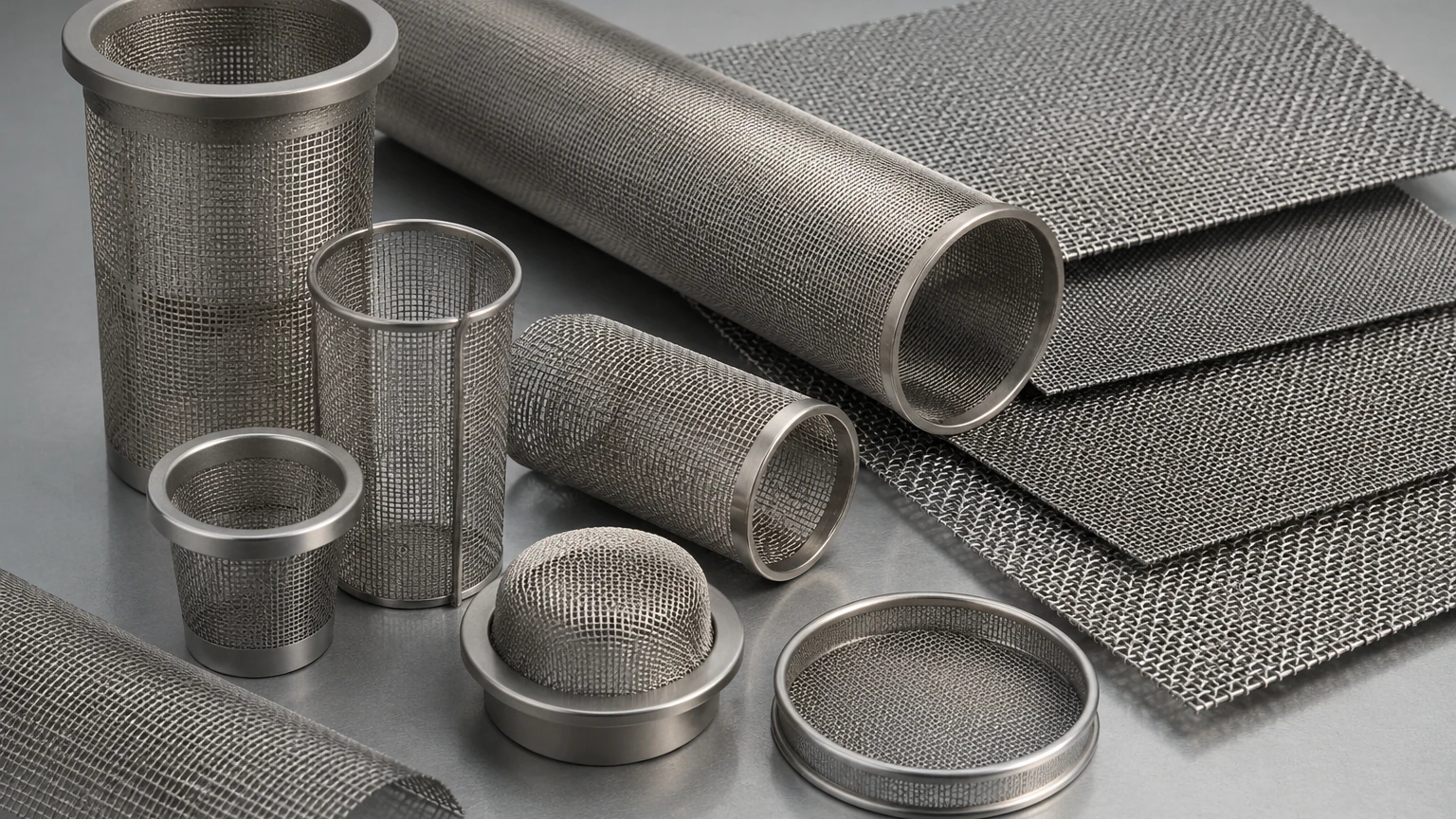
Raw mesh is rarely used in its flat, woven state for industrial processes. It must be fabricated into specific components such as cartridges, discs, cylinders, or pleated elements. Kaifil specializes in these custom transformations, ensuring that the structural integrity of the mesh is maintained throughout the manufacturing process.
Sintered vs. Single-Layer Mesh
For high-pressure applications, a single layer of mesh may lack the necessary rigidity. Sintered mesh involves bonding multiple layers of mesh together through a heat-and-pressure process without the use of binders. This creates a monolithic structure that is incredibly strong, easy to clean, and maintains a precise pore size even under extreme mechanical stress. Sintered laminates often include a fine filtration layer protected by coarser drainage and support layers.
Pleating for Enhanced Surface Area
Pleating the stainless steel mesh is a common strategy to increase the effective filtration area within a fixed housing volume. By increasing the surface area, the flux (flow per unit area) is reduced, which lowers the pressure drop and extends the time between cleaning cycles. However, pleating requires high-quality mesh that can withstand the bending stresses without fracturing the individual wires.
Technical Specifications: Micron Rating and Flow Dynamics
When evaluating filter mesh stainless, engineers must distinguish between nominal and absolute filtration ratings.
* Nominal Rating: An approximate value indicating the ability of the filter to retain a majority of particles of a certain size (typically 60% to 90%).
* Absolute Rating: The diameter of the largest hard spherical particle that will pass through the filter under specified test conditions. For critical applications in the pharmaceutical or aerospace sectors, absolute ratings are mandatory.
Understanding Pressure Drop ($ΔP$)
The pressure drop is the difference in pressure between the upstream and downstream sides of the filter. It is influenced by the fluid's viscosity, the flow velocity, and the mesh's open area percentage. A well-designed filtration system aims for a low initial $ΔP$ to maximize the "dirt-holding capacity" before the filter reaches its terminal pressure drop and requires cleaning or replacement.
To explore specific performance data and technical drawings for various mesh configurations, engineers can refer to the Main Page for a comprehensive overview of available filtration components and customization capabilities.
Industrial Applications and Compliance
Filter mesh stainless is utilized across a spectrum of industries, each with its own set of regulatory and performance requirements.
Food and Beverage Processing
In food production, hygiene is paramount. Stainless steel is the material of choice because it is non-reactive and can withstand rigorous Clean-in-Place (CIP) procedures involving caustic chemicals and high-temperature steam. Applications include the filtration of syrups, beverages, and edible oils, where the mesh must be free of contaminants and comply with FDA or similar food-contact standards.
Chemical and Petrochemical
Filters in this sector often face aggressive solvents and high operating pressures. Stainless steel mesh is used for catalyst recovery, fuel filtration, and the removal of particulates from corrosive process streams. The ability of the mesh to be backwashed or ultrasonically cleaned is a significant cost-saving factor compared to disposable polymer filters.
Pharmaceutical and Biotechnology
Precision is the defining characteristic here. Stainless steel filters are used for sterile venting, solvent purification, and as support structures for membrane filters. The use of 316L stainless steel ensures that the media does not leach metallic ions into the product, maintaining the highest levels of purity.
Hydraulics and Lubrication
In hydraulic systems, even microscopic metal shavings can cause catastrophic component failure. Stainless steel mesh cartridges protect sensitive valves and pumps by removing wear particles from hydraulic fluids and lubricating oils. These filters must handle high flow rates and rapid pressure fluctuations without deforming.
Operational Longevity and Maintenance
One of the primary advantages of filter mesh stainless over synthetic media is its cleanability. Proper maintenance can extend the service life of a stainless steel filter for years, significantly reducing the total cost of ownership.
Cleaning Methodologies
1. Backwashing: Reversing the flow of the fluid to dislodge particles trapped on the surface of the mesh. This is often automated in continuous process systems.
2. Ultrasonic Cleaning: Using high-frequency sound waves in a cleaning solvent to create cavitation bubbles. These bubbles penetrate deep into the mesh pores to remove fine contaminants that backwashing cannot reach.
3. Chemical Cleaning: Soaking the filter in acids, alkalis, or solvents to dissolve organic or inorganic scaling. This requires careful consideration of the mesh's chemical compatibility to avoid corrosion.
Monitoring and Replacement
While stainless steel filters are durable, they are not indestructible. Regular inspection should look for signs of "blinding" (permanent clogging), wire displacement, or fatigue cracking at the weld points. Monitoring the pressure drop across the filter is the most effective way to determine when a cleaning cycle is required. If the pressure drop fails to return to near-baseline levels after cleaning, the media may have reached the end of its functional life.
Critical Considerations for Procurement
When sourcing filter mesh stainless, purchasing teams should confirm several technical details with the manufacturer to ensure the product is fit for purpose:
* Material Certification: Request Mill Test Reports (MTRs) to verify the chemical composition of the stainless steel alloy.
* Filtration Accuracy: Confirm whether the micron rating provided is nominal or absolute, and ask for the testing standard used (e.g., ISO 16889).
* Mechanical Limits: Define the maximum operating pressure (both forward and reverse) and the temperature range the filter will encounter.
* Customization Requirements: Specify end-cap configurations, gasket materials (such as Viton, PTFE, or EPDM), and any specific welding standards required for the application.
By focusing on these factual engineering parameters, organizations can secure filtration solutions that provide reliable performance in the most demanding industrial environments. For detailed product specifications and engineering support regarding custom stainless steel filtration components, visit the Main Page to review the full range of manufacturing capabilities and application-specific designs offered by Kaifil.
