


Filter Panels
In the landscape of industrial filtration, filter panels serve as critical components for separating particulates from fluid or gas streams. Unlike cylindrical cartridges or bag filters, filter panels provide a flat or pleated surface area designed for specific housing configurations, often used in air intake systems, liquid separation tanks, and large-scale industrial machinery. For engineers and procurement specialists, selecting the appropriate panel involves a detailed analysis of material compatibility, structural integrity, and filtration efficiency to ensure long-term operational reliability.
Kaifil specializes in the manufacture of high-precision stainless steel filtration solutions, providing customized filter panels that meet the rigorous demands of chemical processing, pharmaceutical production, and food and beverage manufacturing. By focusing on metal-based media, these panels offer a level of durability and temperature resistance that polymer-based alternatives cannot match.
Understanding Industrial Filter Panels: Construction and Functionality
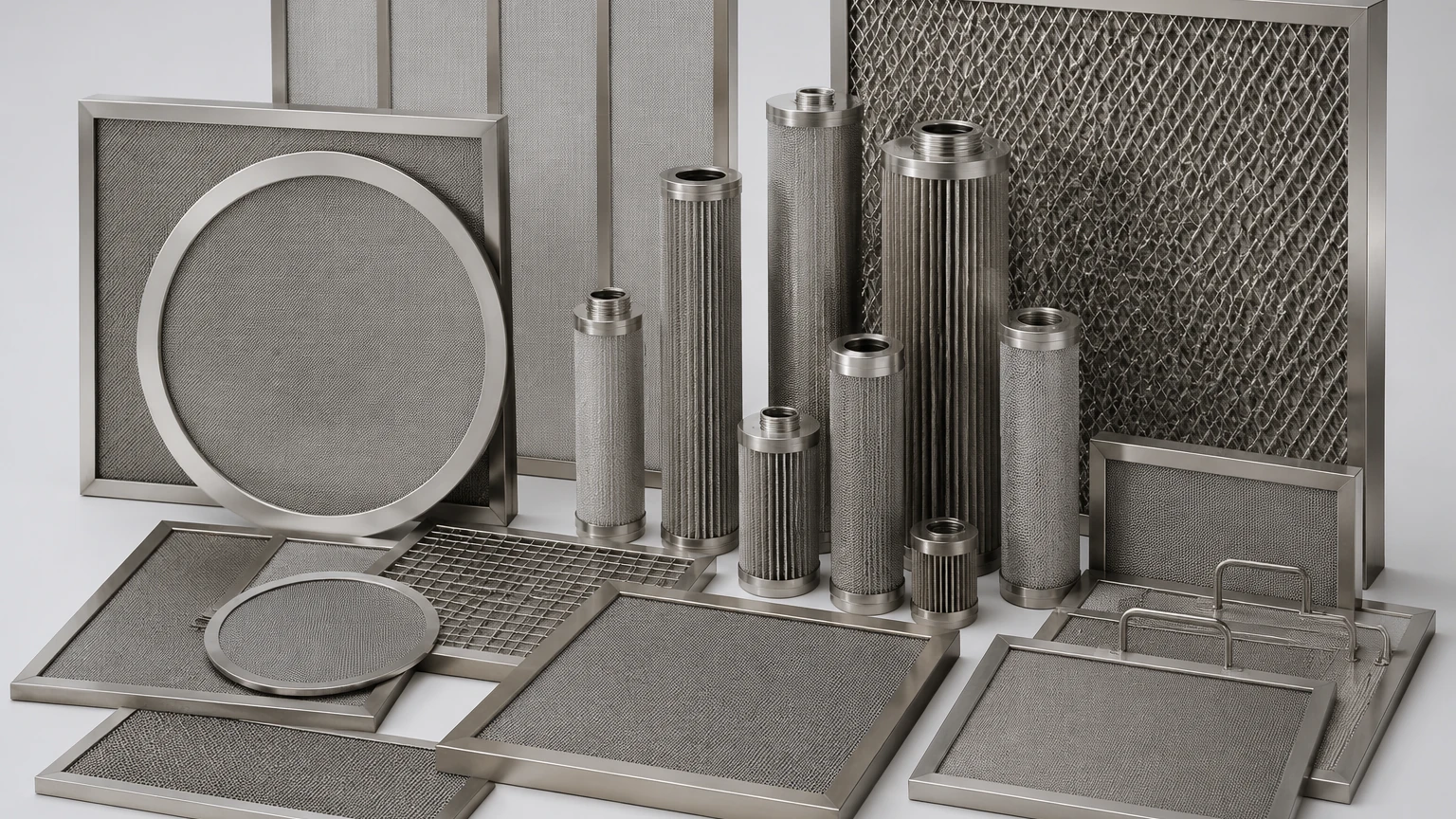
Filter panels are engineered assemblies consisting of a filtration medium—typically wire mesh, sintered metal, or perforated plate—secured within a rigid frame. The primary function of the panel is to provide a consistent barrier that allows the passage of the carrier fluid while capturing contaminants of a specific size.
The structural design of industrial filter panels is dictated by the direction of flow and the pressure differentials expected during operation. In high-pressure applications, the filtration media is often reinforced with a coarser backing mesh or a perforated metal plate to prevent deformation or "media migration." The frame, usually constructed from U-shaped channels or flat bars, ensures a tight seal within the housing, preventing bypass—a common failure point in poorly designed filtration systems.
For technical teams evaluating these components, it is essential to distinguish between surface filtration and depth filtration within the panel structure. Surface-type filter panels, utilizing fine stainless steel wire mesh, capture particles on the top layer, making them easier to clean via backwashing. Depth-type panels, which may use multi-layered sintered felt or mesh, provide higher dirt-holding capacity by trapping particles throughout the thickness of the media.
Material Selection for High-Performance Filter Panels
The choice of material is perhaps the most significant factor in determining the lifespan and effectiveness of filter panels. While various materials are available, stainless steel remains the industry standard for demanding B2B applications due to its mechanical strength and chemical inertness.
Stainless Steel Grades
1. AISI 304: Suitable for general industrial use where basic corrosion resistance is required. It is commonly used in water treatment and air filtration where the environment is not excessively acidic or saline.
2. AISI 316L: The preferred choice for the pharmaceutical and chemical industries. The addition of molybdenum provides superior resistance to chlorides and pitting corrosion. The "L" (low carbon) designation is crucial for panels requiring extensive welding, as it prevents intergranular corrosion in the heat-affected zones.
3. Specialty Alloys: For extreme environments, panels can be fabricated from Duplex stainless steel, Monel, or Inconel, which offer exceptional performance in high-temperature or highly corrosive chemical baths.
Filtration Media Types
* Woven Wire Mesh: Offers precise pore sizes and high open-area ratios. It is ideal for applications requiring exact micron ratings and easy surface cleaning.
* Sintered Metal Mesh: Created by diffusion-bonding multiple layers of wire mesh. This process creates a porous metal plate that combines the filtration accuracy of fine mesh with the structural strength of a heavy plate.
* Perforated Metal: Often used as a pre-filter or as a support layer for finer meshes, providing the necessary rigidity to withstand high differential pressures.
Key Engineering Specifications and Performance Metrics
When specifying filter panels for a project, engineers must look beyond simple dimensions. Performance is defined by several technical parameters that influence the total cost of ownership and system efficiency.
Micron Rating and Efficiency
The micron rating defines the size of particles the panel is intended to capture. It is important to distinguish between "nominal" and "absolute" ratings. An absolute rating indicates that 99.9% of particles of a specific size will be retained, which is critical for sterile pharmaceutical applications or high-purity chemical processing. Nominal ratings are more common in general industrial pre-filtration.
Pressure Drop ($ΔP$)
Pressure drop is the difference in pressure between the upstream and downstream sides of the filter. A high initial pressure drop indicates that the filter media may be too restrictive for the desired flow rate, leading to increased energy consumption by pumps or fans. Filter panels must be designed to maximize the effective filtration area (EFA) to keep initial $ΔP$ low and extend the time between cleaning cycles.
Dirt Holding Capacity (DHC)
DHC refers to the amount of contaminant the panel can retain before the pressure drop reaches a terminal point requiring maintenance. Panels with pleated designs or multi-layered sintered media typically offer significantly higher DHC than single-layer flat panels, though they may be more complex to clean.
Application-Specific Requirements for Filter Panels
Industrial filtration is not a one-size-fits-all field. Each sector has unique regulatory and operational hurdles that dictate the design of filter panels.
Chemical and Petrochemical Processing
In these environments, panels are often exposed to aggressive solvents and high temperatures. The primary concern is chemical compatibility. Stainless steel filter panels are favored here because they do not leach contaminants into the process stream and can withstand the thermal expansion and contraction associated with batch processing.
Food and Beverage Industry
Hygiene is the priority. Filter panels used in food production must be constructed from FDA-approved materials. Welds must be ground smooth to eliminate "dead zones" where bacteria could proliferate. Stainless steel's ability to withstand Clean-in-Place (CIP) procedures, involving caustic chemicals and high-pressure steam, makes it the ideal material for this sector.
Pharmaceutical and Biotechnology
Filtration in the pharmaceutical sector requires extreme precision and validation. Filter panels are often used in fluid bed dryers or as vent filters for storage tanks. These components must be manufactured to strict tolerances to ensure that no bypass occurs and that the micron rating is consistent across the entire surface of the panel.
Customization and OEM Solutions for Precision Filtration
Standard off-the-shelf filter panels rarely meet the specific needs of complex industrial machinery. Customization is often required to optimize performance and ensure a perfect fit within existing housings. Kaifil provides extensive OEM capabilities, allowing engineers to specify every aspect of the panel construction.
Dimensional Customization
Panels can be manufactured in virtually any shape—rectangular, circular, or irregular polygons—to fit specialized equipment. This includes varying the thickness of the frame and the depth of the filtration media to match the physical constraints of the installation site.
Multi-Layer Configurations
For applications requiring both fine filtration and high strength, custom multi-layer sintered panels can be engineered. A typical configuration might include a fine filtration layer, a distribution layer to even out flow, and several support layers to provide mechanical rigidity. These layers are vacuum-sintered into a single, monolithic structure that will not delaminate under pressure.
Frame and Sealing Options
The method by which a filter panel is secured is as important as the media itself. Custom frames can include integrated handles for easy replacement, pre-drilled mounting holes, or specialized gasket grooves. Sealing materials such as EPDM, Viton, or PTFE are selected based on the chemical and thermal profile of the application to ensure a leak-proof interface.
Maintenance, Cleaning, and Long-Term Performance
One of the primary advantages of stainless steel filter panels over disposable filters is their cleanability. In many industrial processes, the ability to reuse filtration components significantly reduces waste and long-term operational costs.
Cleaning Methodologies
* Backwashing: Reversing the flow of fluid through the panel to dislodge accumulated debris. This is most effective with surface-loading wire mesh panels.
* Ultrasonic Cleaning: Using high-frequency sound waves in a cleaning solvent to remove fine particulates trapped deep within the pores of sintered media.
* Chemical Cleaning: Soaking panels in acids or alkalis to dissolve organic or inorganic scaling. This requires the panel material (e.g., 316L stainless steel) to be fully resistant to the cleaning agents used.
Evaluating Replacement Cycles
While metal panels are durable, they are not infinite. Over time, repeated cleaning and pressure cycles can lead to fatigue or permanent "blinding" (irreversible clogging). Maintenance teams should monitor the "clean pressure drop" after each cleaning cycle. If the pressure drop remains high even after thorough cleaning, it indicates that the panel has reached the end of its functional life and needs replacement to prevent system inefficiency.
Conclusion: Selecting the Right Partner for Filtration Solutions
Choosing the right filter panels involves a balance of material science, fluid dynamics, and mechanical engineering. For B2B buyers, the goal is to find a solution that minimizes downtime while maximizing filtration quality. By understanding the technical nuances of stainless steel grades, micron ratings, and structural designs, procurement teams can make informed decisions that protect their downstream equipment and process integrity.
Kaifil remains a dedicated provider of high-performance filtration components, offering the technical expertise required to develop custom solutions for the world's most demanding industries. Whether you are designing a new system or looking to optimize an existing process, professional guidance is essential for achieving the best results. To explore the full range of capabilities and technical specifications, you can Review product options and application support on our Main Page.
When evaluating a potential supplier for filter panels, engineers should confirm the manufacturer's ability to provide material certifications (MTRs), pressure test data, and micron validation. These documents ensure that the components delivered meet the exact specifications required for safe and efficient industrial operation.
