


Filter Separator vs Coalescing Filter
In industrial fluid processing, the removal of entrained liquids and solid particulates is a critical requirement for protecting downstream equipment, ensuring product purity, and maintaining process efficiency. Engineers often face a choice between two primary technologies for liquid-gas or liquid-liquid separation: the filter separator and the coalescing filter. While both serve the purpose of removing contaminants, their mechanical principles, internal configurations, and ideal application environments differ significantly.
Understanding the technical nuances of a filter separator vs coalescing filter is essential for system design and procurement. Selecting the wrong technology can lead to premature element failure, excessive pressure drop, or downstream contamination that compromises high-precision components like turbines, compressors, and catalyst beds. This guide examines the engineering considerations, performance characteristics, and selection criteria for these two essential filtration solutions.
The Mechanical Principles of Filter Separators
A filter separator is typically a two-stage horizontal or vertical vessel designed to remove both solid contaminants and relatively large volumes of liquid from a gas stream. It is a robust solution often found in natural gas transmission, refineries, and chemical plants where heavy liquid loading is expected.
Stage One: Solid Filtration and Pre-Coalescing
In the first stage, the fluid passes through filter elements—often constructed from pleated media or depth-style cartridges. These elements are designed to capture solid particulates through mechanical straining and impingement. As the gas passes through these elements, smaller liquid droplets may begin to collide and form larger droplets, a process known as pre-coalescing. However, the primary goal of this stage is the removal of solids that could otherwise clog the secondary separation stage.
Stage Two: Mechanical Separation
The second stage utilizes a mechanical separation device, such as a vane pack or a wire mesh mist extractor. As the gas stream changes direction rapidly through the vanes or the mesh, the heavier liquid droplets cannot follow the gas path due to inertia. They strike the surface of the separator, accumulate into a film, and drain into a collection sump. This stage is highly effective at removing bulk liquids but is generally less efficient at capturing sub-micron aerosols compared to specialized coalescing media.
The Engineering Logic of Coalescing Filters
Coalescing filters are high-efficiency devices specifically engineered to remove fine liquid aerosols and sub-micron droplets from gas or liquid streams. Unlike the filter separator, which relies heavily on mechanical impingement for bulk removal, the coalescing filter utilizes specialized media to facilitate the merger of tiny droplets into larger ones.
The Coalescing Process
The process typically follows an "inside-to-outside" flow pattern. As the contaminated fluid passes through the multi-layered media—often composed of borosilicate glass fibers or specialized stainless steel wire mesh—three mechanisms occur:
1. Direct Impaction: Larger droplets strike the fibers and adhere.
2. Interception: Mid-sized droplets following the gas streamlines come into contact with fibers.
3. Brownian Diffusion: Extremely small sub-micron particles move erratically and eventually collide with the media fibers.
Once these tiny droplets are captured on the fibers, they merge (coalesce) with other droplets to form larger drops. These drops migrate to the outer surface of the filter element, where they become heavy enough to overcome the velocity of the gas stream and drain by gravity into a collection bowl. For high-durability applications, manufacturers like Kaifil provide custom stainless steel filtration components that ensure the structural integrity of these elements under high pressure and corrosive conditions.
Key Technical Differences: Filter Separator vs Coalescing Filter
When evaluating a filter separator vs coalescing filter, engineers must look at specific performance metrics and flow characteristics. The following areas represent the primary points of divergence:
Liquid Loading Capacity
Filter separators are designed for high liquid-to-gas ratios. They can handle "slugs" of liquid—sudden surges of bulk fluid—without failing. In contrast, a coalescing filter is easily overwhelmed by bulk liquid. If a coalescing element becomes saturated with liquid, its efficiency drops significantly, and "carryover" (liquid bypassing the filter) occurs. Therefore, coalescing filters are often placed downstream of a separator or a knock-out pot.
Filtration Efficiency and Particle Size
Coalescing filters are the superior choice for high-purity requirements. They are capable of removing aerosols down to 0.3 microns with efficiencies exceeding 99.9%. Filter separators are generally rated for solid removal down to 1 to 5 microns and are less effective at capturing the extremely fine mists (aerosols) that can bypass mechanical vane packs.
Pressure Drop (Differential Pressure)
Because coalescing filters use much denser media to capture sub-micron particles, they typically exhibit a higher initial pressure drop than filter separators. Engineers must account for this in the system's total energy consumption and compressor sizing. Filter separators, utilizing more open mechanical separation stages, offer lower resistance to flow but at the cost of lower aerosol removal efficiency.
Material Selection and Durability
In industrial environments involving corrosive chemicals, high temperatures, or high pressures, the material of the filter element is as important as the design. Stainless steel is the preferred material for many B2B applications due to its chemical compatibility and mechanical strength.
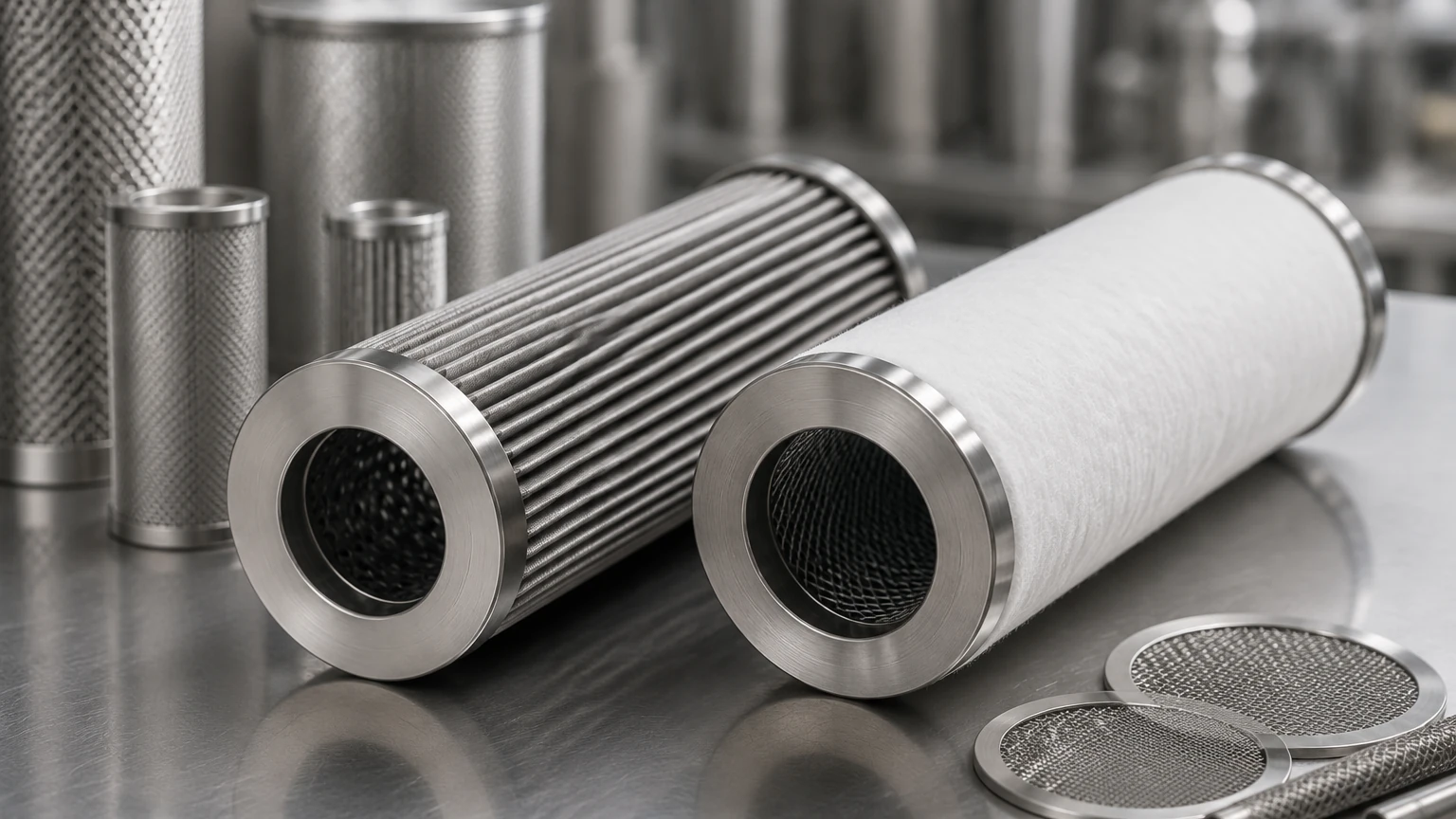
Custom stainless steel wire mesh filters and cartridges are often integrated into both filter separators and coalescing units to provide long-term reliability. For instance, in the chemical processing and pharmaceutical industries, 304 or 316L stainless steel ensures that the filtration media does not react with the process fluid or degrade over time. Professionals looking for specific engineering support and customized designs can explore the Main Page of specialized manufacturers to find components tailored to these demanding specifications.
Application Suitability and Selection Guide
Choosing between these two technologies depends on the specific goals of the filtration process. Below are common scenarios and the recommended equipment:
* Natural Gas Pipelines: Use a Filter Separator. The primary concern is removing pipeline scale (solids) and bulk liquids (brine or hydrocarbons) over long distances where flow rates are high and liquid surges are possible.
* Compressed Air Systems: Use a Coalescing Filter. The goal is typically to remove oil aerosols and water vapor to protect pneumatic tools and sensitive instruments from oil contamination.
* Turbine Fuel Gas Conditioning: Often uses a combination. A filter separator removes bulk contaminants, followed by a high-efficiency coalescing filter to ensure the gas entering the turbine is ultra-clean.
* Liquid-Liquid Separation (e.g., Water from Diesel): Use a Coalescer. Specialized coalescing cartridges are designed to separate two immiscible liquids based on surface tension and density differences.
Maintenance and Total Cost of Ownership (TCO)
From a purchasing and maintenance perspective, the filter separator vs coalescing filter debate involves balancing upfront CAPEX with ongoing OPEX.
1. Element Replacement: Coalescing elements generally have a shorter lifespan if the incoming fluid is not pre-filtered, as they are sensitive to solid loading. Filter separator elements (in the first stage) are often more robust but still require regular replacement based on differential pressure (DP) readings.
2. Cleaning vs. Disposal: Many stainless steel wire mesh filters used in separators can be cleaned and reused, reducing long-term waste and replacement costs. Coalescing media, particularly those using depth-loading fibers, are usually disposable.
3. Monitoring: Both systems require accurate DP gauges. A sudden drop in DP in a coalescer might indicate media rupture, while a slow increase in a separator indicates solid cake build-up on the first-stage elements.
Engineering Questions Before Procurement
Before finalizing a specification, engineering teams should confirm the following data points with their filtration partner:
* What is the expected liquid loading? (mg/m³ or gallons per million standard cubic feet).
* What is the target micron rating? (Does the application require sub-micron aerosol removal?)
* What are the fluid properties? (Viscosity, density, and surface tension significantly impact coalescing performance).
* Is the flow steady or pulsating? (Pulsating flow can negatively affect the drainage of coalesced droplets).
* What are the material compatibility requirements? (Does the process involve H2S, acidic components, or extreme temperatures?)
Conclusion
The choice between a filter separator and a coalescing filter is not about which technology is "better," but which is most appropriate for the contaminant profile of the stream. Filter separators are the workhorses of bulk removal, providing essential protection against solids and liquid surges. Coalescing filters are the precision instruments of the filtration world, removing the fine aerosols that mechanical separators cannot catch.
For many industrial applications, a multi-stage approach utilizing both technologies provides the most reliable protection. By selecting high-quality components, such as those offered on the Kaifil Main Page, engineers can ensure their systems operate with maximum uptime and minimal maintenance interference. Whether you require custom wire mesh for a separator or high-precision cartridges for a coalescing unit, focusing on material quality and engineering accuracy is the key to successful industrial filtration.
