


Filter Stainless Steel Mesh
In industrial filtration, the selection of media is a critical engineering decision that directly impacts system efficiency, product purity, and operational costs. Filter stainless steel mesh stands as one of the most versatile and reliable materials for liquid and gas separation. Unlike synthetic fibers or paper-based media, stainless steel mesh provides a unique combination of thermal stability, chemical resistance, and mechanical strength.
For engineers and procurement professionals, understanding the technical nuances of filter stainless steel mesh—from weave patterns to metallurgical compositions—is essential for optimizing filtration performance in demanding environments such as chemical processing, pharmaceuticals, and hydraulic systems. This guide examines the technical specifications, engineering considerations, and selection criteria necessary for implementing high-performance stainless steel filtration solutions.
Technical Fundamentals of Stainless Steel Mesh Filtration
Filter stainless steel mesh is defined by its precision-woven structure, where metallic wires are interlaced to create uniform apertures. The primary function of this mesh is to act as a barrier that allows the passage of fluids while retaining solid particles larger than the pore size.
The performance of the mesh is governed by three primary variables: wire diameter, mesh count, and aperture size. The mesh count refers to the number of openings per linear inch. As the mesh count increases, the aperture size typically decreases, providing finer filtration. However, the wire diameter also plays a role; thicker wires increase the mechanical strength of the filter but reduce the percentage of open area, which can lead to higher initial pressure drops.
Engineers must calculate the percentage of open area to predict flow characteristics. The formula is generally expressed as:
Percentage Open Area = (Aperture² / (Aperture + Wire Diameter)²) × 100
A higher open area percentage facilitates higher flow rates and lower energy consumption for pumps, but it may compromise the structural integrity of the mesh under high-pressure differentials. Therefore, the design process involves a trade-off between filtration fineness, flow capacity, and physical durability.
Material Science: Selecting the Right Alloy for Industrial Environments
The environmental conditions of an application dictate the choice of stainless steel alloy. While many grades exist, industrial filtration primarily utilizes the 300-series austenitic stainless steels due to their excellent corrosion resistance and formability.
304 Stainless Steel
As the standard industrial grade, 304 stainless steel is suitable for most water treatment and basic industrial applications. It offers good resistance to atmospheric corrosion and many organic and inorganic chemicals. However, it is susceptible to chloride pitting, making it less ideal for marine environments or high-concentration brine solutions.
316L Stainless Steel
For more aggressive environments, 316L is the preferred choice. The addition of molybdenum (2-3%) significantly enhances its resistance to pitting and crevice corrosion in chloride-rich environments. The "L" denotes low carbon content, which minimizes carbide precipitation during welding, ensuring the structural integrity of the mesh at the joints and seams of a filter cartridge.
Specialty Alloys (904L and Hastelloy)
In extreme cases involving high concentrations of sulfuric acid or highly corrosive chemical processing, specialty alloys like 904L or nickel-based alloys (Hastelloy) may be required. These materials provide superior longevity where standard stainless steels would fail within short operational cycles.
Geometry and Weave Patterns: Balancing Flow Rate and Filtration Precision
The method by which the wires are woven determines the pore geometry and the mechanical behavior of the filter stainless steel mesh. There are several standard weave types used in industrial filtration:
* Plain Weave: The most common and simplest weave, where each warp wire crosses alternately over and under each shute wire. It provides the highest open area and is ideal for coarse filtration and high-flow applications.
* Twill Weave: Each warp wire passes over and under two shute wires. This allows for the use of heavier wires in a given mesh count, providing greater strength and better resistance to mechanical fatigue.
* Dutch Weave (Plain and Twill): These weaves use a larger diameter warp wire and a smaller diameter shute wire. The wires are driven close together, creating a "tortuous path" for the fluid. Dutch weaves do not have straight-through openings; instead, the filtration occurs at the intersections. This allows for very fine filtration (down to 1-5 microns) while maintaining high mechanical stability.
* Sintered Wire Mesh: For applications requiring extreme durability, multiple layers of mesh are sintered together. This process involves bonding the contact points of the wires through heat and pressure without melting them. Sintered mesh is virtually non-deformable and is used in high-pressure hydraulic systems and polymer filtration.
Engineering Considerations: Pressure Drop and Mechanical Stability
When integrating filter stainless steel mesh into a system, engineers must account for the Clean Pressure Drop ($ΔP$). This is the resistance the filter media offers to the fluid flow when the filter is new. A high $ΔP$ requires more pump power and can lead to premature system wear.
As particles accumulate on the surface of the mesh, a "filter cake" forms. While this cake can actually improve filtration efficiency by capturing smaller particles, it also increases the pressure drop. The terminal pressure drop—the point at which the filter must be cleaned or replaced—is a critical parameter for system safety. If the mesh is not strong enough to withstand the pressure differential at the end of its cycle, it may undergo mechanical failure, leading to "media migration" or downstream contamination.
To prevent this, support structures such as perforated metal cores or coarser mesh backing layers are often used to reinforce the primary filtration mesh, especially in high-viscosity or high-pressure applications.
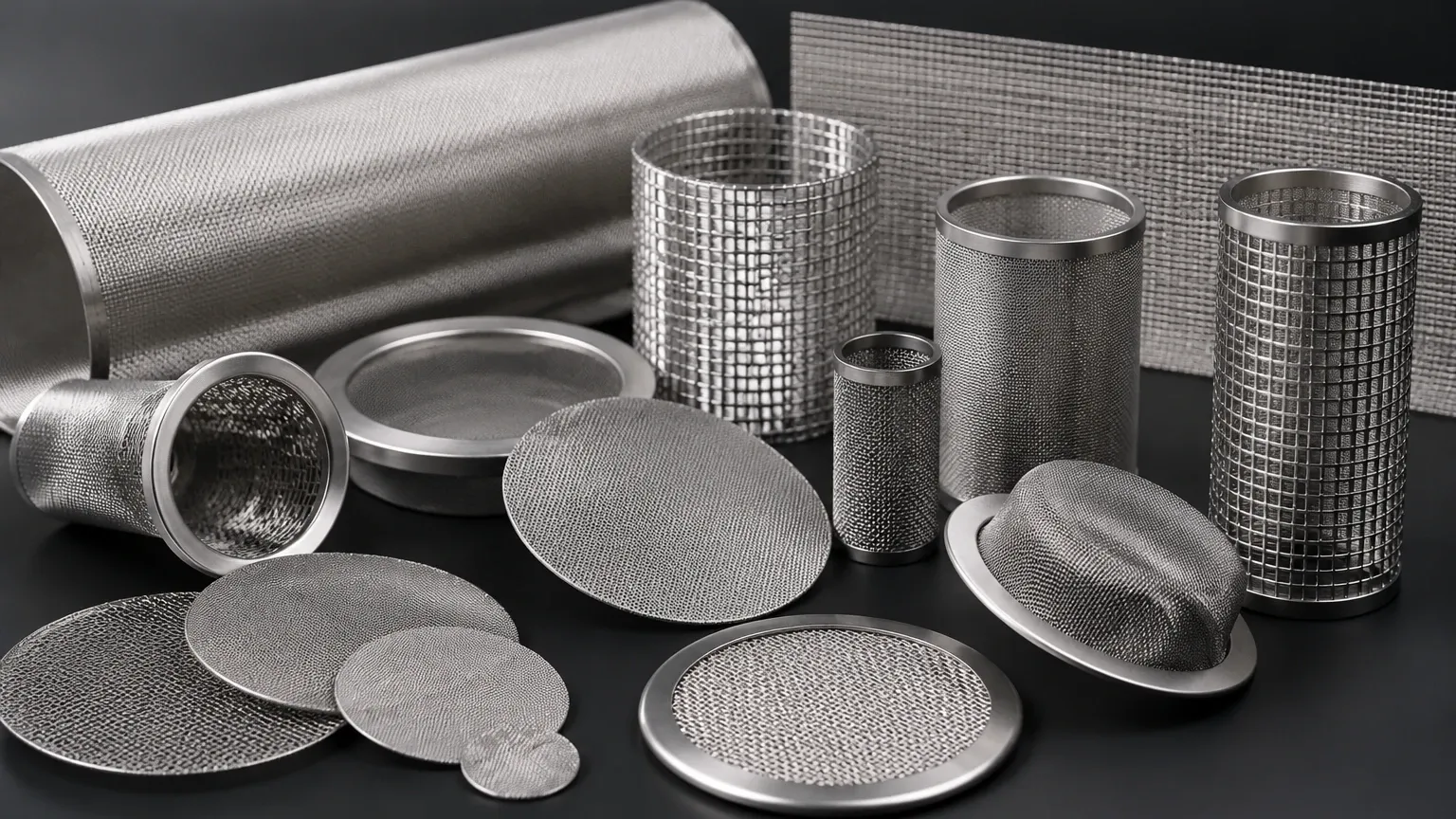
Customization and OEM Integration in Industrial Systems
Off-the-shelf filtration components rarely meet the specific requirements of complex industrial processes. Customization is often necessary to ensure the filter fits perfectly within existing housing and meets the exact micron rating required for the process fluid.
Kaifil specializes in providing these tailored solutions. From custom-sized filter discs and cylinders to complex pleated cartridges that maximize surface area, OEM capabilities allow for the development of filtration components that align with specific engineering drawings. Customization also extends to the finishing of the mesh, such as ultrasonic cleaning to ensure the removal of manufacturing oils, or specialized edge welding to prevent fraying in high-vibration environments.
For more information on customized technical specifications and to explore available filtration components, visit the Main Page of the Kaifil website.
Selection Guide: Key Parameters for Procurement and Engineering
Before purchasing filter stainless steel mesh, technical teams should confirm several key parameters to ensure the product is fit for purpose:
1. Micron Rating (Absolute vs. Nominal): An absolute rating indicates the diameter of the largest hard spherical particle that will pass through the filter under specific test conditions. A nominal rating is an indicative value based on the percentage of particles of a certain size retained. For critical pharmaceutical or chemical processes, absolute ratings are usually required.
2. Operating Temperature: While stainless steel can withstand high temperatures, the housing, seals, and the mechanical tension of the mesh must be evaluated for thermal expansion and potential loss of tensile strength at elevated temperatures.
3. Fluid Compatibility: Beyond corrosion, consider the viscosity of the fluid. High-viscosity fluids require larger apertures or greater surface area (pleating) to maintain acceptable flow rates.
4. Contaminant Characteristics: Are the particles hard, soft, or gelatinous? Hard particles are easily stopped by surface filtration, while soft or deformable particles may require depth-style Dutch weaves to prevent premature blinding of the mesh.
5. Cleaning Requirements: If the application requires the filter to be reused, the mesh must be robust enough to withstand backwashing, ultrasonic baths, or chemical cleaning agents without losing its pore size accuracy.
Maintenance and Cleaning Protocols for Extended Service Life
One of the primary advantages of filter stainless steel mesh over disposable media is its cleanability. Proper maintenance can extend the service life of a stainless steel filter by several years, significantly reducing the total cost of ownership.
Common cleaning methods include:
* Backwashing: Reversing the flow of the fluid to dislodge particles from the surface of the mesh. This is effective for surface-loading plain weaves.
* Ultrasonic Cleaning: Using high-frequency sound waves in a cleaning solution to create cavitation bubbles that remove fine particles lodged deep within Dutch weaves or sintered layers.
* Chemical Cleaning: Using acids, alkalis, or solvents to dissolve organic or inorganic scaling. It is vital to ensure the cleaning agent is compatible with the specific grade of stainless steel (e.g., avoiding certain acids with 304 grade).
* Burn-off (Pyrolysis): For polymer or plastic filtration, the mesh can be heated in a controlled environment to carbonize and remove organic contaminants, followed by ultrasonic cleaning.
Conclusion
Filter stainless steel mesh is a foundational component in modern industrial processes, providing the precision and durability required for high-stakes filtration. By carefully selecting the appropriate alloy, weave pattern, and mechanical structure, engineers can achieve optimal balance between filtration efficiency and operational longevity.
Whether you are designing a new hydraulic system, upgrading a chemical processing line, or seeking reliable OEM filtration components, understanding these technical boundaries is the first step toward a successful implementation. For detailed product catalogs and engineering support regarding custom stainless steel filtration solutions, review the resources available on the Main Page.
