


Filter Stainless Steel
In industrial environments, the choice of filtration media is a critical engineering decision that directly impacts process efficiency, product purity, and equipment longevity. Among the various materials available, stainless steel remains the primary choice for demanding applications. A filter stainless steel solution provides a unique combination of mechanical strength, thermal stability, and chemical resistance that polymer or paper-based filters cannot match. For engineers and procurement teams, understanding the technical nuances of stainless steel filtration is essential for optimizing system performance and managing the total cost of ownership.
Material Selection for Industrial Stainless Steel Filters
The performance of a stainless steel filter begins with the specific alloy selected for the application. While many grades exist, the industrial filtration sector primarily relies on two: Type 304 and Type 316L.
Type 304 Stainless Steel
Type 304 is the most common grade used in industrial filtration. It offers excellent mechanical properties and good resistance to atmospheric corrosion and many organic and inorganic chemicals. It is typically used in water treatment, food processing (where high acidity is not a factor), and general industrial machinery. However, it is susceptible to pitting in high-chloride environments.
Type 316L Stainless Steel
For more aggressive environments, Type 316L is the industry standard. The addition of molybdenum (2-3%) significantly enhances its resistance to pitting and crevice corrosion, particularly in saline or chloride-heavy processes. The "L" denotes low carbon content, which is crucial for components that require welding. Low carbon prevents carbide precipitation during the welding process, ensuring that the filter maintains its corrosion resistance at the joints and seams. This is the preferred material for pharmaceutical, chemical processing, and marine applications.
High-Temperature and Specialty Alloys
In extreme cases involving temperatures exceeding 500°C or highly oxidizing acids, specialty alloys like 904L, Inconel, or Monel may be used. These materials are selected when standard stainless steel would suffer from rapid oxidation or structural failure. Selecting the correct alloy ensures that the filter does not introduce metallic contaminants into the process fluid due to corrosion.
Structural Variations in Stainless Steel Filtration Media
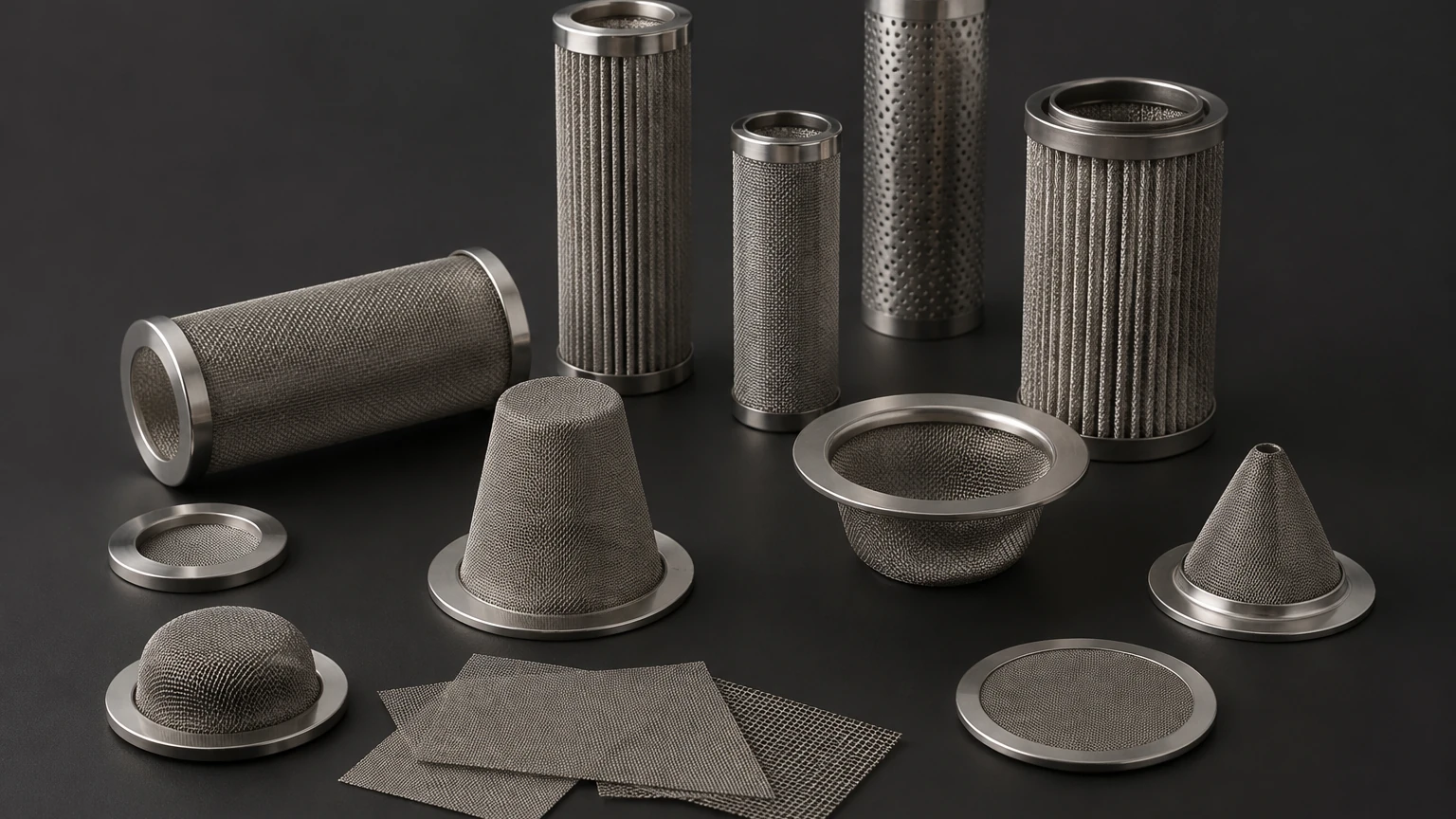
Stainless steel filters are not monolithic; they are engineered into various structures to balance flow rate, dirt-holding capacity, and filtration precision. The three most common structures include woven wire mesh, sintered metal, and perforated metal.
Woven Wire Mesh
Wire mesh is created by weaving individual stainless steel wires into a specific pattern. The type of weave determines the filter's characteristics:
* Plain Weave: The simplest pattern, offering a high open area and low pressure drop. It is ideal for coarse filtration and high-flow applications.
* Dutch Weave: This uses heavier warp wires and finer weft wires, creating a dense, tortuous path for the fluid. It provides much finer filtration ratings and higher mechanical strength than plain weave.
* Twilled Weave: Allows for thicker wires in a given mesh count, increasing the durability of the filter for high-pressure environments.
Sintered Metal Media
Sintering involves bonding multiple layers of wire mesh or metallic fibers together through a high-temperature vacuum process without melting the material. This creates a rigid, porous structure that is exceptionally strong. Sintered filters are preferred for high-pressure backwashing and applications where media migration (the shedding of filter fibers) must be strictly avoided, such as in pharmaceutical manufacturing.
Perforated Metal
Perforated stainless steel is typically used as a support structure rather than the primary filtration medium. It provides the necessary rigidity to prevent the finer wire mesh from collapsing under high differential pressure. In coarse applications, such as basket strainers, perforated metal may serve as the primary filter for removing large debris.
Engineering Parameters: Micron Ratings and Pressure Drop
When specifying a filter stainless steel component, engineers must reconcile the required filtration accuracy with the system's hydraulic constraints.
Absolute vs. Nominal Micron Ratings
* Nominal Rating: This indicates the ability of the filter to retain a majority (typically 60% to 90%) of particles of a specific size. It is a general guide but does not guarantee total removal.
* Absolute Rating: This refers to the diameter of the largest hard spherical particle that will pass through the filter under specified test conditions. In critical applications like sterile filtration or catalyst recovery, absolute ratings are mandatory to ensure process integrity.
Managing Differential Pressure (ΔP)
Differential pressure is the difference between the pressure upstream and downstream of the filter. As a filter captures contaminants, the ΔP increases. A well-designed stainless steel filter must have enough surface area to maintain a low initial ΔP. High initial pressure drops lead to increased energy consumption by pumps and can cause premature filter failure or bypass. Engineers must calculate the "clean pressure drop" based on fluid viscosity, flow rate, and the filter's open area to ensure the system operates within its design limits.
Application-Specific Filtration Challenges
Different industries impose unique demands on stainless steel filtration components. Customization is often required to meet these specific regulatory and operational standards.
Chemical and Petrochemical Processing
In these sectors, filters must withstand highly corrosive fluids and high operating temperatures. The primary challenge is maintaining structural integrity over long production cycles. Stainless steel's resistance to hydrogen embrittlement and thermal expansion makes it superior to synthetic alternatives in refinery and polymer production processes.
Food and Beverage Industry
Filtration in the food industry requires compliance with hygienic standards (such as FDA or 3-A). Stainless steel filters are ideal because they can be cleaned and sterilized using steam or chemical agents (CIP – Clean-In-Place). The surface finish of the filter is critical; a smooth, electropolished surface prevents bacterial growth and ensures that no food particles remain trapped after cleaning.
Hydraulic and Lubrication Systems
In hydraulic systems, the filter stainless steel media must handle high-viscosity fluids and rapid pressure fluctuations. The goal is to protect sensitive valves and actuators from particulate wear. Sintered mesh is often used here because it can withstand the mechanical stresses of high-pressure hydraulic pulses without deforming.
Maintenance, Cleaning, and Service Life
One of the primary B2B advantages of stainless steel filters is their reusability. Unlike disposable cartridges, which represent a recurring cost and a waste stream, stainless steel components can be cleaned and returned to service multiple times.
Cleaning Methodologies
* Backwashing: Reversing the flow of the fluid to dislodge particles from the surface of the filter. This is common in automated water treatment systems.
* Ultrasonic Cleaning: Using high-frequency sound waves in a cleaning solvent to remove fine particles trapped deep within the mesh or sintered structure.
* Chemical Cleaning: Using acids, alkalis, or solvents to dissolve specific contaminants that cannot be removed mechanically.
* Burn-off/Pyrolysis: For filters used in polymer or resin production, heating the filter to high temperatures in a controlled environment can burn off organic buildup.
Determining Replacement Cycles
While stainless steel filters are durable, they are not infinite. Repeated cleaning cycles and mechanical stress can eventually lead to fatigue or permanent clogging (blinding). Engineers should monitor the rate of pressure increase after each cleaning. If the "clean ΔP" begins to rise significantly after successive cleanings, it indicates that contaminants are becoming permanently embedded, and the filter element should be replaced to maintain system efficiency.
Specifying Custom Stainless Steel Filter Components
For many OEM applications, standard off-the-shelf filters are insufficient. Customization allows for the optimization of the filter's geometry and performance to fit specific housing designs or flow requirements. When working with a manufacturer, technical teams should provide the following data points:
1. Fluid Characteristics: Viscosity, density, and chemical composition.
2. Operating Conditions: Maximum and normal operating pressure, temperature ranges, and flow rates.
3. Target Contaminant: Particle size distribution and the nature of the solids (deformable vs. hard particles).
4. Mechanical Interface: End cap configurations (e.g., DOE, 222, 226, or NPT threads) and overall dimensions.
5. Regulatory Requirements: Compliance with industry-specific certifications (ISO, PED, ASME).
By providing these details, engineers can ensure the resulting filter provides the necessary precision without over-engineering the solution, which can lead to unnecessary costs.
Conclusion
Stainless steel filtration is a cornerstone of modern industrial processing. Its ability to operate in environments that would destroy other media makes it indispensable for chemical, pharmaceutical, and high-temperature applications. By selecting the appropriate alloy, understanding the structural benefits of different mesh types, and implementing a rigorous cleaning regimen, industrial facilities can achieve high-performance filtration with a lower long-term cost of ownership. For technical teams looking to optimize their filtration processes, it is advisable to Review product options and application support on the Main Page to evaluate how customized stainless steel solutions can meet specific operational challenges.
Choosing the right filter stainless steel component is not merely a purchase; it is an engineering decision that safeguards the entire production line. Whether the priority is absolute micron precision or the ability to withstand aggressive chemical cleaning, the versatility of stainless steel ensures there is a configuration suited for every industrial demand.
