


Filter Water Treatment Plant
In industrial environments, the efficiency of a filter water treatment plant is a critical determinant of operational uptime and product quality. Unlike municipal water systems, industrial water treatment often involves aggressive chemicals, high temperatures, and high-pressure differentials that necessitate robust filtration components. For engineers and facility managers, selecting the correct filtration media—particularly stainless steel wire mesh and sintered metal cartridges—is essential to protect downstream equipment, such as reverse osmosis (RO) membranes, high-pressure pumps, and sensitive analytical instruments.
Industrial filtration is not a one-size-fits-all solution. It requires a deep understanding of fluid dynamics, particle distribution, and material science. This guide examines the technical considerations for integrating high-performance metal filters into water treatment plants, focusing on material selection, engineering specifications, and long-term maintenance strategies.
The Role of Precision Metal Filters in Water Treatment Plants
A modern filter water treatment plant typically employs a multi-stage approach to remove contaminants. While primary treatment might involve coarse screening or sedimentation, the secondary and tertiary stages require precision filtration to remove fine particulates. Stainless steel filters are preferred in these stages due to their mechanical strength and resistance to environmental stressors.
Pre-Filtration and Membrane Protection
In systems utilizing RO or ultrafiltration (UF), the presence of suspended solids can lead to rapid membrane fouling. Precision wire mesh filters act as a critical barrier, capturing particles that could otherwise lodge in the membrane spacers or cause physical abrasion. By maintaining a consistent micron rating, these filters extend the service life of expensive membranes and reduce the frequency of chemical cleaning cycles.
High-Temperature and Chemical Processing
In chemical processing and pharmaceutical water systems, the water may be treated at elevated temperatures or contain corrosive cleaning agents. Standard polymer-based filters often fail under these conditions. Stainless steel filter cartridges provide the thermal stability and chemical compatibility required to maintain integrity during Steam-in-Place (SIP) or Clean-in-Place (CIP) procedures.
Material Science: Why Stainless Steel is Standard
When designing or upgrading a filter water treatment plant, the choice of material directly impacts the total cost of ownership. Stainless steel, specifically grades 304 and 316L, is the industry standard for high-durability filtration components.
Corrosion Resistance
Grade 316L stainless steel contains molybdenum, which significantly enhances its resistance to pitting and crevice corrosion in chloride-rich environments. This is particularly important in water treatment plants dealing with brackish water or systems that use chlorine-based disinfectants. Grade 304 is often sufficient for general industrial water applications where high corrosion resistance is less critical but mechanical durability is still required.
Structural Integrity
Industrial water systems often experience pressure surges or "water hammer" effects. Metal filters, unlike plastic or fabric alternatives, possess high collapse pressure ratings. They can withstand significant differential pressure ($ΔP$) without deforming or bypassing, ensuring that the filtration efficiency remains constant even during system fluctuations. To explore specific material options and technical data, engineers can refer to the Main Page for detailed product specifications.
Engineering Parameters for Filter Selection
Selecting a filter for a filter water treatment plant requires a quantitative analysis of several engineering parameters. Purchasing teams must look beyond the initial price and evaluate the performance characteristics that affect operational costs.
Micron Rating: Absolute vs. Nominal
It is vital to distinguish between nominal and absolute micron ratings. A nominal rating refers to a filter's ability to retain a majority of particles of a certain size, whereas an absolute rating indicates the size at which 99.9% (or higher) of particles are captured. In critical water treatment stages, absolute-rated stainless steel mesh is necessary to ensure the removal of specific contaminants that could compromise the final water quality.
Flow Rate and Differential Pressure
The relationship between flow rate and pressure drop is a key design consideration. A filter with too small a surface area will result in a high initial pressure drop, reducing the overall system efficiency and increasing energy consumption at the pump. Engineers should calculate the "clean pressure drop" and determine the maximum allowable pressure drop before the filter requires cleaning or replacement. Increasing the effective filtration area through pleated designs can mitigate these issues without increasing the filter housing footprint.
Customization and OEM Integration
Every filter water treatment plant has unique spatial and flow requirements. Off-the-shelf filtration solutions often require compromises in piping layout or filtration efficiency. Custom-engineered filtration components allow for seamless integration into existing infrastructure.
Tailored Filter Geometry
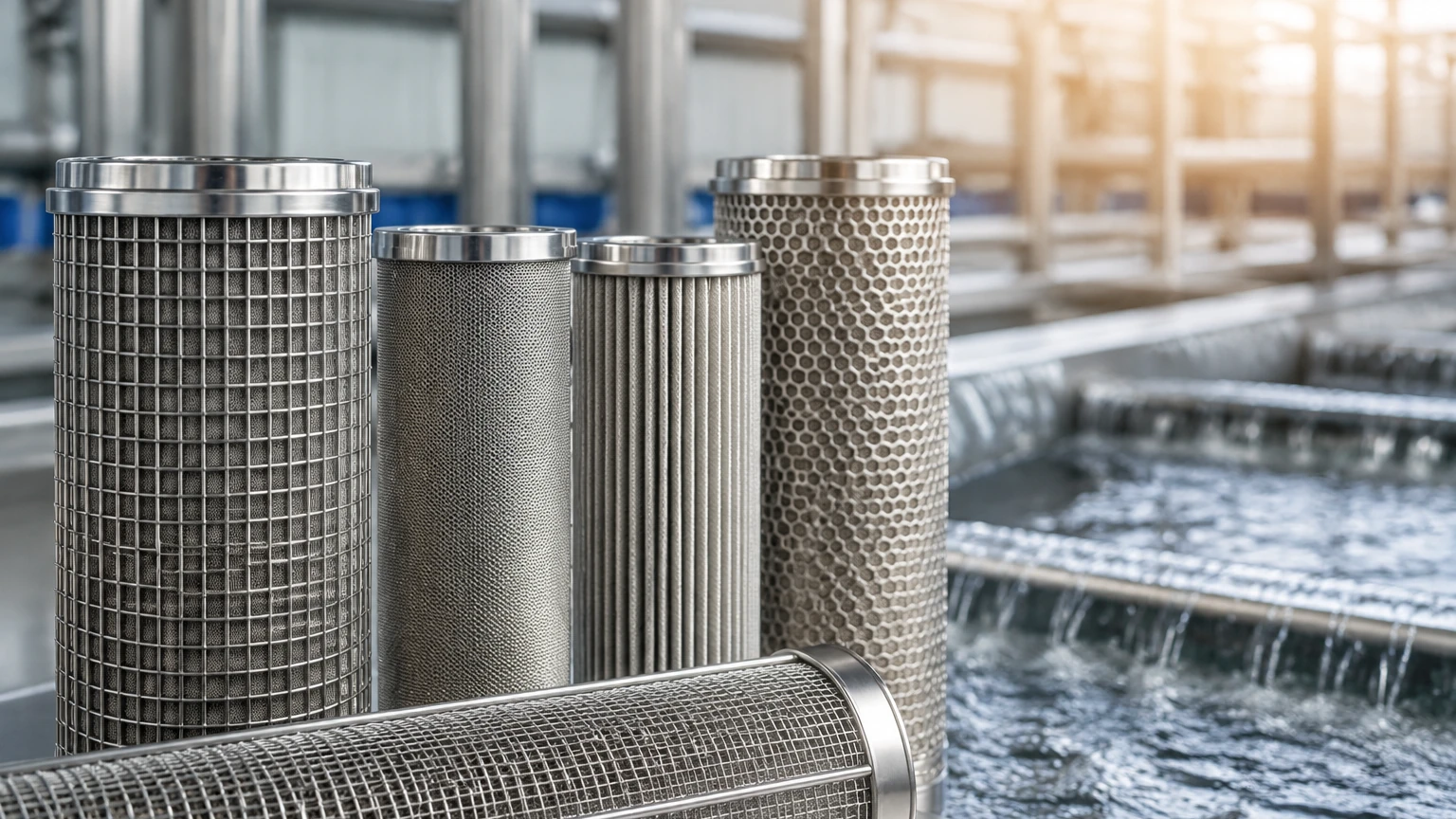
Customization options include varying the diameter, length, and end-cap configurations of filter cartridges. Whether the system requires DOE (Double Open End), SOE (Single Open End) with specific O-ring seals, or threaded connections, precision manufacturing ensures a leak-proof fit. This level of customization is essential for OEM applications where the filter must fit within a proprietary machine or a compact skid-mounted system.
Multi-Layer Mesh Structures
For applications requiring both high strength and fine filtration, multi-layer sintered wire mesh is an ideal solution. This involves bonding multiple layers of stainless steel mesh together through a heat-treatment process. The result is a filter media that combines a fine filtration layer with a robust support layer, providing excellent permeability and mechanical stability.
Maintenance, Cleaning, and Replacement Cycles
One of the primary advantages of using metal filters in a filter water treatment plant is their cleanability. Unlike disposable depth filters, stainless steel cartridges can be cleaned and reused multiple times, significantly reducing the waste stream and long-term procurement costs.
Cleaning Methodologies
* Backwashing: Reversing the flow of water through the filter to dislodge accumulated particles. This is often automated in large-scale treatment plants.
* Ultrasonic Cleaning: For fine mesh filters where particles are deeply embedded, ultrasonic baths use high-frequency sound waves to create cavitation bubbles that strip away contaminants without damaging the mesh structure.
* Chemical Cleaning: Using compatible acids or alkalis to dissolve organic or mineral scaling. The chemical inertness of 316L stainless steel allows for aggressive cleaning protocols that would destroy synthetic media.
Determining Replacement Intervals
While metal filters are durable, they are not infinite. Engineers should monitor the rate of pressure increase after each cleaning cycle. If the "clean" pressure drop begins to rise over time, it indicates that the media is becoming permanently blinded or that the structural integrity is degrading. Establishing a baseline for replacement helps prevent unexpected downtime and ensures the water treatment plant operates at peak efficiency.
Mitigating Operational Risks in Filtration
Failure to correctly specify filtration components in a filter water treatment plant can lead to significant operational risks. These include bypass leakage, media migration, and premature clogging.
Preventing Bypass Leakage
Bypass occurs when fluid flows around the filter media rather than through it. This is usually caused by poor sealing at the end caps or improper installation. Utilizing precision-machined end caps and high-quality elastomers (such as EPDM, Viton, or PTFE) is essential to maintain a positive seal, especially in high-pressure water systems.
Eliminating Media Migration
In some low-quality filters, the filtration media itself can shed fibers or particles into the downstream flow. This is a major concern in the pharmaceutical and food and beverage industries. Sintered metal filters and high-quality wire mesh are inherently resistant to media migration because the wires are physically bonded or woven tightly together, ensuring that the filter does not become a source of contamination.
Technical Specification Checklist for Procurement
Before finalizing a purchase for a filter water treatment plant, technical professionals should confirm the following data points with their manufacturer:
1. Fluid Characteristics: Temperature, pH level, and chemical composition (especially chloride content).
2. Contaminant Profile: Particle size distribution and the nature of the solids (e.g., hard, soft, or fibrous).
3. Flow Requirements: Minimum, normal, and maximum flow rates.
4. Pressure Limits: Maximum operating pressure and maximum allowable differential pressure.
5. Compliance Standards: Required certifications for food contact (FDA) or specific industrial standards.
6. Connection Specs: Exact dimensions for housing compatibility to ensure zero-leakage installation.
By addressing these factors, engineering teams can ensure that their filtration system provides reliable, long-term performance. For further assistance in selecting the appropriate filtration components for specific industrial applications, please consult the technical resources available on our Main Page.
Conclusion
The integration of high-quality stainless steel filters into a filter water treatment plant is a strategic investment in system reliability. By focusing on material integrity, precise engineering parameters, and the advantages of customized OEM solutions, industrial operators can achieve superior filtration performance while minimizing maintenance overhead. Whether the goal is to protect sensitive membranes or to ensure the purity of process water in demanding environments, the choice of filtration component remains a cornerstone of efficient water treatment design.
