


Filteration Flask
In the realm of industrial laboratory processes and small-scale chemical engineering, the filteration flask—often referred to as a Büchner flask or vacuum flask—serves as a fundamental component for liquid-solid separation. While industrial production lines typically rely on large-scale stainless steel filter cartridges and wire mesh systems, the filteration flask remains the primary tool for R&D, pilot testing, and quality control. Understanding the technical nuances of this equipment is essential for engineers who must ensure that laboratory results can be accurately scaled to industrial filtration solutions.
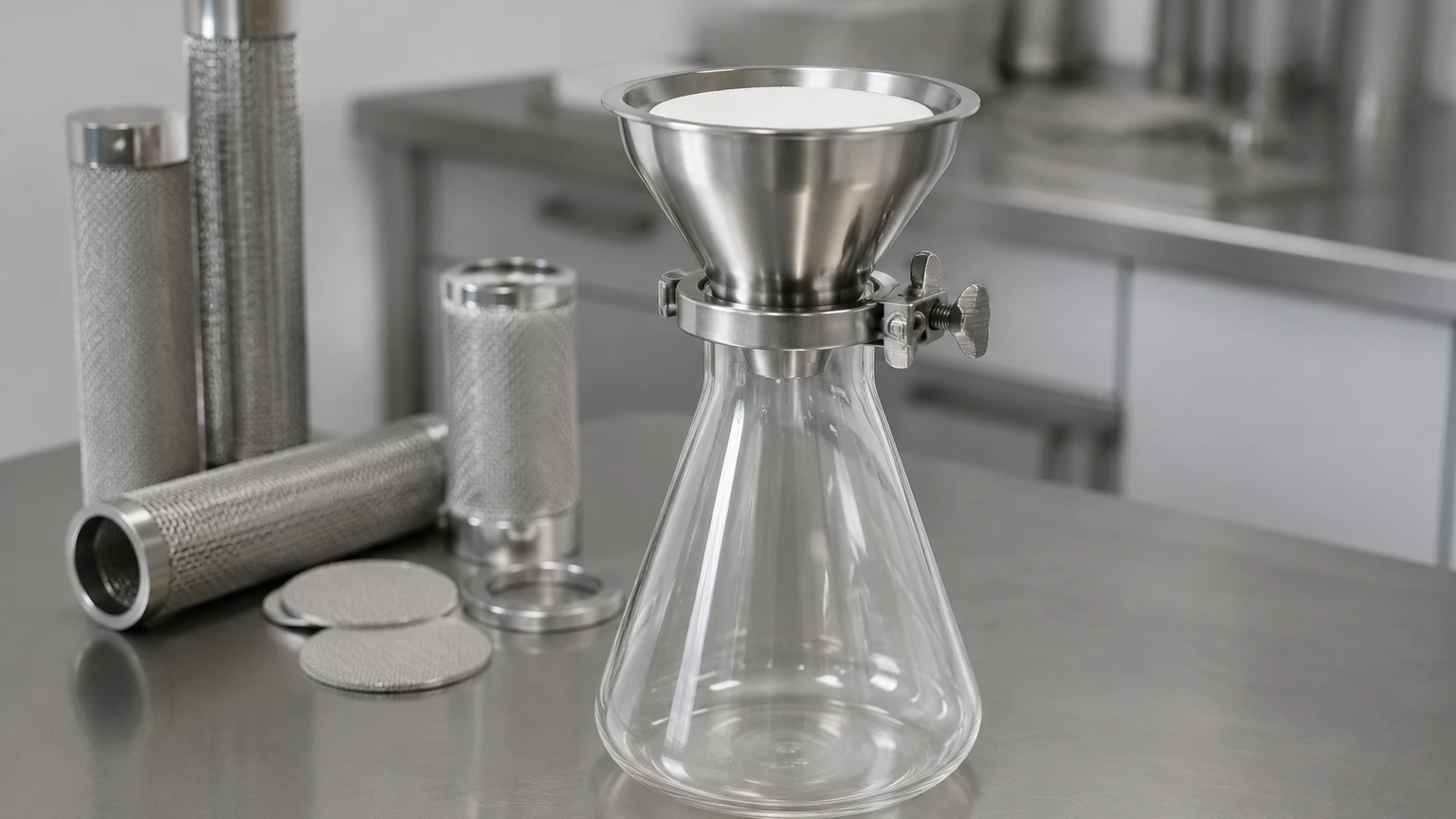
A filteration flask is designed to withstand the pressure differentials created during vacuum-assisted filtration. Unlike standard Erlenmeyer flasks, these vessels feature reinforced walls and a side-arm hose barb, allowing for a secure connection to a vacuum source. This setup significantly accelerates the filtration process, making it indispensable for handling high-viscosity fluids or dense particulate matter that would otherwise take hours to process via gravity-fed methods.
Understanding the Function of a Filteration Flask in Industrial R&D
The primary function of a filteration flask is to serve as a receiving vessel for filtrate while maintaining a vacuum environment. In an industrial R&D setting, engineers use these flasks to determine the filtration characteristics of a slurry, such as the cake resistance and the required micron rating for the filter medium. These data points are critical when designing custom stainless steel filtration solutions for full-scale production.
When a vacuum is applied to the flask, a pressure gradient is established across the filter medium (typically a Büchner funnel or a sintered metal disk). This gradient forces the liquid through the medium, leaving the solids behind. For technical professionals, the filteration flask is not just a container; it is a diagnostic tool. By measuring the time taken to filter a specific volume under a controlled vacuum, engineers can calculate the efficiency of different mesh sizes and materials, eventually leading to the selection of the most cost-effective and durable industrial filters.
Technical Specifications and Engineering Design
From an engineering perspective, the design of a filteration flask must prioritize structural integrity. Most industrial-grade flasks are manufactured from heavy-walled borosilicate glass 3.3, which offers excellent chemical resistance and thermal stability.
Wall Thickness and Pressure Resistance
Standard laboratory glassware is prone to implosion under vacuum if the walls are too thin or if there are surface scratches. A high-quality filteration flask is engineered with a wall thickness significantly greater than that of a standard Erlenmeyer flask. This allows it to safely handle a vacuum of up to 100 mbar or lower, depending on the volume of the flask. For applications involving highly volatile solvents or extreme pressure differentials, engineers may opt for plastic-coated glass or even stainless steel receiving vessels to mitigate the risk of catastrophic failure.
The Side Arm (Hose Barb)
The side arm is the defining feature of the filteration flask. It is typically a molded glass barb or a threaded plastic connector. In a professional setup, a vacuum-rated hose is attached here, leading to a vacuum pump or a central vacuum line. It is common practice to include a "trap" bottle between the flask and the vacuum source to prevent any liquid carryover from damaging the pump. This configuration is a microcosm of the larger manifold systems used in industrial filtration plants.
Selecting the Right Filter Medium for Vacuum Flask Applications
The performance of a filteration flask is largely dependent on the medium used in conjunction with it. While filter paper is common in general chemistry, industrial engineers often require more robust media that mimic the performance of production-scale equipment.
1. Stainless Steel Wire Mesh: For testing durability and flow rates, a precision-cut stainless steel wire mesh disk can be used within a funnel assembly. This allows engineers to test the exact mesh count and weave type—such as plain, twill, or Dutch weave—that will eventually be used in a custom filter cartridge.
2. Sintered Metal Filters: Sintered porous metal disks provide a rigid filtration surface that can withstand high pressures without deforming. These are ideal for testing the filtration of abrasive particles or high-temperature slurries.
3. Ceramic and Glass Frits: These are often used for fine particulate removal where chemical inertness is the highest priority.
By selecting a medium that reflects the intended industrial application, purchasing teams can ensure that the filtration performance observed in the laboratory will be reproducible when they invest in larger filtration systems. For those seeking comprehensive details on industrial filtration components and their technical specifications, the Main Page of the manufacturer's website provides a wealth of information on material compatibility and custom design options.
Operational Safety and Risk Management in Vacuum Filtration
Safety is a paramount concern when operating a filteration flask under vacuum. The risk of implosion is real, especially in environments where the glassware may be subject to mechanical impact or rapid temperature changes.
Inspection Protocols
Before every use, engineers must inspect the filteration flask for "star cracks," deep scratches, or any signs of stress. Even a minor flaw can act as a stress concentrator, leading to a sudden collapse of the vessel under vacuum. In industrial labs, it is recommended to replace flasks periodically or use protective shielding during operation.
Chemical Compatibility
While borosilicate glass is resistant to most acids and organic solvents, it can be etched by hydrofluoric acid or strong, hot alkalis. Etching weakens the glass and increases the risk of failure. Engineers must verify that the flask material and the gaskets used in the funnel assembly are compatible with the process fluid. For instance, in pharmaceutical or food-grade applications, using high-performance elastomers like EPDM or PTFE for the seals is necessary to prevent contamination.
Scaling from Laboratory Flasks to Industrial Stainless Steel Filtration
The ultimate goal of using a filteration flask in a B2B context is often to gather the data required to scale up to an industrial solution. Laboratory results provide the baseline for "Total Cost of Ownership" (TCO) calculations, which include the cost of the filter media, replacement cycles, and energy consumption of the vacuum system.
From Batch to Continuous Processing
A filteration flask is essentially a batch process tool. Once the flask is full, the vacuum must be broken, the filtrate removed, and the filter cake harvested. In an industrial environment, this is replaced by continuous or semi-continuous systems like duplex filters or large-scale multi-cartridge housings. The data gathered from the flask—such as the rate of flow decay as the cake builds up—is used to determine the necessary surface area for the industrial filter to ensure long run times between cleaning or replacement.
Customization of Industrial Components
Manufacturers like Kaifil specialize in taking the requirements identified during flask-scale testing and translating them into custom stainless steel filtration solutions. Whether the application requires a specific micron rating for a chemical processing plant or a high-durability wire mesh for a hydraulic system, the transition from the laboratory filteration flask to a precision-engineered metal filter is a critical step in process optimization. Customization options often include specialized flange connections, reinforced internal cores for high-pressure differentials, and specific alloy selections (e.g., 304, 316L, or Hastelloy) to match the chemical environment tested in the lab.
Key Procurement Considerations for Filtration Components
When transitioning from laboratory testing to purchasing industrial filtration equipment, procurement teams and engineers should focus on several key performance indicators (KPIs):
* Filtration Accuracy: Does the industrial filter provide the same micron rating as the laboratory setup?
* Durability and Cleanability: Can the filter be backwashed or ultrasonically cleaned to extend its service life, or is it a disposable component?
* Pressure Drop: What is the clean pressure drop across the filter, and how does it compare to the vacuum pressure used in the flask testing?
* Material Certification: For pharmaceutical and food industries, do the components meet FDA or other regulatory standards?
By addressing these questions early, companies can avoid costly missteps in the scale-up process. The technical expertise provided by filtration manufacturers helps bridge the gap between the small-scale filteration flask and the high-capacity systems required for modern industrial manufacturing.
Conclusion
The filteration flask remains a cornerstone of laboratory-scale liquid-solid separation, providing the essential data needed for industrial process design. By understanding its engineering limits, safety requirements, and the role of various filter media, technical professionals can effectively bridge the gap between R&D and full-scale production. As processes scale, the move toward durable, high-performance stainless steel filtration solutions becomes necessary to achieve efficiency and reliability in demanding environments. For further technical guidance and to explore a wide range of industrial filtration products, visit the Main Page to find solutions tailored to your specific application requirements.
