


Wastewater Screen
In the hierarchy of industrial and municipal water treatment, the wastewater screen serves as the critical first line of defense. As a primary physical filtration component, its function is to remove large solids, debris, and inorganic matter from the influent stream before it reaches downstream processes such as pumping stations, aeration tanks, or sensitive membrane bioreactors (MBR). For engineers and facility managers, selecting the appropriate wastewater screen is not merely a matter of sizing a mesh; it involves a complex evaluation of hydraulic flow, material durability, and filtration precision to ensure long-term operational stability and protect high-value equipment from mechanical damage or clogging.
Industrial filtration specialist Kaifil provides engineered stainless steel solutions designed to meet these rigorous demands. By understanding the technical nuances of screen design—ranging from aperture geometry to alloy selection—purchasing teams can optimize their systems for both performance and total cost of ownership.
The Role of Wastewater Screens in Pre-treatment
The primary objective of a wastewater screen is the separation of suspended solids from the liquid phase. In a typical treatment plant, this occurs at the "headworks." Without effective screening, solids such as plastics, rags, wood, and stones can cause catastrophic failure in downstream centrifugal pumps, foul heat exchangers, and settle in anaerobic digesters, significantly reducing their effective volume.
Screening is generally categorized into three levels based on the size of the openings:
1. Coarse Screening: Typically featuring openings larger than 6mm (0.25 inches). These are used to remove large objects that could cause immediate mechanical blockages.
2. Fine Screening: Openings ranging from 0.5mm to 6mm. Fine screens are essential for protecting advanced treatment processes and reducing the organic loading on secondary treatment stages.
3. Micro-screening: Openings smaller than 0.5mm. These are often used in specialized industrial applications or as a final polishing step to meet stringent discharge requirements.
From an engineering perspective, the wastewater screen must be designed to handle peak flow conditions without excessive head loss. Head loss refers to the pressure drop across the screen; if it becomes too high, it can lead to upstream flooding or bypass events, where untreated wastewater escapes the system.
Technical Classifications of Screen Media
The efficiency of a wastewater screen is largely determined by the type of media used. Different industrial environments require different structural configurations to balance filtration accuracy with mechanical strength.
Wedge Wire Screens
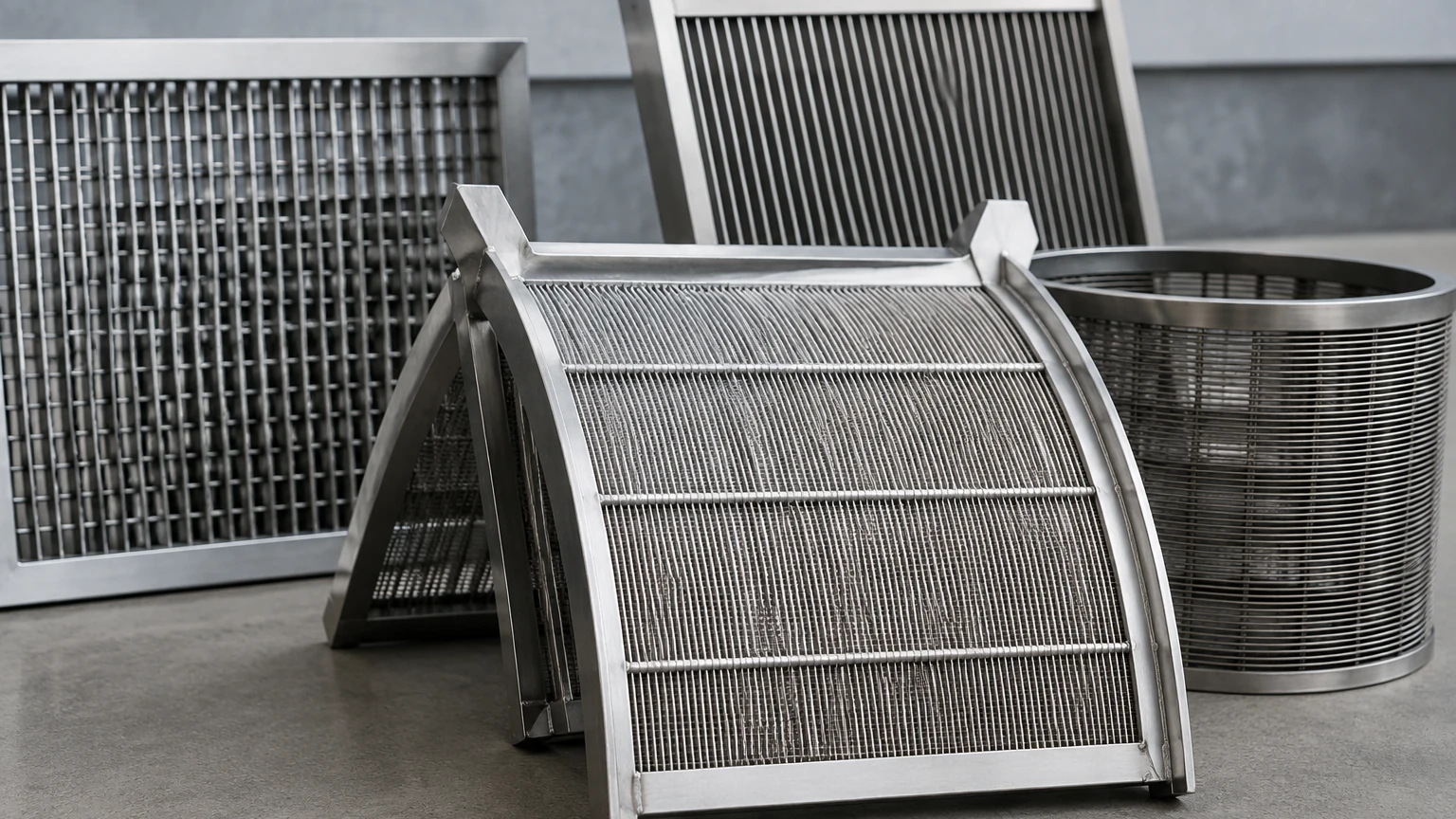
One of the most effective technologies for wastewater applications is the wedge wire or V-wire screen. This design utilizes triangular-shaped wires welded onto support rods. The V-shaped profile creates a widening slot that allows particles to pass through easily once they have cleared the surface, effectively minimizing "blinding" or clogging. For high-solids environments, wedge wire provides a superior strength-to-weight ratio and a high percentage of open area, which facilitates high flow rates.
Perforated Plates
Perforated stainless steel plates are often used in fine screening applications. These plates offer precise circular or square apertures that provide a high degree of capture efficiency for two-dimensional solids (like hair or fibers) that might otherwise slip through longitudinal slots. However, perforated plates generally have a lower open area compared to wire mesh or wedge wire, requiring larger surface areas to maintain the same hydraulic capacity.
Woven Wire Mesh
For specialized industrial wastewater where fine particulate removal is the priority, woven stainless steel wire mesh is employed. This media allows for extremely fine filtration ratings. In these cases, the mesh is often supported by a coarser backing screen or integrated into a cartridge to withstand the differential pressure typical of pressurized filtration systems.
Engineering Considerations for Material Selection
Wastewater is a chemically complex environment. Depending on the source—whether municipal sewage, chemical processing runoff, or food and beverage effluent—the screen may be exposed to extreme pH levels, high chloride concentrations, and abrasive grit. Consequently, material selection is the most significant factor in determining the lifespan of the wastewater screen.
Stainless Steel Grade 304
Grade 304 is the standard for many general-purpose municipal applications. It offers excellent corrosion resistance to most oxidizing acids and is highly durable. However, in environments with high salinity or chloride levels, 304 can be susceptible to pitting corrosion.
Stainless Steel Grade 316L
For more demanding industrial applications, particularly in chemical processing or coastal treatment plants, Grade 316L (low carbon) is preferred. The addition of molybdenum enhances its resistance to chloride-induced pitting and crevice corrosion. The "L" designation ensures that the material maintains its corrosion resistance in the heat-affected zones of welds, which is critical for the structural integrity of custom-fabricated screens.
Surface Treatments
To further enhance performance, many industrial screens undergo passivization or electropolishing. These processes remove surface contaminants and create a uniform chromium-oxide layer, which significantly improves the material’s resistance to chemical attack and reduces the adhesion of biological films (biofouling).
Hydraulic Design and Performance Metrics
When specifying a wastewater screen, engineers must look beyond the physical dimensions. Several hydraulic parameters dictate the success of the installation:
* Approach Velocity: The speed at which the wastewater reaches the screen. This must be high enough to keep solids in suspension (typically above 0.4 m/s) but low enough to prevent the "extruding" of soft solids through the screen openings.
* Through-Screen Velocity: The velocity of the liquid as it passes through the apertures. Ideally, this should be maintained between 0.6 and 1.2 m/s. Excessive velocity increases head loss and can cause fragile solids to break apart.
* Open Area Ratio: This is the ratio of the total area of the openings to the total surface area of the screen. A higher open area reduces head loss and allows for a more compact screen footprint.
To ensure these metrics are met, Kaifil works closely with clients to provide customized filtration components that align with specific flow dynamics. Detailed technical specifications and engineering support can be found on the Main Page of our website, which serves as a resource for professional filtration solutions.
Cleaning Mechanisms and Operational Efficiency
A wastewater screen is only as effective as its cleaning system. As solids accumulate on the screen surface, a "mat" or "filter cake" forms. While this mat can actually improve filtration efficiency by capturing smaller particles, it also increases resistance to flow. Therefore, a mechanism for removing these solids is required.
Mechanical Raking
In coarse screening, mechanical rakes are used to physically lift debris from the screen bars and deposit it into a conveyor or skip. The frequency of the raking cycle is usually controlled by the differential pressure (head loss) across the screen.
Backwashing and Brushing
For fine screens and micro-screens, automated backwashing systems use high-pressure water jets to clear the apertures. In some designs, rotating brushes are used in conjunction with water to ensure that sticky or fibrous materials are completely removed from the stainless steel surface.
Total Cost of Ownership (TCO)
When evaluating the cost of a wastewater screen, procurement teams must consider the TCO rather than just the initial purchase price. A screen made from lower-grade materials may be cheaper upfront but will incur higher costs due to frequent replacements, manual cleaning labor, and potential damage to downstream pumps. Investing in high-quality stainless steel components from a specialized manufacturer like Kaifil ensures a longer service life and reduced maintenance intervals.
Customization and OEM Solutions
No two wastewater treatment applications are identical. Factors such as tank geometry, flow variability, and specific debris types necessitate customized designs. OEM manufacturers play a vital role in this process by providing bespoke filtration components that fit seamlessly into existing infrastructure.
Customization options typically include:
* Variable Aperture Sizes: Tailoring the slot or hole size to the specific particle distribution of the influent.
* Structural Reinforcement: Adding support frames or thicker gauge materials for applications involving high differential pressures or heavy debris loads.
* Integrated Housing: Designing the screen to fit specific flanged connections or channel widths in a treatment plant.
Kaifil’s expertise in precision metal filtration allows for the development of these specialized components, ensuring that each wastewater screen is optimized for its unique environment. Whether the application involves hydraulic systems, food processing, or municipal water treatment, the focus remains on durability and precise filtration performance.
Conclusion: Selecting the Right Filtration Partner
The selection of a wastewater screen is a critical engineering decision that impacts the efficiency and longevity of an entire treatment facility. By focusing on high-quality materials like stainless steel, understanding the hydraulic requirements of the system, and opting for customized designs, engineers can significantly mitigate the risks of equipment failure and operational downtime.
As a professional manufacturer, Kaifil provides the technical expertise and manufacturing capabilities required to produce high-performance stainless steel filter cartridges, wire mesh filters, and precision metal components. For those seeking to optimize their industrial filtration processes or develop custom OEM solutions, we invite you to explore our full range of capabilities and technical resources. To learn more about our products and how we can support your specific application requirements, please visit our Main Page for detailed information and engineering guidance.
