


Filtering New Oil
In the industrial sector, a common misconception persists that oil arriving in sealed drums or bulk tankers is "clean" and ready for immediate use in sensitive machinery. However, for engineers and maintenance professionals managing high-precision hydraulic systems, turbines, and lubrication circuits, the reality is quite different. Filtering new oil is a critical pre-commissioning step that prevents premature component wear, reduces downtime, and ensures that the fluid meets the stringent ISO cleanliness standards required by modern equipment manufacturers.
New oil is often contaminated during the refining process, storage, or transport. By the time it reaches a facility, it may contain metal shavings, silica, fibers, and moisture that exceed the tolerance levels of sophisticated industrial components. This guide examines the technical necessity of filtering new oil, the engineering criteria for selecting filtration media, and the strategic implementation of pre-filtration systems.
The Technical Reality of "New" Oil Contamination
When a drum of hydraulic fluid or lubricating oil is delivered, it is technically "new," but it is rarely "clean" by the standards of high-pressure systems. Contamination enters the fluid at several stages before it reaches the end-user. During the manufacturing process at the refinery, airborne dust and metallic particles from processing equipment can be introduced. Subsequently, the oil is transferred through various hoses, pumps, and tankers, each of which may harbor residual contaminants from previous batches or environmental exposure.
Storage containers themselves are a significant source of particulate matter. Steel drums can have internal scale or rust, while plastic containers may shed microscopic polymer fragments. Furthermore, as drums "breathe" due to temperature fluctuations, moisture-laden air is drawn into the headspace, leading to water contamination. For a system requiring an ISO 4406 cleanliness level of 16/14/11, typical as-delivered oil—which often tests at 21/19/16—represents a significant risk. Without filtering new oil, these particles act as grinding paste, accelerating the wear of pumps, valves, and actuators.
Understanding ISO 4406 and Cleanliness Targets
To manage oil quality effectively, engineers rely on the ISO 4406:2017 standard, which quantifies particulate contamination levels per milliliter of fluid at three micron sizes: 4µm, 6µm, and 14µm.
1. The First Scale Number: Represents particles equal to or larger than 4µm.
2. The Second Scale Number: Represents particles equal to or larger than 6µm.
3. The Third Scale Number: Represents particles equal to or larger than 14µm.
For example, a high-performance servo valve may require a cleanliness level of 15/13/10. If the new oil being added to the reservoir is at 20/18/15, the particle count is approximately 32 times higher than the valve’s tolerance. This discrepancy highlights why filtering new oil before it enters the machine reservoir is non-negotiable. Achieving these targets requires high-efficiency filtration media capable of capturing fine particles without significantly restricting flow.
Engineering Criteria for Filter Selection
Selecting the right filter for new oil involves more than just choosing a micron rating. Engineers must consider the material properties, structural integrity, and performance metrics of the filtration component.
Material Selection: Stainless Steel vs. Synthetic Media
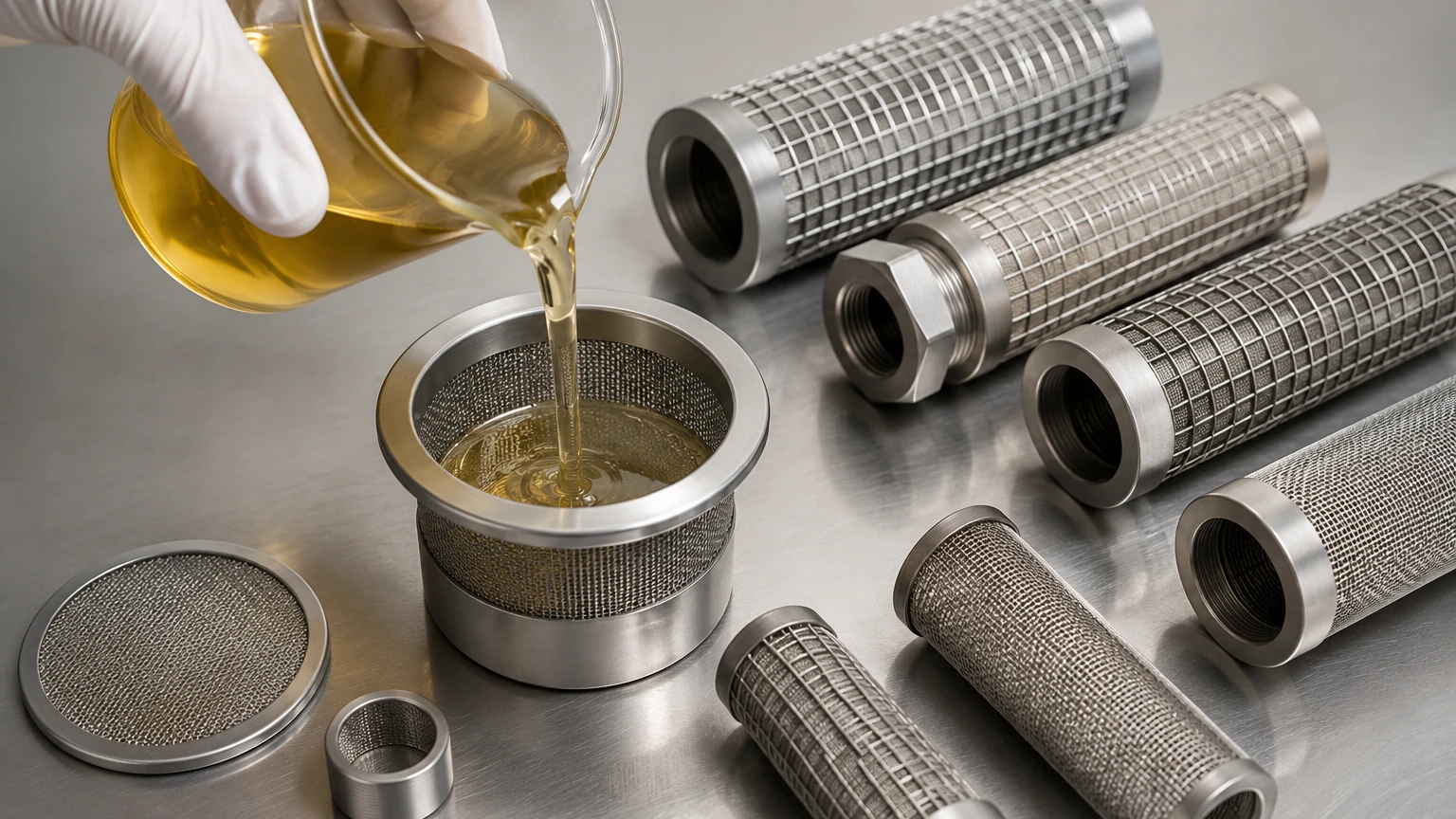
In many industrial applications, stainless steel wire mesh and sintered metal filters offer distinct advantages over disposable cellulose or synthetic fiber elements. Stainless steel filters, such as those manufactured by Kaifil, provide exceptional chemical compatibility and thermal stability. They do not shed fibers into the fluid—a common failure mode for lower-quality disposable filters—and they can withstand high differential pressures without collapsing. For more information on specialized filtration components, you can visit the Main Page to review product options and application support.
Micron Rating and Beta Ratio
The effectiveness of a filter is defined by its Beta Ratio ($\beta$). A nominal micron rating is often misleading; engineers should look for the absolute rating. The Beta Ratio is calculated by dividing the number of particles upstream of the filter by the number of particles downstream. A $\beta_{x(c)} = 1000$ indicates that the filter is 99.9% efficient at that specific micron size. When filtering new oil, using a filter with a high Beta Ratio ensures that the fluid reaching the reservoir is within the specified ISO limits.
Pressure Drop and Viscosity
Oil viscosity varies significantly with temperature and grade (e.g., ISO VG 32 vs. ISO VG 460). A filter must be sized to handle the maximum flow rate at the highest expected viscosity without triggering a bypass valve. If the pressure drop ($\Delta P$) across the filter is too high, the system may bypass the filter entirely, allowing contaminated oil to enter the machine. Stainless steel mesh filters are particularly effective here, as their precise geometry allows for optimized flow paths and lower resistance compared to dense depth media.
Implementation Strategies for Pre-Filtration
There are several professional methods for filtering new oil before it is introduced to a system. The choice depends on the volume of oil, the sensitivity of the equipment, and the available maintenance infrastructure.
Filter Carts and Kidney-Loop Systems
A portable filter cart is the most versatile tool for off-line filtration. It consists of a pump, a motor, and one or more high-capacity filter housings. Before transferring oil from a drum to a reservoir, the oil is circulated through the filter cart in a "kidney-loop" fashion until the desired ISO cleanliness code is achieved. This ensures that only clean fluid is ever introduced to the main system.
Dedicated Transfer Stations
For facilities handling large volumes of oil, dedicated transfer stations with integrated filtration are preferred. These stations often utilize multi-stage filtration: a coarse stainless steel mesh pre-filter to remove large debris, followed by a high-efficiency fine filter to capture microscopic silt. This staged approach protects the more expensive fine filter elements and extends their service life.
Inline Reservoir Filling
In some designs, the reservoir fill port is equipped with a permanent, high-efficiency filter. This ensures that any fluid added—whether from a drum or a top-up container—must pass through a controlled filtration barrier. This "gatekeeper" approach minimizes the risk of human error during the oil transfer process.
The Role of Custom Stainless Steel Filtration
Every industrial environment presents unique challenges, from corrosive chemical additives in the oil to extreme operating temperatures. Standard off-the-shelf filters may not always meet the specific requirements of a specialized hydraulic circuit or a unique OEM piece of equipment.
Custom stainless steel filtration solutions allow engineers to specify exact dimensions, mesh weaves, and reinforcement structures. For instance, in high-viscosity gear oil applications, a custom-designed pleated stainless steel cartridge can provide the large surface area necessary to maintain low pressure drops while still capturing fine particulates. These components are engineered for durability, allowing for cleaning and reuse in certain applications, which contributes to a lower total cost of ownership compared to frequent disposable filter replacements.
Risks of Neglecting New Oil Filtration
The consequences of introducing unfiltered new oil into a system can be catastrophic and costly. The most immediate risk is "silt-lock," where fine particles accumulate in the tight clearances of spool valves, causing them to stick or operate erratically.
Over the long term, particulate contamination leads to:
* Abrasive Wear: Hard particles grind against metal surfaces, creating more wear debris in a chain reaction of degradation.
* Surface Fatigue: Particles trapped between rolling elements (like bearings) create localized high-stress points, leading to pitting and spalling.
* Reduced Fluid Life: Contaminants act as catalysts for oil oxidation, breaking down the chemical additives and reducing the oil's lubricating effectiveness.
* Increased Energy Consumption: Internal leakage caused by worn components reduces volumetric efficiency, requiring the system to work harder to maintain pressure and flow.
Best Practices for Maintenance Teams
To successfully implement a protocol for filtering new oil, maintenance teams should adhere to the following best practices:
1. Establish Baseline Cleanliness: Test new oil deliveries regularly to understand the typical contamination levels from your suppliers.
2. Define Target ISO Codes: Work with equipment manufacturers to determine the required cleanliness levels for every critical machine.
3. Use Quality Sampling Ports: Ensure that oil can be sampled upstream and downstream of the filtration unit to verify performance.
4. Maintain Filtration Equipment: Regularly inspect and replace (or clean, in the case of stainless steel) filter elements. A clogged or bypassed filter provides zero protection.
5. Seal the System: Use high-quality breathers on reservoirs to prevent environmental contaminants from entering after the oil has been filtered and added.
Conclusion
Filtering new oil is an essential engineering practice that bridges the gap between the "as-delivered" state of industrial lubricants and the high-performance requirements of modern machinery. By understanding the technical parameters of ISO 4406, selecting robust filtration media like stainless steel mesh, and implementing disciplined transfer protocols, organizations can significantly extend the life of their equipment and reduce the total cost of operation. Investing in precise, durable filtration components is not merely a maintenance task; it is a fundamental strategy for ensuring industrial reliability and operational excellence.
