


Filtion
In the landscape of industrial processing, the efficiency of liquid and gas separation—often referred to in technical procurement and engineering circles as filtion—is a cornerstone of operational reliability. For engineers and facility managers, the selection of filtration components is not merely a purchasing decision but a critical engineering choice that impacts product purity, equipment longevity, and total cost of ownership. Stainless steel filtration solutions have emerged as the standard for demanding environments where polymer-based media fail due to temperature, pressure, or chemical incompatibility.
Industrial filtration requires a deep understanding of fluid dynamics, particle characteristics, and material science. Whether the application involves chemical processing, pharmaceutical manufacturing, or high-pressure hydraulic systems, the goal remains the same: to remove contaminants with precision while maintaining optimal flow rates. To achieve this, technical professionals must evaluate several variables, including micron ratings, structural integrity, and the specific nuances of the filtion process.
Engineering Fundamentals of Stainless Steel Filtration
The performance of a filter is primarily dictated by its media. In the context of metal filtration, stainless steel wire mesh and sintered metal components are the primary choices. These materials are selected for their ability to withstand extreme conditions that would degrade synthetic fibers.
Weave Patterns and Their Impact
Stainless steel wire mesh is available in various weave patterns, each offering different characteristics for the filtion process:
* Plain Weave: The most common pattern where wires cross over and under each other. It provides high flow rates and is suitable for simple straining tasks.
* Twilled Weave: Used for finer filtration, where wires are woven two over and two under, allowing for a heavier wire diameter in a given mesh count.
* Dutch Weave: This pattern uses a larger diameter warp wire and a smaller diameter shute wire, creating a dense, strong mesh with very fine openings. It is ideal for high-pressure applications where precision is paramount.
Micron Ratings: Absolute vs. Nominal
Understanding the difference between absolute and nominal micron ratings is essential for effective filtion. A nominal rating refers to the ability of the filter to retain a certain percentage (usually 60% to 90%) of particles of a specific size. In contrast, an absolute rating indicates the diameter of the largest spherical particle that can pass through the filter under laboratory conditions. For critical applications like pharmaceutical sterile filtering or precision hydraulic protection, absolute-rated stainless steel cartridges are mandatory to ensure no bypass occurs.
For those seeking specific technical data on these components, you can visit the Main Page to review product options and application support tailored to industrial requirements.
Material Selection and Chemical Compatibility
One of the primary reasons engineers specify stainless steel for filtion systems is its inherent resistance to corrosion and high temperatures. However, "stainless steel" is a broad category, and selecting the wrong grade can lead to premature failure.
Grade 304 vs. Grade 316L
* Type 304: This is the standard industrial grade, offering excellent durability and resistance to oxidation. It is suitable for most water treatment and food-grade applications where the environment is not excessively corrosive.
* Type 316L: The "L" stands for low carbon, which improves weldability and resistance to intergranular corrosion. 316L contains molybdenum, significantly increasing its resistance to chlorides and acids. This makes it the preferred choice for chemical processing and marine environments.
Temperature and Pressure Thresholds
Unlike plastic or paper filters, stainless steel components can operate in environments exceeding 500°F (260°C) and withstand high differential pressures. In high-viscosity filtion, such as polymer melt filtration, the structural rigidity of the metal mesh prevents the media from deforming or "migrating" under the force of the flow, ensuring consistent filtration accuracy throughout the production cycle.
Structural Design of Industrial Filter Cartridges
The physical architecture of a filter cartridge determines its dirt-holding capacity and the frequency of maintenance. For industrial filtion, two main designs predominate: cylindrical and pleated.
Cylindrical Filter Elements
Cylindrical elements consist of a simple layer or multiple layers of wire mesh wrapped around a perforated support core. These are robust and easy to clean, making them suitable for coarse filtration or as pre-filters in a multi-stage system. Their limited surface area, however, means they may require more frequent cleaning in high-load applications.
Pleated Filter Elements
By pleating the stainless steel mesh, manufacturers can significantly increase the effective filtration area within the same footprint. This design is highly effective for filtion tasks involving fine particles, as the increased surface area lowers the face velocity of the fluid, reducing the pressure drop and extending the time between cleaning cycles. Pleated cartridges are frequently used in hydraulic systems and gas filtration where space is limited but high efficiency is required.
Support and Reinforcement
In high-pressure filtion, the filter media must be supported to prevent collapse. This is typically achieved through an internal perforated core and an external guard or shroud. For ultra-fine filtration, a sintered multi-layer mesh is used, where several layers of mesh are bonded together through heat and pressure to create a single, rigid structure that combines fine filtration with high mechanical strength.
Evaluating Filtration Efficiency and Pressure Drop
In any filtion system, there is a trade-off between filtration fineness and pressure drop (ΔP). An oversized filter with a very fine micron rating will provide excellent purity but may cause a significant drop in system pressure, forcing pumps to work harder and increasing energy consumption.
The Role of Differential Pressure
Monitoring differential pressure—the difference in pressure between the inlet and the outlet of the filter—is the most reliable way to gauge the state of the filtion process. As the filter captures contaminants, the openings in the mesh become restricted, and ΔP increases. Engineers must define a "terminal pressure drop," at which point the filter must be cleaned or replaced to prevent bypass or structural damage.
Dirt Holding Capacity (DHC)
DHC refers to the total amount of contaminant a filter can retain before reaching its terminal pressure drop. In industrial filtion, maximizing DHC is vital for reducing downtime. This is often achieved by using depth-loading media or multi-stage filtration, where a coarse outer layer protects a finer inner layer.
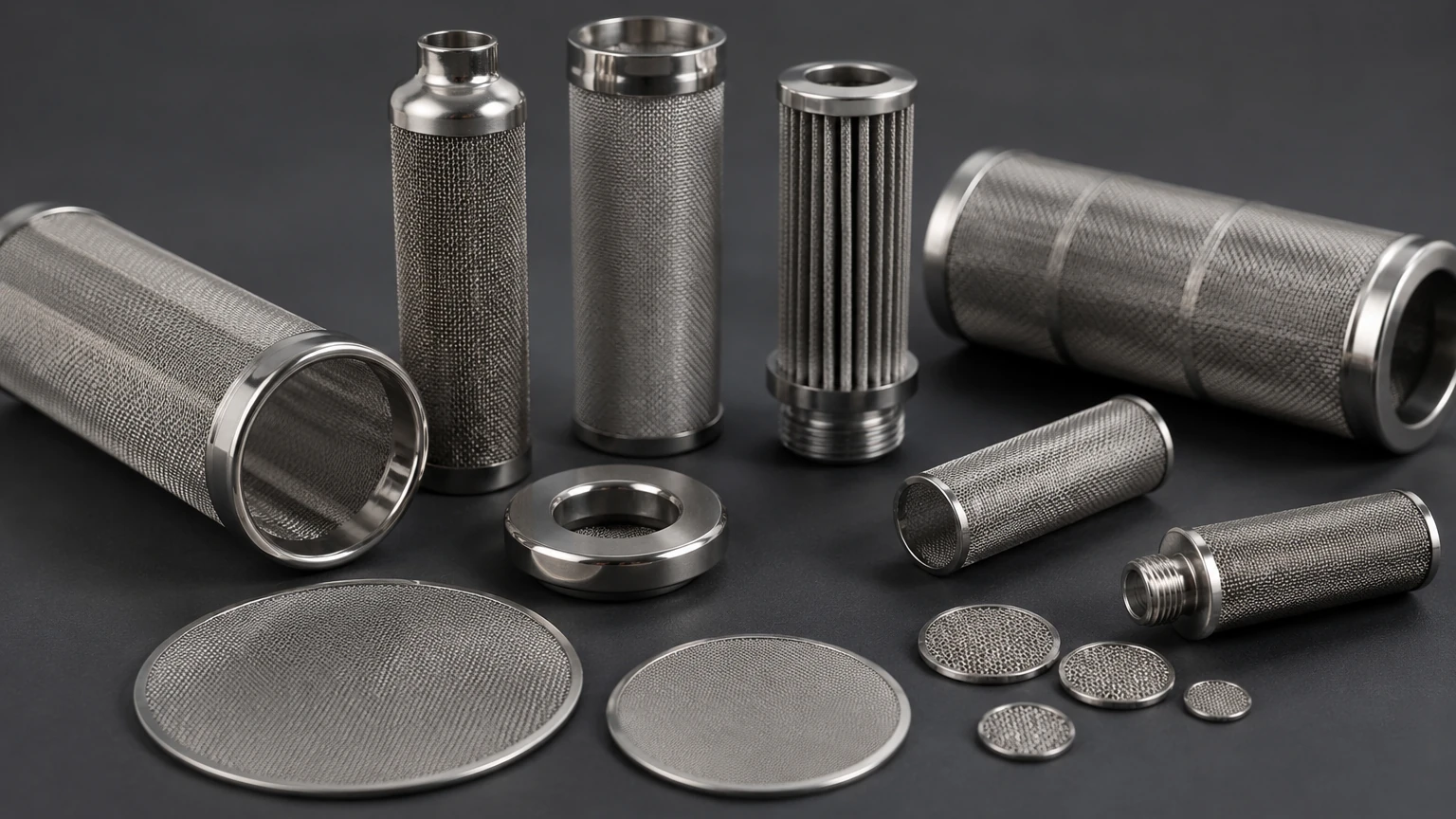
Customization and OEM Solutions in Filtion
Standard off-the-shelf filters often fail to meet the specific spatial or performance constraints of specialized industrial machinery. This is where custom OEM (Original Equipment Manufacturer) solutions become necessary. Customization in the filtion sector involves more than just changing dimensions; it includes:
* Custom End Cap Configurations: Ensuring the filter fits perfectly into existing housings with specialized seals (O-rings, gaskets) made from Viton, PTFE, or EPDM to match the chemical profile of the fluid.
* Specialty Alloys: For environments involving extreme acids or high-temperature oxidation, alloys like Monel, Inconel, or Hastelloy may be used in place of standard stainless steel.
* Precision Porosity: Tailoring the mesh count and wire diameter to achieve a specific flow-to-filtration ratio that standard products cannot provide.
By working with a manufacturer that specializes in custom stainless steel filters, engineering teams can optimize their filtion processes for specific machinery, reducing the need for expensive system retrofits.
Maintenance, Cleaning, and Longevity
One of the most significant advantages of stainless steel media in the filtion process is that it is cleanable and reusable. This contrasts sharply with disposable filters, which contribute to waste streams and recurring procurement costs.
Cleaning Methodologies
Depending on the nature of the contaminant, several methods can be used to restore a stainless steel filter:
1. Backwashing: Reversing the flow of the fluid to flush particles off the surface of the mesh.
2. Ultrasonic Cleaning: Using high-frequency sound waves in a cleaning solvent to dislodge fine particles trapped deep within the mesh or sintered structure.
3. Chemical Cleaning: Using acids, alkalis, or surfactants to dissolve organic or chemical deposits.
4. Burn-off/Pyrolysis: For polymer or organic heavy loading, heating the filter in a controlled environment to carbonize and remove the contaminants.
Determining Replacement Cycles
While stainless steel filters are durable, they are not infinite. Repeated cleaning cycles can eventually lead to work hardening of the wire or microscopic abrasions that alter the micron rating. A robust filtion management program includes regular inspections for mesh integrity and bubble point testing to ensure the filter still meets its original absolute rating.
Total Cost of Ownership (TCO) in Filtration
When evaluating filtion solutions, purchasing departments often focus on the initial unit price. However, a technical TCO analysis usually favors high-quality stainless steel solutions over disposables. The TCO calculation includes:
* Initial Purchase Price: The cost of the filter and housing.
* Operational Costs: Energy consumption related to pressure drop.
* Maintenance Costs: Labor and materials required for cleaning or replacement.
* Downtime Costs: The lost production value when a system is offline for filter changes.
* Disposal Costs: The expense of handling and disposing of contaminated single-use filters.
In high-volume industrial filtion, the ability to clean a filter and return it to service hundreds of times significantly offsets the higher initial investment of stainless steel components.
Conclusion: Confirming Specifications for Procurement
Successful filtion implementation depends on the accurate exchange of technical data between the engineer and the manufacturer. Before proceeding with a procurement or design phase, technical teams should confirm the following:
* The exact chemical composition and temperature of the process fluid.
* The required micron rating (absolute vs. nominal) and the nature of the contaminants.
* The maximum allowable pressure drop at the required flow rate.
* The mechanical constraints of the filter housing.
By focusing on these factual boundaries, companies can ensure they select a filtration solution that provides reliable, long-term performance in even the most demanding industrial environments. For further technical specifications and to explore a wide range of custom metal filter components, professionals are encouraged to visit the Main Page for comprehensive product details and engineering support.
