


Filtration Tube
In the landscape of industrial liquid and gas processing, the filtration tube serves as a fundamental component for ensuring fluid purity and protecting downstream equipment. Unlike standard piping or tubing, a filtration tube is a precision-engineered porous structure designed to intercept contaminants while maintaining a specific flow rate and pressure profile. For engineers and procurement specialists, selecting the correct filtration tube involves a deep understanding of material science, fluid dynamics, and the specific mechanical stresses of the operating environment.
Industrial filtration tubes are primarily utilized in demanding sectors such as chemical processing, pharmaceuticals, food and beverage production, and hydraulic systems. In these environments, the failure of a filtration component can lead to significant downtime, product contamination, or catastrophic equipment damage. Therefore, evaluating these components requires a technical lens that prioritizes structural integrity and filtration accuracy over generic performance claims.
Structural Components and Material Science
The performance of a filtration tube is largely dictated by its construction and the materials used in its fabrication. Stainless steel is the industry standard for high-performance filtration due to its inherent strength and resistance to environmental degradation. Specifically, alloys like 304, 316, and 316L are favored for their varying degrees of corrosion resistance and thermal stability.
Wire Mesh and Sintered Structures
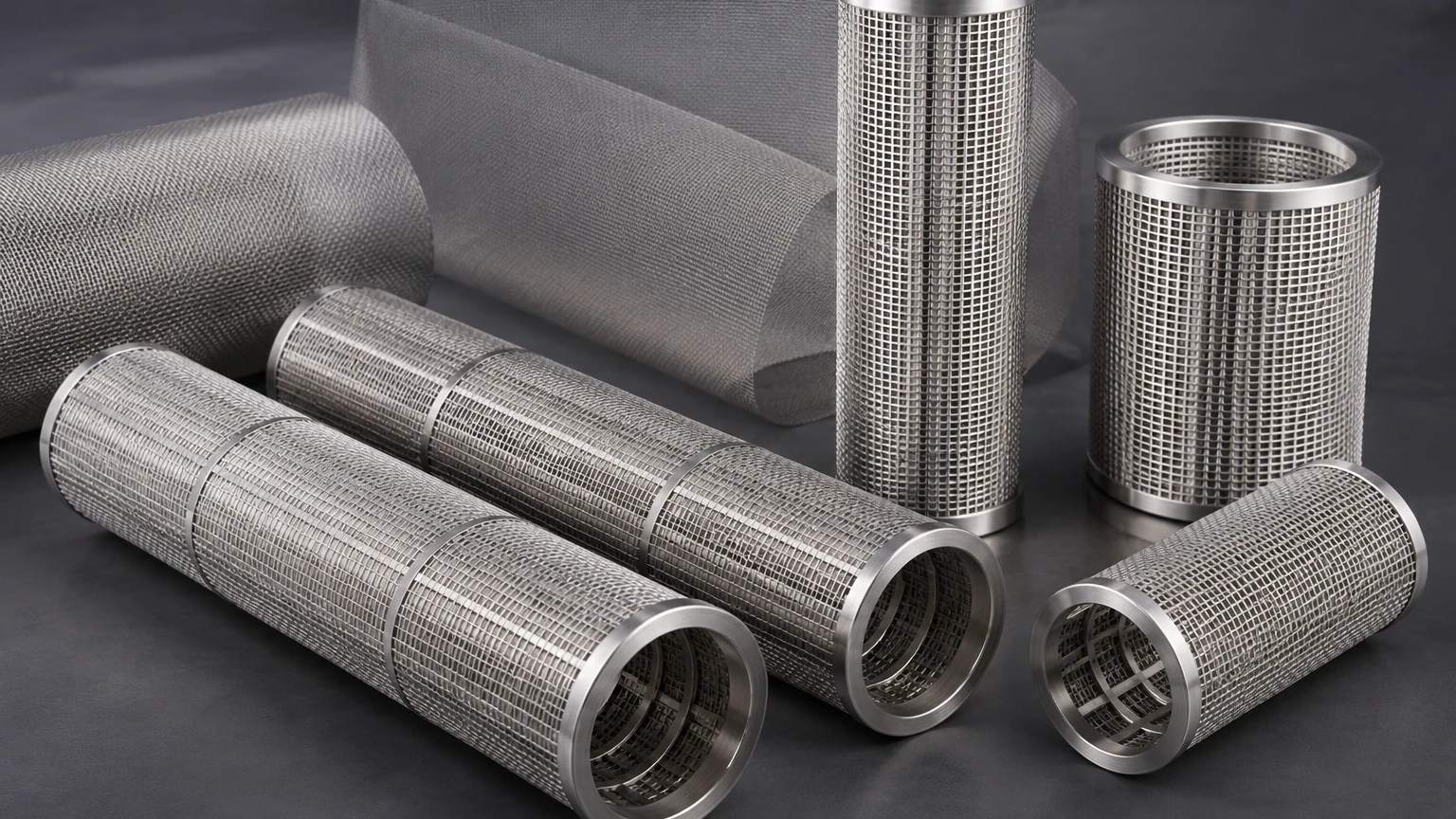
Most industrial filtration tubes utilize stainless steel wire mesh as the primary filtering medium. This mesh can be applied in single or multiple layers. Sintered wire mesh, a process where multiple layers of woven wire cloth are bonded together through heat and pressure without the use of binders, provides a rigid structure that maintains its pore size even under high-pressure differentials. This is critical for applications requiring absolute filtration ratings, where the consistency of the opening size is paramount.
Perforated Support Cores
To withstand high collapse pressures, many filtration tubes incorporate a perforated metal core. This internal or external support structure allows the finer mesh to remain stable during backwashing or high-velocity flow. The open area of the perforated core must be carefully calculated to ensure it does not become the primary restriction in the system, which would lead to an unnecessary increase in pressure drop.
Wedge Wire Technology
In certain heavy-duty applications, such as water treatment or pulp and paper processing, wedge wire filtration tubes are employed. These are constructed by wrapping a V-shaped profile wire around longitudinal support rods. The resulting continuous slot allows for high flow rates and is particularly effective for surface filtration and easy cleaning via backpulsing.
Evaluating Filtration Efficiency and Accuracy
When specifying a filtration tube, the most critical metric is its filtration rating, typically measured in microns (μm). However, a simple micron number is insufficient for industrial procurement; engineers must distinguish between nominal and absolute ratings.
Nominal vs. Absolute Ratings
A nominal rating indicates the ability of the filter to retain a major percentage (usually 60% to 90%) of particles of a specific size. This is often sufficient for pre-filtration or less critical applications. In contrast, an absolute rating refers to the diameter of the largest hard spherical particle that will pass through the filter under specific test conditions. For pharmaceutical or high-purity chemical applications, absolute ratings are essential to ensure the removal of all contaminants above a certain threshold.
Pore Size Distribution
The uniformity of the pores across the surface of the filtration tube determines the reliability of the process. A narrow pore size distribution ensures that the filter does not allow larger-than-expected particles to pass through while also preventing premature clogging by smaller particles that should have been captured by a different stage of the system.
Flow Rate and Pressure Drop (ΔP)
Every filtration tube introduces a degree of resistance to the flow. The initial pressure drop (clean ΔP) must be low enough to allow for an efficient process, leaving sufficient room for the pressure to rise as the filter accumulates debris (dirt-holding capacity). Engineers must balance the desire for finer filtration with the energy costs associated with pushing fluid through a denser medium.
Application-Specific Selection Parameters
The environment in which the filtration tube operates will dictate the necessary specifications. A "one size fits all" approach often leads to premature failure or inefficient processing.
Chemical Compatibility
In chemical processing, the filtration tube must be resistant to the fluid being processed. While 304 stainless steel is suitable for many applications, 316L is often required for environments involving chlorides or organic acids to prevent pitting and stress corrosion cracking. In extreme cases, specialized alloys or surface treatments may be necessary to ensure the longevity of the filtration element.
Temperature Extremes
Unlike polymer-based filters, stainless steel filtration tubes can operate in high-temperature environments, often exceeding 500°F (260°C) depending on the alloy and joining methods used. This makes them ideal for steam filtration, hot oil processing, and polymer melt applications. The thermal expansion coefficients of the filter and its housing must be considered to maintain a proper seal at operating temperatures.
Mechanical Stress and Vibration
In hydraulic systems or high-velocity gas streams, filtration tubes are subject to mechanical vibrations and pressure surges. The construction method—whether longitudinal welding or spiral welding—must be robust enough to prevent fatigue failure. Sintered components are particularly valued here for their monolithic structure, which resists media migration (the shedding of filter fibers into the filtrate).
Customization and OEM Engineering Considerations
Standard off-the-shelf filtration tubes rarely meet the exact needs of specialized industrial equipment. Customization is often a requirement rather than a luxury for many engineering teams. For comprehensive technical specifications and customized engineering support, professionals can visit the Main Page to review available configurations.
Dimensional Precision
Custom filtration tubes can be manufactured to specific diameters and lengths to fit existing housings or to optimize the surface area within a limited footprint. Tight tolerances on the outer diameter (OD) and inner diameter (ID) are essential for ensuring a leak-proof fit with gaskets and O-rings.
End Fitting Configurations
The method by which the filtration tube connects to the rest of the system is a critical design point. Common configurations include:
- Double Open End (DOE): Requires gaskets on both ends and is often used in simple cartridge housings.
- Single Open End (SOE): Often features a threaded connection or a bayonet-style fitting (e.g., 222 or 226 O-rings) for a more secure and hygienic seal.
- Flanged Ends: Used in large-scale industrial vessels where high flow rates and mechanical stability are required.
Layer Integration
Customization also allows for the "tuning" of the filter media. For example, a filtration tube can be designed with a coarse outer layer for pre-filtration, a fine middle layer for absolute particle retention, and a robust inner layer for structural support. This multi-stage approach within a single tube can significantly extend the service life of the element.
Operational Maintenance and Cleaning Protocols
One of the primary advantages of stainless steel filtration tubes over disposable alternatives is their cleanability. Understanding the total cost of ownership (TCO) requires looking beyond the initial purchase price to the maintenance cycle.
Cleaning Methods
Depending on the nature of the contaminant, filtration tubes can be cleaned using several methods:
- Backwashing/Backpulsing: Reversing the flow of fluid to dislodge particles from the surface of the mesh. This is highly effective for wedge wire and surface-loading mesh tubes.
- Ultrasonic Cleaning: Using high-frequency sound waves in a cleaning solution to remove deeply embedded particles within the sintered structure.
- Chemical Cleaning: Using acids, alkalis, or solvents to dissolve organic or inorganic scale. This requires the filter material to be fully compatible with the cleaning agents.
- Burn-off/Pyrolysis: For polymer or organic heavy loading, controlled heating can carbonize the contaminants, which are then flushed out.
Determining Replacement Cycles
While cleanable, no filtration tube lasts forever. Over time, repeated cleaning and operational stresses can lead to "work hardening" of the metal or irreversible blinding of the pores. Engineers should monitor the "terminal pressure drop"—the point at which the filter can no longer be cleaned to an acceptable initial ΔP. Establishing a clear protocol for when to retire a filtration tube is essential for maintaining process consistency.
Integrity Testing
For critical applications, especially in the pharmaceutical and food industries, regular integrity testing (such as the Bubble Point Test) ensures that the filtration tube has not developed any bypasses or structural breaches. This provides a factual basis for continuing to use a cleaned element or deciding on its replacement.
Conclusion
The selection of a filtration tube is a technical decision that impacts the efficiency, safety, and cost-effectiveness of industrial operations. By focusing on material integrity, precise micron ratings, and the specific demands of the application, engineering teams can implement filtration solutions that offer long-term reliability. Whether dealing with high-pressure hydraulics or sensitive pharmaceutical grade fluids, the structural and functional characteristics of the stainless steel filtration tube remain a cornerstone of modern industrial processing. For those seeking reliable OEM and customized filtration components, partnering with a manufacturer that understands these engineering nuances is the most effective path toward optimized filtration performance.
