


String Wound Filters
In the landscape of industrial liquid filtration, string wound filters represent one of the most established and versatile technologies for depth filtration. These cartridges are engineered to remove suspended solids, sediment, and particulate matter from process fluids through a tortuous path created by precisely wound textile fibers. For engineers and procurement professionals, understanding the technical nuances of string wound filters—ranging from winding patterns to material compatibility—is essential for optimizing filtration efficiency and managing the total cost of ownership (TCO).
As a professional manufacturer of custom filtration solutions, Kaifil recognizes that selecting the right depth filter is often the first step in protecting more sensitive downstream components, such as high-precision stainless steel filter cartridges or reverse osmosis membranes. This guide provides a technical analysis of string wound technology to assist in informed decision-making for industrial applications.
Engineering Principles of String Wound Filtration
String wound filters operate on the principle of depth filtration. Unlike surface filtration, where particles are trapped on a single plane, depth filtration captures contaminants throughout the entire thickness of the filter media.
The Winding Pattern and Graded Density
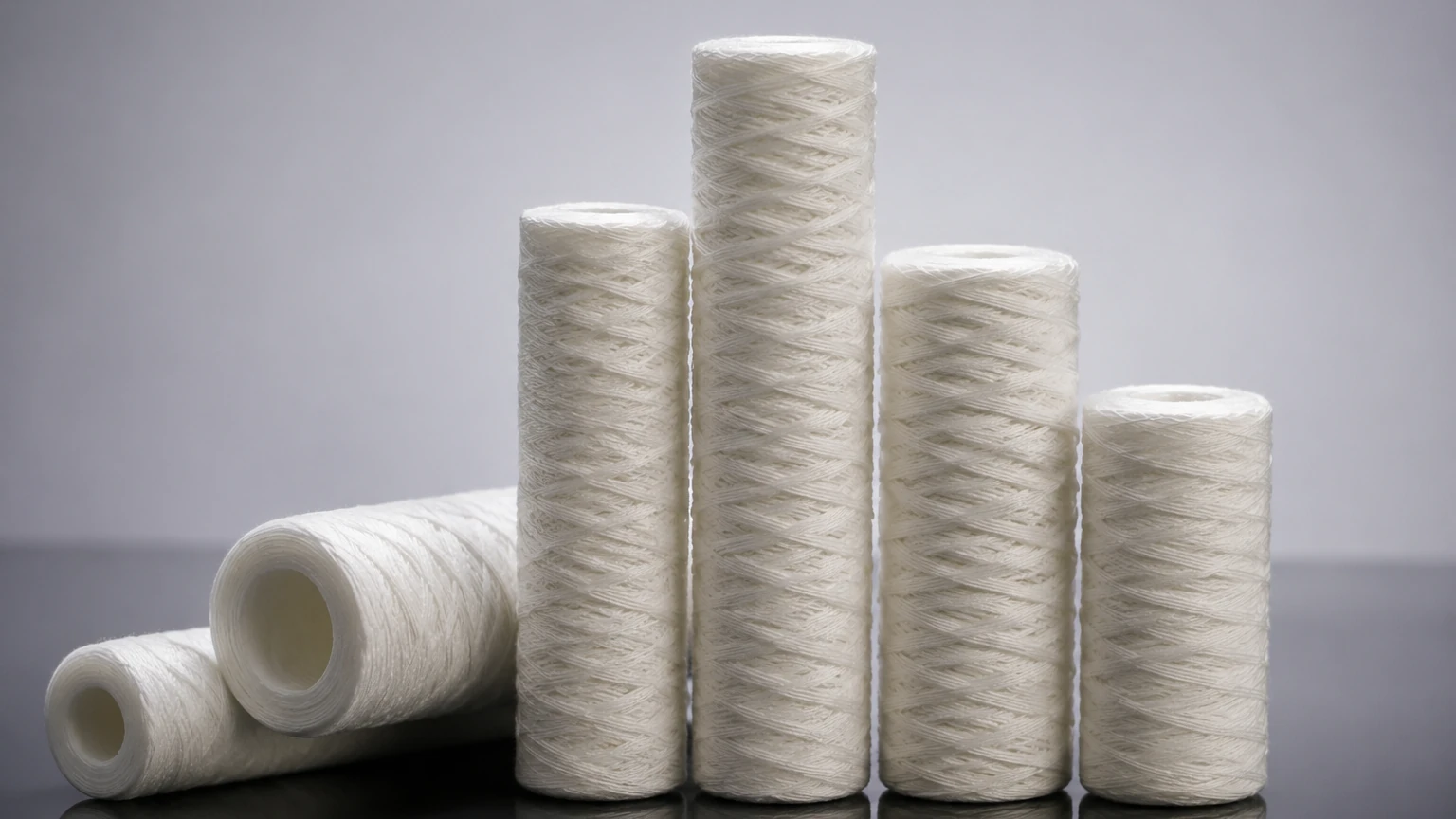
The performance of a string wound filter is primarily determined by the winding pattern and the tension applied during the manufacturing process. The yarn is wound around a perforated central core in a specific geometric pattern, typically creating diamond-shaped openings.
In a high-quality string wound filter, the winding process is controlled to create a "graded density" structure. This means the filter is more open at the outer layers and becomes progressively tighter toward the center core. This design allows larger particles to be trapped near the surface, while finer particles penetrate deeper into the media before being captured. This prevents the surface from blinding prematurely, significantly increasing the dirt-holding capacity compared to non-graded media.
The Tortuous Path
As fluid moves from the outside of the cartridge toward the center, it must navigate the complex network of fibers. This "tortuous path" increases the probability of particle-to-fiber contact. Contaminants are removed through a combination of mechanical straining, impingement, and, in some cases, adsorption. The effectiveness of this path is a direct result of the yarn's nap (the fuzziness of the fiber) and the precision of the winding equipment.
Material Selection and Chemical Compatibility
Selecting the appropriate combination of yarn and core material is critical to ensure the filter can withstand the chemical and thermal stresses of the specific industrial environment. Using incompatible materials can lead to media migration, chemical leaching, or structural failure of the cartridge.
Common Yarn Materials
1. Polypropylene (PP): The most common material due to its broad chemical resistance and low cost. It is suitable for water, acids, alkalis, and many solvents. However, it is limited by a maximum operating temperature of approximately 140°F (60°C).
2. Cotton: Often used for filtering oils, fuels, and organic solvents. Bleached cotton is preferred for food and beverage applications to ensure no natural oils or waxes leach into the filtrate. It can typically handle temperatures up to 250°F (121°C).
3. Fiberglass: Reserved for high-temperature applications (up to 750°F or 400°C) and aggressive chemical environments where synthetic fibers would degrade. It is commonly used in the petrochemical and power generation industries.
4. Polyester: Provides better heat resistance than polypropylene (up to 300°F/149°C) and is resistant to many oxidizing agents and solvents.
Core Materials
The core provides the structural integrity necessary to resist the differential pressure $(\Delta P)$ exerted by the fluid flow.
* Polypropylene Cores: Economical and chemically compatible with PP yarn, but limited by temperature.
* Tin-Plated Steel: Offers higher strength and temperature resistance for general industrial use.
* Stainless Steel (304/316): Essential for high-temperature, high-pressure, or corrosive applications. Stainless steel cores are the standard in pharmaceutical and food-grade processes where corrosion resistance and cleanliness are paramount.
Performance Metrics: Micron Ratings and Efficiency
One of the most common points of confusion in filter procurement is the distinction between nominal and absolute micron ratings. String wound filters are almost exclusively categorized by nominal ratings.
Nominal vs. Absolute Filtration
A nominal rating indicates the filter's ability to retain a majority percentage (typically 60% to 90%) of particles of a specific micron size. Because the winding process creates a flexible matrix, the pore sizes are not fixed. Under high pressure or flow surges, the fibers may shift slightly, potentially allowing some particles to pass through.
For applications requiring high-precision removal of specific particle sizes (e.g., sterile filtration), engineers often transition from string wound pre-filters to absolute-rated stainless steel or pleated cartridges. However, for bulk solids removal, string wound filters offer a superior balance of flow rate and dirt-holding capacity.
Pressure Drop and Flow Rate
Every filter introduces a pressure drop $(\Delta P)$ into the system. A new, clean string wound filter should ideally have an initial pressure drop of less than 2-3 psi. As the filter captures contaminants, the $\Delta P$ increases. Engineers must monitor this to determine the optimal change-out point. Most industrial systems set a terminal pressure drop of 15 to 30 psi. Operating beyond this point risks "channeling," where the fluid forces its way through the media, or even structural collapse of the cartridge.
String Wound vs. Melt-Blown Filters
Both string wound and melt-blown filters are depth-type cartridges, but they differ in construction and performance characteristics.
* Structural Integrity: String wound filters generally have a more rigid internal structure due to the central core and the tensioned yarn. This makes them less prone to "unloading" (releasing trapped particles) during pressure spikes compared to some lower-quality melt-blown filters.
* Customization: String wound technology allows for a wider variety of material combinations. While melt-blown filters are primarily restricted to thermoplastic polymers like polypropylene, string wound filters can utilize natural fibers and metallic cores for specialized environments.
* Viscosity Handling: For high-viscosity fluids, the distinct diamond pattern of a string wound filter often provides better flow characteristics and lower initial pressure drop than the denser fiber matrix of a melt-blown cartridge.
Industrial Applications and Use Cases
String wound filters are utilized across a broad spectrum of industries due to their adaptability and cost-effectiveness.
Water Treatment and RO Pre-filtration
In reverse osmosis (RO) systems, string wound filters serve as critical pre-filters. They remove silt, sand, and scale that would otherwise foul the expensive RO membranes. By using a 5-micron or 1-micron string wound filter, facilities can significantly extend the life of their membranes.
Chemical and Petrochemical Processing
In the production of chemicals, lubricants, and fuels, these filters are used to remove catalysts, pipe scale, and other process debris. The ability to use fiberglass or stainless steel components allows these filters to operate in the harsh environments typical of this sector.
Food and Beverage
Bleached cotton or FDA-compliant polypropylene string wound filters are used to clarify juices, syrups, and potable water. In these applications, the focus is on ensuring the media does not impart any taste, odor, or color to the final product.
Selection Criteria for Procurement and Engineering
When specifying string wound filters for an industrial system, engineers should confirm the following technical parameters with their supplier:
1. Fluid Compatibility: Does the yarn and core material react with the process fluid? Consider pH levels and solvent concentration.
2. Operating Temperature: What is the maximum temperature during normal operation and during potential system upsets or cleaning cycles?
3. Flow Rate Requirements: What is the total GPM (gallons per minute) required? Ensure the housing can accommodate enough cartridges to keep the initial $\Delta P$ low.
4. Target Particle Size: What is the size of the contaminant being removed, and what is the required cleanliness level downstream?
5. End Cap Configuration: Does the application require standard double-open-end (DOE) cartridges, or specialized end caps like 222 or 226 O-rings to ensure a bypass-free seal?
Optimizing Filtration Systems with Kaifil
While string wound filters are excellent for general-purpose depth filtration, many industrial processes eventually require the precision and durability of metallic filtration. Kaifil specializes in the engineering and manufacture of custom stainless steel filtration solutions that complement depth filtration stages.
By integrating high-capacity string wound filters as a primary stage and following with Kaifil’s precision-engineered wire mesh or sintered metal filters, facilities can achieve a multi-stage filtration strategy that maximizes efficiency and minimizes downtime. Our expertise in material science and industrial design ensures that every component—from the simplest pre-filter to the most complex custom cartridge—meets the rigorous demands of modern manufacturing.
To explore our full range of custom industrial filtration components and technical support services, visit our Main Page. We work closely with engineering teams to develop filtration solutions that address specific challenges in chemical processing, hydraulic systems, and water treatment, ensuring reliable performance in the most demanding environments.
