


Filtration Wastewater Treatment
In the landscape of industrial resource management, filtration wastewater treatment represents a critical phase in ensuring environmental compliance, operational efficiency, and resource recovery. For engineers and facility managers, selecting the appropriate filtration technology is not merely a matter of meeting regulatory discharge limits; it is an engineering challenge that involves balancing flow dynamics, chemical compatibility, and long-term maintenance costs. As industries move toward more sustainable "closed-loop" water systems, the reliance on high-performance filtration components—specifically those constructed from durable materials like stainless steel—has become a standard for demanding applications.
Industrial wastewater often contains a complex mixture of suspended solids, oils, chemicals, and organic matter. Effective treatment requires a multi-stage approach where mechanical filtration serves as a primary or secondary barrier. By understanding the technical nuances of filtration media and the specific requirements of the wastewater stream, technical professionals can optimize their systems for maximum uptime and minimal environmental impact.
The Role of Mechanical Filtration in Wastewater Management
Mechanical filtration is the physical separation of solids from liquids using a porous medium. In the context of filtration wastewater treatment, this process is fundamental for protecting downstream equipment, such as reverse osmosis (RO) membranes, heat exchangers, and high-pressure pumps. Without robust pre-filtration, these sensitive components are prone to fouling, scaling, and mechanical wear, leading to frequent shutdowns and expensive repairs.
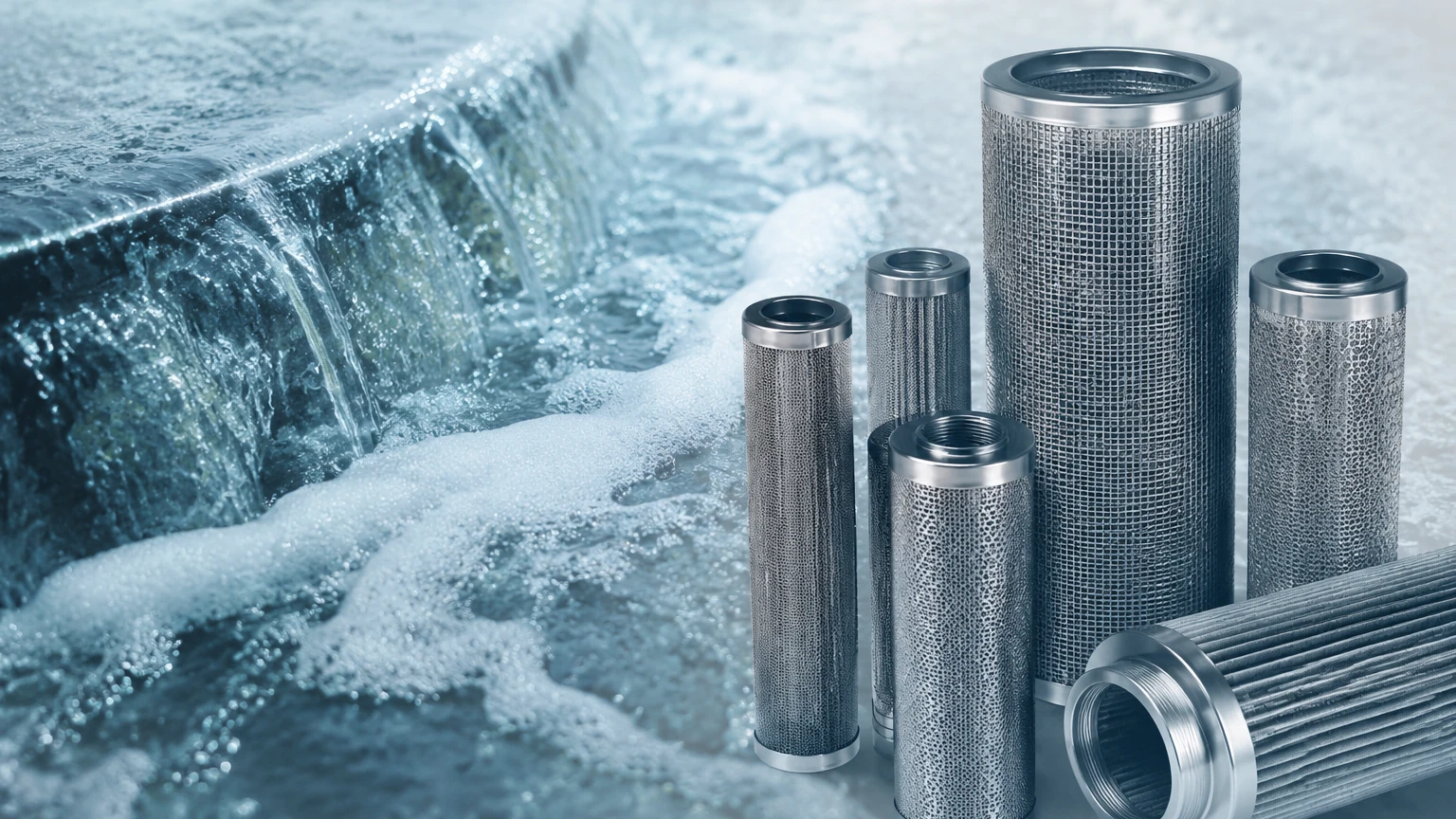
Stainless steel wire mesh filters and filter cartridges are frequently employed in these scenarios due to their structural integrity. Unlike polymer-based filters, metal filtration components can withstand high differential pressures and abrasive particles without deforming. This makes them ideal for the initial stages of treatment where the solids loading is highest. By capturing larger particulates early in the process, these filters reduce the burden on biological treatment stages or fine chemical precipitation processes.
Key Engineering Criteria for Selecting Filtration Components
When designing or upgrading a wastewater treatment system, engineers must evaluate several technical parameters to ensure the filtration media is fit for purpose. A mismatch between the filter specifications and the wastewater characteristics can lead to bypass, premature clogging, or material failure.
1. Filtration Accuracy and Micron Ratings
Filtration accuracy is defined by the micron rating, which indicates the size of particles the filter is capable of retaining. In wastewater treatment, it is common to use a graduated approach. Coarse filtration (100 microns and above) removes large debris, while fine filtration (down to 1 or 5 microns) targets smaller suspended solids. Engineers must determine whether a nominal or absolute rating is required. For critical applications where downstream protection is paramount, absolute-rated stainless steel cartridges provide the necessary precision to ensure no particles above a specific size pass through the system.
2. Material Compatibility and Corrosion Resistance
Wastewater streams in the chemical processing and pharmaceutical industries often contain aggressive solvents, acids, or alkalis. Standard carbon steel or plastic filters may degrade rapidly under these conditions. Stainless steel 304 and 316L are the industry standards for filtration wastewater treatment due to their excellent corrosion resistance. 316L, in particular, contains molybdenum, which enhances its resistance to pitting and crevice corrosion in chloride-rich environments, such as those found in brine treatment or seawater applications.
3. Flow Rate and Pressure Drop (Delta P)
The flow rate determines the volume of water processed per unit of time. Every filter introduces a certain level of resistance, known as the pressure drop or Delta P. An optimized system maintains a high flow rate with a low initial pressure drop. As the filter captures contaminants, the Delta P increases. Engineers must calculate the maximum allowable pressure drop before the filter requires cleaning or replacement. High-quality wire mesh filters are designed with optimized open areas to maximize flow while maintaining structural strength.
Advantages of Stainless Steel Media in Harsh Environments
While disposable filters may seem cost-effective initially, the demanding nature of industrial wastewater often favors permanent or cleanable stainless steel solutions. The technical advantages of metal media extend beyond simple durability.
* Thermal Stability: Industrial wastewater can often be discharged at high temperatures, especially in the food and beverage or textile industries. Stainless steel filters maintain their mechanical properties at temperatures that would cause plastic filters to soften or fail.
* Mechanical Strength: High-pressure hydraulic systems and high-flow water lines can subject filters to significant physical stress. Stainless steel cartridges can withstand high collapse pressures, ensuring the integrity of the filtration barrier even during pressure spikes.
* Cleanability and Reusability: One of the most significant benefits of stainless steel wire mesh is that it can be cleaned via backwashing, ultrasonic cleaning, or chemical soaking. This reusability is a key factor in reducing the total cost of ownership and minimizing the waste generated by discarded filter elements.
Addressing Common Risks: Fouling and Maintenance Cycles
Fouling is the accumulation of unwanted material on the surface or within the pores of the filter media. In filtration wastewater treatment, fouling can be biological (biofilm growth), chemical (scaling), or physical (solids buildup). Managing these risks is essential for maintaining consistent performance.
Engineers should look for filter designs that facilitate easy cleaning. For example, pleated stainless steel cartridges increase the available surface area, which extends the time between cleaning cycles by distributing the solids load over a larger region. Furthermore, the use of specific wire mesh weaves, such as Dutch weave or Twilled weave, can influence how easily particles are released during backwashing. A "surface filtration" mechanism, where particles are caught on the exterior of the mesh, is generally easier to clean than "depth filtration," where particles are trapped within a thick matrix of fibers.
Regular monitoring of the differential pressure is the most effective way to determine maintenance cycles. Automated systems can trigger a backwash cycle once a specific Delta P threshold is reached, ensuring that the system operates within its engineered parameters without manual intervention.
Customization and OEM Solutions for Specialized Applications
No two wastewater streams are identical. A solution that works for a municipal treatment plant may be entirely unsuitable for a specialized chemical manufacturing facility. This is where customization becomes vital. Custom-engineered filtration components allow for the integration of specific end-fittings, unique dimensions to fit existing housings, and specialized mesh configurations tailored to the specific particle size distribution of the effluent.
For original equipment manufacturers (OEMs), partnering with a specialist who understands the nuances of metal fabrication and filtration science is critical. Customizations can include reinforced internal cores for high-pressure applications or specialized coatings to further enhance chemical resistance. By consulting with experts at the Main Page, engineering teams can develop bespoke solutions that meet the exact rigors of their specific industrial environment.
Evaluating Total Cost of Ownership (TCO)
In the procurement process, it is easy to focus on the initial purchase price. However, for filtration wastewater treatment, the total cost of ownership (TCO) provides a more accurate picture of value. TCO includes the initial cost, installation, energy consumption (related to pressure drop), maintenance labor, and the cost of replacement parts and disposal.
Stainless steel filters typically have a higher upfront cost than disposable polypropylene or paper filters. However, because they can last for years with proper maintenance, the cost per gallon of treated water is often significantly lower over the lifespan of the equipment. Additionally, reducing the frequency of filter changes reduces labor costs and the risk of system contamination during maintenance windows. For industries focused on sustainability, the reduction in landfill waste from disposable filters also contributes to corporate environmental goals.
Application-Specific Considerations
Chemical Processing
In chemical plants, filtration is used to recover valuable catalysts or to remove impurities from process water before it is recycled. The filters must be resistant to a wide range of pH levels and potentially volatile organic compounds (VOCs). Stainless steel's inert nature makes it the preferred choice for these sensitive environments.
Food and Beverage
Wastewater from food processing often contains organic solids and fats. Filtration components must not only be durable but also meet sanitary standards. Stainless steel filters are easy to sterilize and do not shed fibers or particles into the fluid stream, ensuring that the treatment process remains hygienic and compliant with food safety regulations.
Pharmaceutical Industry
Pharmaceutical wastewater treatment requires high precision to ensure that active pharmaceutical ingredients (APIs) and other fine particulates are effectively removed. The use of precision-engineered metal filter cartridges ensures that the filtration process is repeatable and verifiable, which is essential for regulatory documentation and quality control.
Conclusion: Making Informed Filtration Decisions
Effective filtration wastewater treatment is a cornerstone of modern industrial operations. By focusing on technical specifications such as material grade, micron rating, and structural design, engineers can implement systems that are both reliable and cost-effective. The transition from disposable media to durable, cleanable stainless steel components offers a clear path toward optimized performance and reduced operational overhead.
When selecting filtration components, it is essential to confirm the chemical composition of the wastewater, the expected solids loading, and the required flow rates. Working with a manufacturer that offers technical expertise and customization capabilities ensures that the final product will perform as expected in the field. For those seeking to explore high-performance metal filtration options, reviewing the available technical resources and product specifications on the Main Page is a recommended next step in the engineering process.
