


Filtro Coalescente Para Agua
In industrial fluid processing, the separation of immiscible liquids—specifically the removal of hydrocarbons or oils from water—is a critical requirement for environmental compliance, equipment protection, and process efficiency. A filtro coalescente para agua (coalescing filter for water) serves as a specialized component designed to facilitate this separation by merging small, dispersed droplets into larger masses that can be easily removed through gravity or mechanical means. Unlike standard particulate filters that rely solely on mechanical straining, coalescing systems utilize the physical properties of surface tension and phase attraction to achieve high-purity results.
For engineers and procurement teams, understanding the technical nuances of coalescing media, housing design, and material compatibility is essential for optimizing the lifespan and performance of water treatment systems. This guide examines the engineering principles, material considerations, and selection criteria for industrial coalescing filtration solutions.
The Role of Coalescing Filtration in Industrial Water Systems
Coalescing filtration is primarily employed when water is contaminated with non-emulsified or finely dispersed oils. In many industrial contexts, such as petrochemical refining, power generation, and heavy manufacturing, water often becomes entrained with lubricants, fuels, or process chemicals. These contaminants can damage downstream equipment, foul heat exchangers, or lead to regulatory violations if discharged into municipal systems.
A filtro coalescente para agua operates on the principle of liquid-liquid separation. It is specifically engineered to handle "secondary dispersions," where oil droplets are typically between 1 and 50 microns in size. While primary dispersions (larger droplets) may settle out in a standard API separator, secondary dispersions require the high-surface-area contact provided by specialized coalescing media to break the surface tension holding the droplets in suspension.
Technical Mechanics: The Coalescence Process
The effectiveness of a coalescing filter is determined by a three-stage mechanical process: interception, attachment, and coalescence.
1. Interception: As the contaminated water passes through the filter media—often a multi-layered stainless steel wire mesh or a specialized fiber matrix—the fine oil droplets come into contact with the media fibers.
2. Attachment: Due to the oleophilic (oil-attracting) nature of the media or the specific weave pattern, the droplets attach to the surface of the filter. At this stage, the velocity of the fluid must be carefully controlled; if the flow is too high, the shear forces will prevent the droplets from adhering.
3. Coalescence: As more droplets are intercepted, they migrate along the fibers and merge with one another. These droplets grow in size until they reach a mass where the buoyancy force (the difference in density between oil and water) overcomes the attachment force. The large droplets then release from the media and either rise to the top of the vessel (for light oils) or sink to the bottom (for heavy hydrocarbons), where they can be skimmed or drained.
Material Engineering: Why Stainless Steel is Preferred
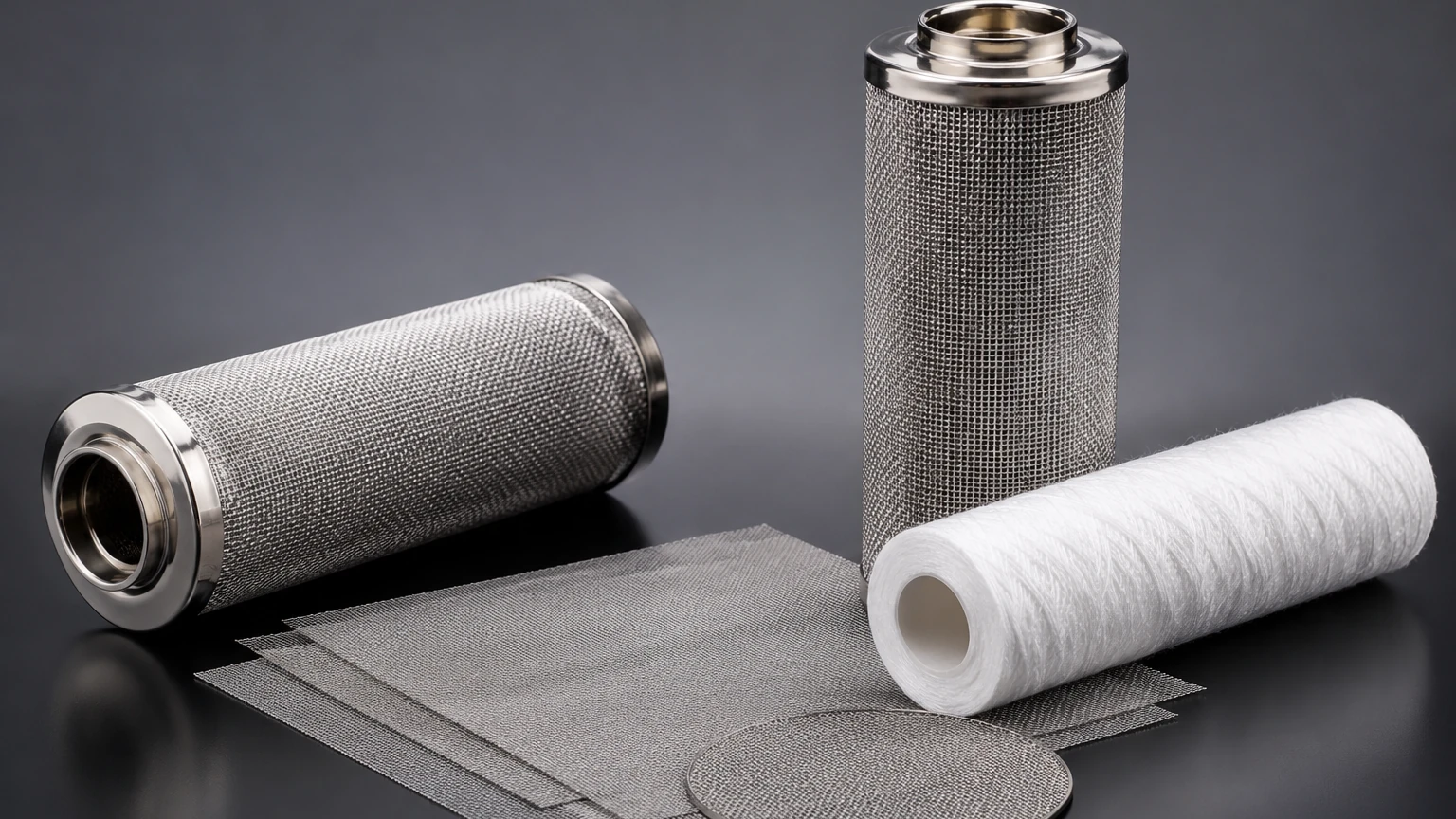
In demanding industrial environments, the choice of material for a filtro coalescente para agua is paramount. While synthetic materials are sometimes used in low-temperature, non-corrosive applications, stainless steel remains the industry standard for high-performance coalescing components. Manufacturers like Kaifil specialize in utilizing stainless steel wire mesh and sintered metal media for several technical reasons:
Chemical and Thermal Resistance
Industrial water often contains aggressive chemicals, high salinity, or extreme temperatures that would degrade polymer-based filters. Stainless steel (typically Grades 304 or 316L) provides the necessary corrosion resistance to maintain structural integrity over long service cycles.
Structural Rigidity
Coalescing requires stable pore structures. Under high differential pressure, synthetic media may compress or "channel," allowing contaminants to bypass the filtration zones. Stainless steel wire mesh maintains its geometry, ensuring consistent filtration accuracy and predictable flow patterns.
Cleanability and Reusability
Unlike disposable cartridges, stainless steel coalescing elements can often be cleaned and returned to service. Methods such as ultrasonic cleaning or chemical backwashing can remove accumulated solids that might otherwise blind the coalescing surface, significantly reducing the total cost of ownership (TCO).
Critical Selection Criteria for Engineers
When specifying a filtro coalescente para agua, engineers must evaluate several variables to ensure the system meets the required effluent quality. For detailed technical support and to review standard configurations, engineers can visit the Kaifil Main Page for comprehensive product data.
1. Fluid Velocity and Flux Rate
Coalescence is a residence-time-dependent process. If the fluid velocity is too high, the droplets will not have sufficient time to attach and merge. Conversely, an oversized system increases capital expenditure. Calculating the optimal flux rate (flow per unit area) is the most critical step in design.
2. Droplet Size Distribution
Knowing the size of the oil droplets in the influent water is essential. If the droplets are extremely small (sub-micron) or chemically emulsified (surfactant-stabilized), a standard coalescer may require pre-treatment, such as pH adjustment or the addition of demulsifiers, to be effective.
3. Density Difference
Coalescing relies on the density gap between the two liquids. The closer the density of the oil is to the density of the water, the larger the coalesced droplets must be to achieve separation. In cases where densities are nearly identical, the coalescer design must incorporate longer settling zones.
4. Particulate Loading
Coalescing filters are not intended to be primary particulate filters. If the water contains high levels of suspended solids, these solids will clog the coalescing media. A pre-filtration stage (such as a stainless steel wire mesh strainer) should always be installed upstream to protect the coalescing element.
Application-Specific Configurations
Different industries require different configurations for their coalescing systems. A filtro coalescente para agua used in a marine bilge water separator must meet different regulatory standards (such as IMO MEPC) than one used in a closed-loop hydraulic cooling system.
* Petrochemical Industry: Used for separating produced water and protecting downstream membranes or ion exchange resins.
* Food and Beverage: Used in wastewater treatment to recover fats, oils, and greases (FOG) before the water enters the biological treatment stage.
* Power Generation: Essential for removing turbine oil from condensate return lines to prevent boiler tube fouling.
Kaifil provides customized OEM solutions, allowing for the adjustment of mesh density, layer counts, and housing dimensions to meet these specific industrial demands. Customization ensures that the filter fits within existing spatial constraints while meeting the exact micron rating required for the process.
Maintenance and Total Cost of Ownership (TCO)
While the initial investment in a high-quality stainless steel filtro coalescente para agua may be higher than disposable alternatives, the long-term TCO is typically lower. Maintenance teams should monitor the following to ensure peak performance:
* Differential Pressure (DP): An increase in DP usually indicates particulate buildup rather than oil saturation. Regular monitoring prevents element collapse and ensures timely cleaning.
* Effluent Quality Monitoring: Regular sampling of the discharge water confirms that the coalescer is still achieving the target oil-in-water (OIW) concentration (often measured in ppm).
* Seal Integrity: In high-pressure systems, the gaskets and seals within the filter housing must be inspected during every maintenance cycle to prevent bypass.
Conclusion: Optimizing Water Separation Systems
The selection of a filtro coalescente para agua is a technical decision that impacts the reliability of an entire industrial process. By focusing on high-quality materials like stainless steel and adhering to rigorous engineering principles regarding flow velocity and droplet dynamics, facilities can achieve superior water purity and equipment protection.
For organizations looking to implement or upgrade their filtration infrastructure, working with a specialized manufacturer is vital. From initial material selection to the production of precision-engineered components, professional filtration solutions provide the durability and accuracy required for modern industrial water treatment. To explore the full range of custom stainless steel filtration components and engineering services, visit the Kaifil Main Page and consult with their technical team for application-specific guidance.
