


Sparging in Bioreactor
In the field of industrial biotechnology and pharmaceutical manufacturing, the efficiency of a bioprocess is often dictated by the precision of gas-liquid mass transfer. Sparging in bioreactor systems is the fundamental process of introducing gas—typically air, oxygen, nitrogen, or carbon dioxide—into the liquid culture medium. This process is critical for maintaining the physiological requirements of microorganisms or mammalian cells, ensuring optimal growth rates, and maximizing product yield.
For engineers and technical procurement teams, selecting the right sparging hardware is not merely a matter of air delivery; it is an exercise in fluid dynamics, material science, and sterile engineering. The choice of sparger directly influences the volumetric mass transfer coefficient ($k_La$), shear stress on sensitive cells, and the overall energy efficiency of the vessel. As a manufacturer specializing in precision stainless steel filtration and fluid components, Kaifil provides the technical foundation required to optimize these complex systems.
Fundamentals of Gas Exchange in Bioprocessing
The primary objective of sparging in bioreactor operations is to facilitate the transfer of oxygen from the gas phase to the liquid phase (Oxygen Transfer Rate, or OTR) and the removal of metabolic carbon dioxide. In aerobic fermentations, oxygen is often the limiting nutrient due to its low solubility in aqueous media.
The efficiency of this transfer is governed by the equation:
$$OTR = k_La (C^* – C_L)$$
Where:
- $k_La$ is the volumetric mass transfer coefficient.
- **$C^*$** is the saturated dissolved oxygen concentration.
- $C_L$ is the actual dissolved oxygen concentration in the broth.
To maximize OTR, engineers focus on increasing the interfacial area ($a$) between the gas and the liquid. This is achieved by producing smaller bubbles, which have a higher surface-area-to-volume ratio than larger bubbles. However, the design must balance high mass transfer with the physical constraints of the biological system, such as the shear sensitivity of the cells and the potential for foaming.
Engineering the Sparging Process: Key Parameters
When designing or specifying a system for sparging in bioreactor applications, several engineering parameters must be evaluated to ensure the hardware meets the process requirements.
Bubble Size and Distribution
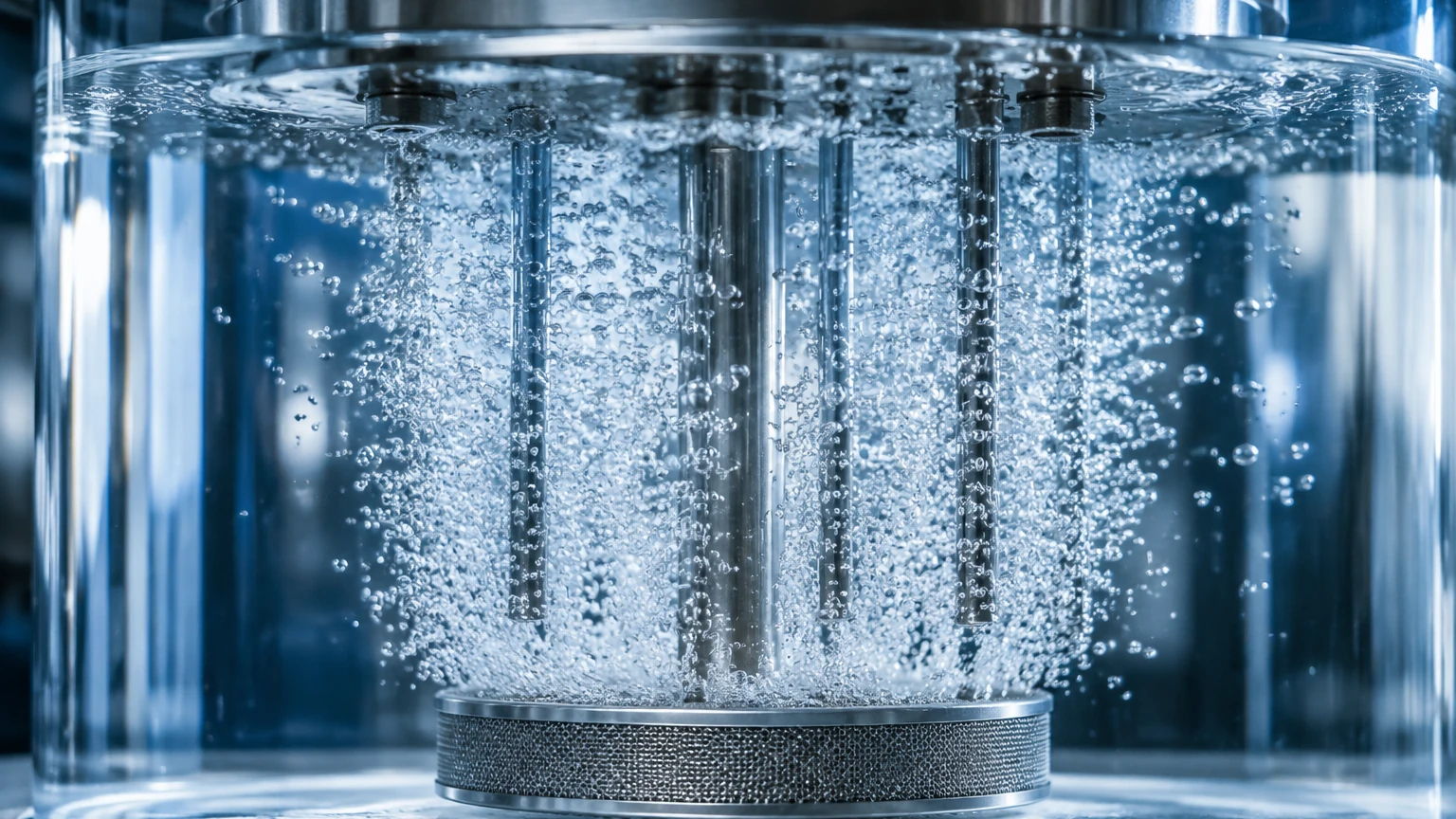
Bubble size is perhaps the most critical factor influenced by the sparger design. Porous spargers, often made from sintered stainless steel, produce micro-bubbles (typically in the range of 10 to 100 microns). These small bubbles rise slowly through the medium, increasing the residence time and the surface area available for gas exchange. Conversely, orifice spargers produce larger bubbles that rise quickly, which may be necessary for high-velocity gas stripping but are less efficient for oxygenation.
Superficial Gas Velocity
This is the ratio of the gas flow rate to the cross-sectional area of the bioreactor. High superficial velocities can lead to "flooding" of the impeller, where the gas displaces the liquid around the mixing blades, causing a drastic drop in mixing efficiency and $k_La$. Sparger placement and pore distribution are essential to prevent this phenomenon.
Pressure Drop
The resistance to flow across the sparger element—the pressure drop—must be carefully calculated. A sparger with pores that are too fine may require excessive upstream pressure, leading to potential leaks or inconsistent flow. Engineers must specify a sparger that provides the necessary bubble size while maintaining a manageable pressure profile across the operating range of gas flow rates.
Types of Spargers and Their Applications
The selection of sparger type depends heavily on the specific cell line and the scale of production. For detailed technical specifications on various filtration and gas distribution components, engineers can refer to the Main Page for a comprehensive overview of industrial solutions.
Sintered Metal Spargers (Micro-spargers)
Sintered stainless steel spargers are the industry standard for high-performance bioreactors. These components are manufactured by fusing metal powders or wire meshes under heat and pressure, creating a rigid, porous structure.
- Advantages: They produce extremely fine bubbles, significantly boosting $k_La$. They are highly durable and can withstand repeated sterilization cycles.
- Applications: Ideal for high-density microbial fermentations and shear-sensitive mammalian cell cultures where high oxygen demand must be met without aggressive agitation.
Orifice and Ring Spargers
These consist of a pipe or ring with precisely drilled holes. While they are easier to clean and have a lower pressure drop, the bubbles produced are significantly larger.
- Advantages: Low risk of clogging and easy to validate for cleanliness.
- Applications: Often used in large-scale waste treatment or in processes where gas stripping (e.g., CO2 removal) is more critical than oxygen mass transfer.
Frit Spargers
Similar to sintered spargers but often smaller in scale, these are frequently used in laboratory-scale glass bioreactors. They provide excellent gas dispersion for small volumes but may face challenges in scaling due to the fragility of some frit materials compared to industrial-grade stainless steel.
Material Selection and Durability in Bioreactor Environments
In biopharmaceutical manufacturing, material integrity is non-negotiable. Sparging components are in constant contact with the culture medium and must withstand rigorous cleaning and sterilization protocols.
Stainless Steel 316L
Kaifil utilizes 316L stainless steel as the primary material for sparging elements. The "L" denotes low carbon content, which minimizes carbide precipitation during welding and enhances corrosion resistance. This material is biocompatible, non-leaching, and resistant to the organic acids and salts commonly found in fermentation broths.
Surface Finish and Cleanability
The surface roughness (Ra) of the sparger and its housing is a critical factor in preventing biofouling. A high-quality surface finish (typically Ra < 0.4 µm) ensures that proteins and cellular debris do not adhere to the metal, facilitating effective Clean-in-Place (CIP) and Steam-in-Place (SIP) operations. Porous sintered materials require specialized cleaning protocols, such as ultrasonic baths or chemical back-flushing, to ensure all interstitial spaces are free of contaminants.
Optimizing the Volumetric Mass Transfer Coefficient (kLa)
Achieving a high $k_La$ is the goal of any aeration strategy. While the sparger creates the initial bubbles, the bioreactor's agitation system (impellers) plays a secondary role in breaking those bubbles down further and distributing them throughout the vessel.
The Synergy Between Sparging and Agitation
In a well-engineered system, the sparger is located directly beneath the bottom impeller. As the gas enters, the impeller's shear forces break the bubbles into a finer dispersion. If the sparger produces bubbles that are already small (micro-sparging), the reliance on high-speed agitation—which can cause mechanical damage to cells—is reduced. This is particularly important in the production of monoclonal antibodies or vaccines using mammalian cells, which lack a rigid cell wall.
Gas Hold-up
Gas hold-up refers to the volume fraction of the gas phase in the gas-liquid mixture. A well-designed sparger increases gas hold-up by producing bubbles that rise slowly. This increases the contact time between the gas and the nutrients, allowing more oxygen to dissolve before the bubble reaches the surface and escapes into the headspace.
Maintenance, Sterilization, and Operational Longevity
Industrial spargers are significant investments that must perform reliably over hundreds of batches. Failure to maintain these components can lead to batch contamination or reduced yields due to oxygen limitation.
1. Sterilization (SIP): Stainless steel spargers are designed to withstand saturated steam at temperatures of 121°C to 135°C. The structural integrity of sintered metal ensures that the pore size distribution remains constant even after repeated thermal cycling.
2. Preventing Clogging: Media components like antifoaming agents, concentrated salts, and cellular biomass can gradually block the pores of a micro-sparger. Implementing a regular maintenance schedule involving back-pulsing with clean water or mild caustic solutions is essential.
3. Integrity Testing: For critical processes, engineers should perform pressure-hold tests or bubble-point tests to ensure the sparger has not developed leaks or suffered structural damage that would compromise bubble uniformity.
Custom Filtration and Sparging Solutions for OEM
Every bioreactor design has unique requirements based on vessel geometry, aspect ratio, and the specific metabolic needs of the culture. Standard off-the-shelf spargers may not provide the optimized performance required for high-value biological products.
Kaifil specializes in the custom engineering of stainless steel filtration and sparging components. By adjusting the powder grain size in sintered elements or the weave pattern in wire mesh filters, we can fine-tune the pore size and permeability to match specific $k_La$ targets. Our manufacturing process ensures that every component meets the stringent tolerances required for pharmaceutical and food-grade applications.
When evaluating a partner for sparging hardware, engineers should confirm:
- Material Certifications: Full traceability for 316L stainless steel.
- Pore Size Validation: Documented bubble point testing to ensure uniform gas distribution.
- Custom Geometry: The ability to manufacture spargers in various shapes (rings, pipes, or discs) to fit specific vessel configurations.
Conclusion
Effective sparging in bioreactor systems is a cornerstone of successful bioprocessing. By understanding the relationship between bubble dynamics, mass transfer coefficients, and material science, engineers can design systems that maximize productivity while protecting the biological integrity of the culture. Sintered stainless steel spargers offer the precision and durability necessary for modern industrial applications, providing a reliable path to high-density growth and efficient gas management.
For technical professionals looking to optimize their filtration or aeration systems, reviewing advanced product options and application support on the Main Page is the first step toward achieving superior process control. Whether you are scaling up a pilot plant or retrofitting an existing production line, the right sparging solution is essential for long-term operational success.
