


Filts
In the landscape of modern industrial processing, the term "filts"—a common industry shorthand for high-performance filtration components—represents a critical intersection of material science and mechanical engineering. For technical professionals and procurement teams in the chemical, pharmaceutical, and food and beverage sectors, selecting the right filtration media is not merely a maintenance decision but a strategic investment in process integrity and equipment longevity. Industrial filts manufactured from stainless steel and specialized alloys provide the durability and precision required to handle aggressive fluids, high temperatures, and stringent purity standards.
As a professional manufacturer specializing in custom stainless steel filtration solutions, Kaifil provides the technical expertise and manufacturing precision necessary to develop reliable components for demanding industrial environments. Understanding the engineering nuances of these components is essential for optimizing system performance. To explore comprehensive product specifications and application support, engineers can visit the Main Page of our technical resource center.
Understanding the Engineering Principles of Industrial Filts
Industrial filtration is governed by the physics of fluid dynamics and particle retention. When designing or selecting filts, engineers must account for the interaction between the process fluid and the filter media. The primary objective is to achieve a specific level of cleanliness while minimizing the impact on system pressure and flow rates.
Porosity and Permeability
Porosity refers to the volume of open space within the filter media, while permeability measures the ability of the media to allow fluid to pass through it. High-quality stainless steel filts are engineered to balance these two factors. A higher porosity often leads to a lower initial pressure drop, which reduces the energy requirements of the pumping system. However, the structure must remain robust enough to withstand the mechanical stresses of the flow without deforming.
Particle Capture Mechanisms
Filtration in industrial systems occurs through several mechanisms:
1. Inertial Impaction: Larger particles, unable to follow the fluid streamlines, strike the filter fibers and are captured.
2. Interception: Particles following a streamline come within one particle radius of a fiber and adhere to it.
3. Diffusion: Very small particles (sub-micron) move erratically due to Brownian motion, increasing their likelihood of contacting the filter media.
4. Sieving: Particles larger than the pore size are physically blocked from passing through.
By selecting the appropriate mesh weave or sintered structure, engineers can target specific particle sizes based on these mechanical behaviors.
Material Selection for Specialized Filtration Applications
The performance of industrial filts is heavily dependent on the metallurgy of the media. While many materials are available, stainless steel remains the industry standard due to its mechanical strength and chemical resistance.
Stainless Steel 304 vs. 316L
* Type 304: This is the most common grade used for general industrial applications. It offers excellent strength and good corrosion resistance in mildly corrosive environments. It is frequently used in food processing and water treatment where high-grade chemical resistance is not the primary concern.
* Type 316L: The "L" stands for low carbon, which improves weldability and reduces the risk of intergranular corrosion. 316L contains molybdenum, providing significantly better resistance to chlorides and acids. This makes it the preferred choice for pharmaceutical and chemical processing filts where the media is exposed to aggressive cleaning agents or corrosive process fluids.
High-Temperature Capabilities
Unlike polymer-based filters, metal filts can operate in extreme thermal environments. Stainless steel components maintain their structural integrity at temperatures exceeding 400°C (752°F), and specialized alloys can extend this range even further. This thermal stability is crucial for steam filtration, hot gas processing, and high-temperature hydraulic systems.
Structural Configurations of Stainless Steel Filter Components
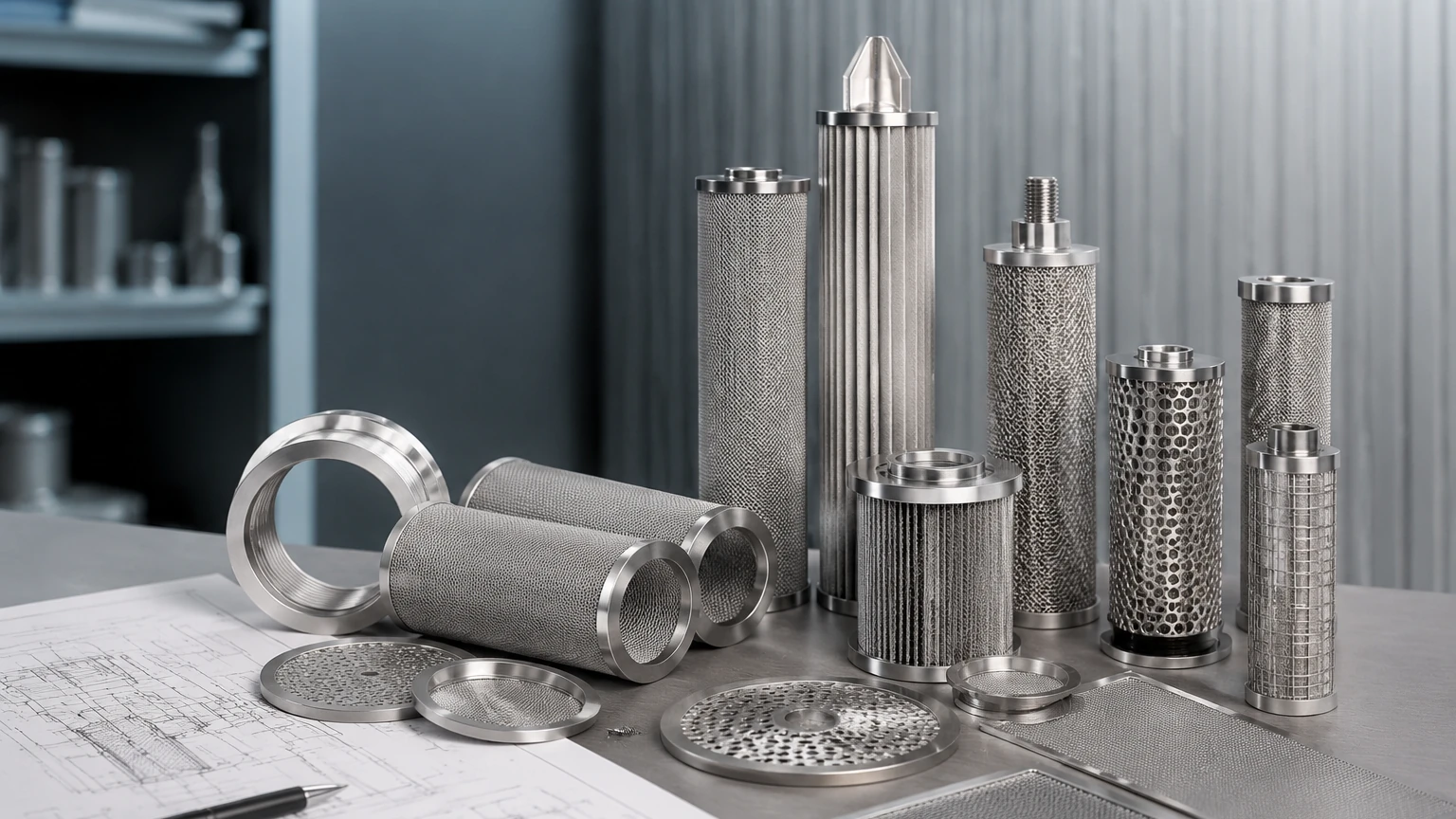
The physical architecture of a filter determines its capacity, cleanability, and pressure tolerance. Industrial filts are typically manufactured in three primary configurations:
Wire Mesh Filters
Precision-woven wire mesh provides a predictable and consistent pore size. These are often used for surface filtration, where particles are captured on the upstream side of the mesh. Common weaves include plain weave, twilled weave, and Dutch weave, each offering different levels of flow capacity and mechanical strength. Wire mesh filts are highly cleanable and are often used in applications requiring frequent reuse.
Sintered Metal Media
Sintering involves bonding multiple layers of wire mesh or metal fibers together using heat and pressure without melting the material. This process creates a porous, monolithic structure with exceptional mechanical strength. Sintered filts are ideal for high-pressure applications and deep filtration, where a tortuous path is required to capture fine contaminants. They are virtually immune to media migration, ensuring that no part of the filter itself enters the process stream.
Pleated Filter Cartridges
Pleating the filter media significantly increases the available surface area within a standard cartridge footprint. This design choice reduces the flux (flow per unit area), which in turn lowers the pressure drop and extends the service life of the filter between cleaning cycles. Pleated stainless steel filts are widely used in high-flow hydraulic systems and liquid processing lines.
Performance Evaluation: Micron Ratings and Flow Dynamics
When specifying filts, engineers must distinguish between different performance metrics to ensure the component meets the system's requirements.
Absolute vs. Nominal Micron Ratings
* Nominal Rating: This is an arbitrary value indicating the ability of the filter to retain a percentage of particles of a specific size (e.g., 90% of 10-micron particles). It is often used for general-purpose filtration.
* Absolute Rating: This represents the diameter of the largest hard spherical particle that will pass through the filter under specified test conditions. For critical pharmaceutical or chemical processes, an absolute rating is necessary to ensure the complete removal of hazardous or contaminating particles.
Pressure Drop and Dirty Life
The "clean pressure drop" is the resistance the filter offers when it is first installed. As the filter captures contaminants, the pressure drop increases. The "terminal pressure drop" is the point at which the filter must be cleaned or replaced to prevent damage to the system or a bypass of the filter media. Properly engineered filts are designed with a large enough surface area to maximize the time between these two points.
Customization and OEM Integration in Industrial Systems
Standard off-the-shelf filtration products often fail to meet the specific spatial or performance constraints of specialized industrial machinery. This is where custom OEM (Original Equipment Manufacturer) solutions become vital.
Customization allows for the optimization of:
* End Cap Fittings: Ensuring a leak-proof seal with existing housing via threaded, flanged, or O-ring connections.
* Reinforcement Structures: Adding internal cores or external cages to withstand high differential pressures or hydraulic surges.
* Specific Alloy Selection: Utilizing Hastelloy, Monel, or Inconel for environments where standard stainless steel would fail due to extreme acidity or temperature.
Kaifil works closely with engineering teams to develop these tailored solutions, ensuring that the filtration component is an integrated part of the equipment's design rather than an afterthought.
Maintenance, Cleaning, and Life Cycle Management
One of the primary advantages of stainless steel filts is their ability to be cleaned and reused, which significantly reduces the total cost of ownership compared to disposable alternatives. However, the cleaning process must be handled with precision to avoid damaging the media.
Cleaning Methodologies
1. Backwashing: Reversing the flow of fluid through the filter to dislodge surface-captured particles. This is often automated in continuous process systems.
2. Ultrasonic Cleaning: Using high-frequency sound waves in a cleaning solvent to create cavitation bubbles that remove deeply embedded contaminants from sintered or complex mesh structures.
3. Chemical Cleaning: Utilizing acids, alkalis, or surfactants to dissolve organic or mineral deposits. It is critical to ensure the cleaning chemistry is compatible with the filter's metallurgy.
4. Burn-off/Pyrolysis: Heating the filter in a controlled environment to carbonize and remove organic polymers or resins.
Determining Replacement Cycles
While metal filts are durable, they are not infinite. Repeated cleaning cycles and mechanical stress can eventually lead to fatigue or permanent blinding (where pores are irreversibly clogged). Engineers should monitor the pressure recovery after each cleaning; if the "clean" pressure drop begins to rise steadily over time, it indicates that the media is reaching the end of its functional life.
Conclusion: Strategic Selection for Long-Term Efficiency
The selection of industrial filts is a technical decision that impacts the entire production chain. By focusing on material integrity, precise micron ratings, and structural suitability, organizations can prevent costly downtime and protect sensitive downstream equipment. Whether the application involves the delicate filtration of pharmaceutical ingredients or the high-volume processing of industrial chemicals, the quality of the filtration component determines the success of the operation.
Kaifil remains committed to providing the global industrial market with high-performance, customized stainless steel filtration solutions. By combining manufacturing expertise with a deep understanding of fluid dynamics, we help engineers achieve the balance of durability and precision required for modern manufacturing. For more information on our capabilities and to view our full range of filtration components, please visit our Main Page.
