


Fluidized Bed Bioreactor
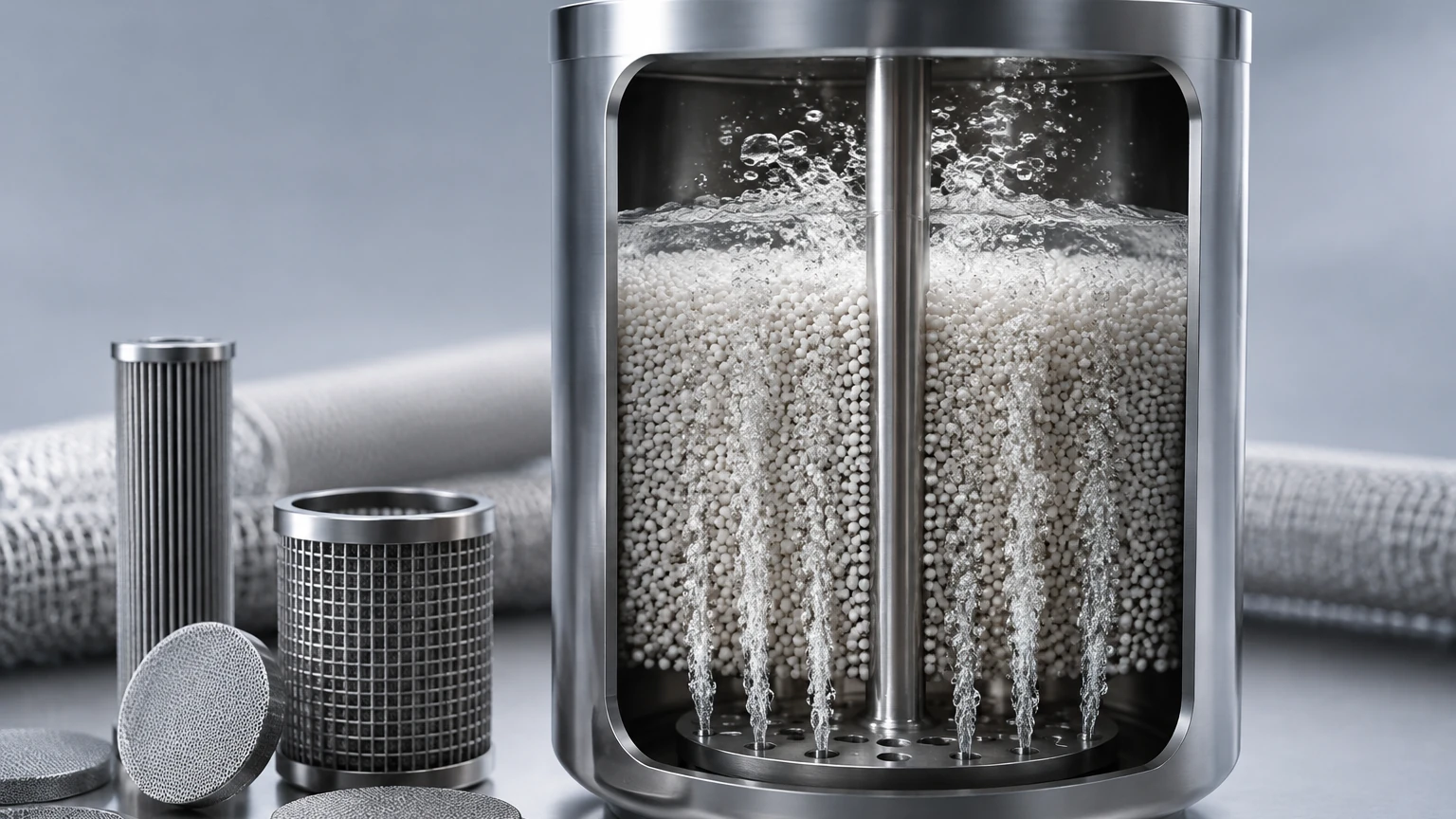
In the landscape of industrial bioprocessing and wastewater treatment, the fluidized bed bioreactor (FBBR) represents a sophisticated engineering solution designed to maximize efficiency through enhanced mass transfer and high biomass concentrations. Unlike traditional fixed-bed reactors, an FBBR utilizes a fluid—typically a liquid or gas—passed through a granular solid material at high enough velocities to suspend the solid and cause it to behave as though it were a fluid.
For engineers and technical procurement teams, understanding the mechanical and filtration requirements of these systems is essential. The performance of a fluidized bed bioreactor is heavily dependent on the precision of its internal components, particularly the filtration and distribution media that manage flow and retain biological carriers. As a manufacturer of specialized stainless steel filtration solutions, Kaifil provides the technical components necessary to ensure these reactors operate within their designed parameters.
Understanding Fluidized Bed Bioreactors in Industrial Processing
The fundamental principle of a fluidized bed bioreactor is the suspension of solid particles, often referred to as "carriers" or "media," within an upward-flowing stream of fluid. These carriers provide a large surface area for the growth of microorganisms (biofilm). By fluidizing the bed, the system achieves several technical advantages over static systems.
First, fluidization eliminates the risk of clogging and channeling, which are common failure points in fixed-film reactors. Second, the constant movement of the particles ensures a high rate of oxygen and nutrient transfer to the biofilm, which is critical for high-rate biological processes. This makes the FBBR an ideal choice for demanding applications such as aerobic and anaerobic wastewater treatment, fermentation, and specialized chemical synthesis.
From an engineering perspective, the transition from a fixed bed to a fluidized state occurs at the "minimum fluidization velocity." Maintaining this state requires precise control over flow rates and pressure distribution. If the flow is uneven, the bed may experience "slugging" or "bubbling," which reduces the effective contact time and can lead to mechanical wear on the reactor vessel and the media itself.
The Critical Role of Filtration Components in FBBR Design
While the biological process is the heart of the reactor, the mechanical integrity of the system relies on high-performance filtration components. There are two primary areas where precision metal filtration is indispensable in a fluidized bed bioreactor: the distributor plate at the base and the media retention screens at the outlet.
Distributor Plates
The distributor plate is located at the bottom of the reactor. Its primary function is to distribute the incoming fluid evenly across the entire cross-section of the bed. If the distribution is non-uniform, the fluid will take the path of least resistance, leading to "dead zones" where the media remains stationary and zones of excessive velocity where media may be carried out of the reactor.
Kaifil’s custom stainless steel wire mesh and sintered metal plates are frequently specified for this role. These components provide the necessary pressure drop to ensure uniform flow while maintaining the structural strength to support the weight of the media bed during shutdown periods.
Media Retention Screens
At the top of the reactor, or at the effluent discharge point, retention screens are required to prevent the biofilm carriers from escaping the system. These screens must have a pore size smaller than the smallest media particle but must also offer a high open area to minimize pressure drop and prevent the buildup of excess biomass (biofouling).
Material Selection and Engineering for Harsh Environments
Selecting the correct material for FBBR internals is a decision driven by the chemical composition of the process fluid and the mechanical stresses of fluidization. In most industrial applications, stainless steel—specifically grades 304, 316, and 316L—is the standard due to its balance of corrosion resistance and mechanical durability.
Corrosion Resistance
In wastewater treatment or chemical processing, the fluid may contain chlorides, acids, or volatile organic compounds. 316L stainless steel, with its addition of molybdenum, offers superior resistance to pitting and crevice corrosion. This is particularly important for the fine wires used in mesh filters, where even minor corrosion can lead to a loss of structural integrity and a change in filtration accuracy.
Mechanical Strength and Fatigue
The constant motion of particles in a fluidized bed bioreactor creates an abrasive environment. The filtration components must withstand continuous impingement from the media. Sintered wire mesh is often preferred for these applications because the sintering process thermally bonds the wire contact points, creating a robust, multi-layer structure that does not shift or unweave under mechanical stress.
Temperature Stability
Certain bioreactors operate at elevated temperatures to facilitate specific microbial activities or chemical reactions. Unlike polymer-based filters, stainless steel components maintain their dimensional stability and filtration precision across a wide temperature range, ensuring consistent performance throughout the reactor's lifecycle.
Optimizing Fluidization Through Precision Wire Mesh
The efficiency of a fluidized bed bioreactor is directly linked to the permeability and pore geometry of the filtration media. Engineers must calculate the required pressure drop across the distributor plate to ensure that it is significantly higher than the pressure drop across the bed itself. This ratio is what guarantees uniform fluidization.
Kaifil provides technical support in selecting the appropriate mesh weave for these calculations. Common options include:
* Plain Weave Mesh: Offers high open area and is suitable for applications with lower mechanical stress.
* Twilled Weave Mesh: Allows for a heavier wire diameter in a given mesh count, increasing durability.
* Dutch Weave Mesh: Provides superior filtration accuracy and strength, making it ideal for high-pressure retention screens.
By customizing the wire diameter and weave pattern, manufacturers can fine-tune the flow characteristics of the reactor. This level of customization is essential for OEM applications where the bioreactor is designed for a specific throughput or a unique type of biofilm carrier.
Operational Challenges and Maintenance Strategies
One of the most significant challenges in operating a fluidized bed bioreactor is biofouling. Because the system is designed to promote biological growth, the filtration screens and distributor plates are also susceptible to the accumulation of biomass. If left unmanaged, this leads to increased pressure drop, reduced flow rates, and eventually, system failure.
Cleaning and Maintenance
Stainless steel filters are preferred in FBBRs because they support various aggressive cleaning protocols. These include:
1. Backwashing: Reversing the flow of fluid to dislodge accumulated solids from the surface of the mesh.
2. Chemical Cleaning (CIP): Using acids, bases, or specialized surfactants to dissolve biological films without damaging the filter material.
3. Ultrasonic Cleaning: For removable components, ultrasonic baths can remove deeply embedded particles that backwashing cannot reach.
Replacement Cycles
While stainless steel components are durable, they are not infinite. Regular inspection of the distributor plate for signs of erosion or uneven wear is necessary. For purchasing teams, considering the total cost of ownership involves balancing the initial investment in high-quality sintered mesh against the reduced frequency of replacement and the prevention of costly unscheduled downtime.
Selecting a Filtration Partner for Custom FBBR Solutions
Designing and maintaining a fluidized bed bioreactor requires a partnership with a manufacturer that understands the nuances of industrial filtration. It is not enough to simply provide a mesh; the component must be engineered to fit the specific housing, withstand the operational pressures, and provide the exact filtration rating required by the process.
When evaluating a supplier, engineers should confirm:
* Customization Capabilities: Can the supplier produce non-standard dimensions and specialized mesh laminates?
* Material Certification: Is there documented proof of the stainless steel grade and purity?
* Technical Expertise: Does the manufacturer understand the relationship between pore size, flow rate, and pressure drop in a fluidized environment?
Kaifil specializes in these custom requirements, providing the precision metal components that allow complex systems like the fluidized bed bioreactor to function reliably. To explore the full range of stainless steel cartridges, wire mesh, and custom filtration elements available for industrial applications, visit our Main Page to review product options and application support.
Conclusion
The fluidized bed bioreactor is a powerful tool for high-rate biological processing, but its success is built on the foundation of precise mechanical engineering. From the distribution of fluid at the base to the retention of media at the outlet, every component must be designed to withstand the unique demands of a fluidized environment. By prioritizing high-quality stainless steel filtration and working with experienced manufacturers, industrial operators can ensure their FBBR systems deliver consistent, efficient, and long-term performance in even the most demanding applications.
