


Frit Disk
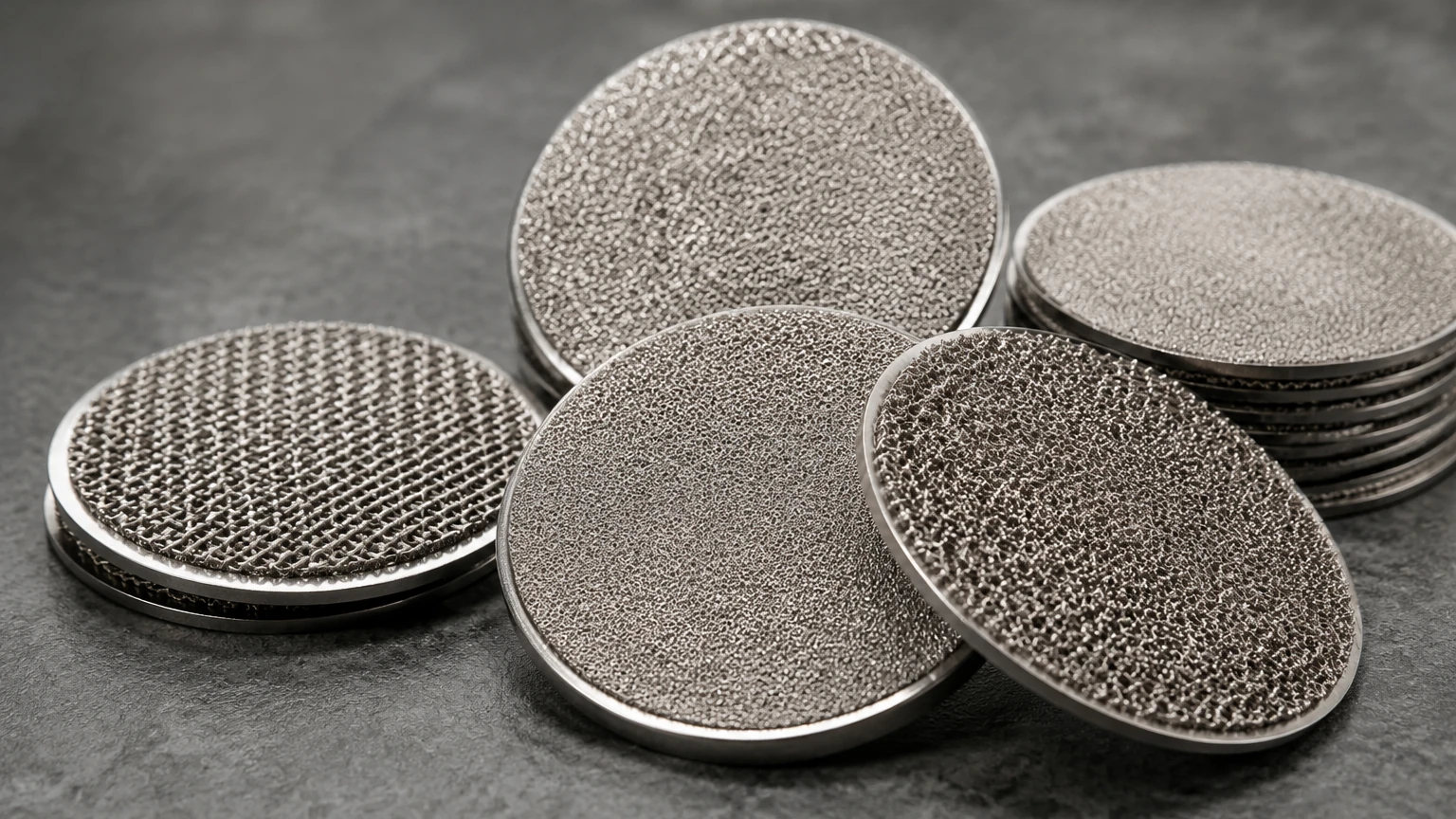
In the field of industrial filtration and fluid control, the frit disk serves as a critical component for achieving precise separation, gas diffusion, and flow regulation. Often manufactured from sintered metal powders or multi-layered wire mesh, these porous structures are designed to withstand extreme environments where polymer-based filters would fail. For engineers and procurement specialists, understanding the technical nuances of frit disk design—from pore geometry to mechanical integrity—is essential for optimizing system performance and ensuring long-term reliability.
As a specialized manufacturer, Kaifil provides custom stainless steel filtration solutions that address the rigorous demands of chemical processing, pharmaceuticals, and hydraulic systems. This guide examines the engineering principles, material considerations, and application-specific parameters that define the selection and implementation of industrial frit disks.
Engineering Principles of Sintered Metal Frit Disks
The performance of a frit disk is primarily determined by its internal structure, which is created through a process known as sintering. Sintering involves taking metal powder (typically 316L stainless steel) and subjecting it to high temperatures—below the melting point—within a controlled atmosphere. This causes the particles to bond at their contact points through atomic diffusion, creating a rigid, porous matrix.
Unlike woven wire mesh, which has a two-dimensional pore structure, a sintered frit disk features a three-dimensional "tortuous path." This path forces the fluid to change direction multiple times as it passes through the media, which significantly increases the probability of trapping particles smaller than the nominal pore size. The engineering advantage here is twofold: high filtration efficiency and exceptional structural strength. Because the particles are fused together, the disk maintains its shape and pore distribution even under high differential pressures or mechanical vibration.
Material Selection and Chemical Compatibility
Material choice is the first boundary in any filtration design. In most industrial B2B applications, stainless steel is the preferred medium due to its balance of cost, mechanical strength, and chemical resistance.
1. 316L Stainless Steel: This is the industry standard for the majority of frit disk applications. The "L" denotes low carbon content, which improves weldability and prevents sensitization—a common cause of corrosion in heat-affected zones. It offers excellent resistance to organic acids, many industrial chemicals, and high-temperature oxidation.
2. Specialty Alloys: For environments involving high concentrations of chlorides or highly aggressive acids, materials such as Inconel, Monel, or Hastelloy may be utilized. These alloys provide superior resistance to pitting and stress corrosion cracking.
3. Temperature Stability: One of the defining characteristics of a metal frit disk is its ability to operate at temperatures exceeding 450°C (842°F) in oxidizing environments, and even higher in reducing environments. This makes them indispensable for hot gas filtration and high-temperature chemical reactors.
Key Performance Indicators for Industrial Filtration
When specifying a frit disk for a project, engineers must evaluate several key performance indicators (KPIs) to ensure the component meets the application's requirements.
Micron Rating and Pore Size Distribution
The micron rating of a frit disk can be categorized as either "nominal" or "absolute." A nominal rating refers to the ability of the filter to retain a certain percentage of particles of a specific size, whereas an absolute rating indicates the size of the largest spherical particle that can pass through the media. In precision applications like chromatography or catalyst recovery, a narrow pore size distribution is critical to prevent "leaking" of fines or premature clogging.
Permeability and Pressure Drop
Permeability is a measure of how easily a fluid can flow through the porous medium. It is inversely proportional to the pressure drop (∆P). A well-designed frit disk maximizes surface area and porosity to allow for high flow rates while maintaining a low pressure drop. Engineers often use Darcy’s Law to calculate the expected flow characteristics based on fluid viscosity, disk thickness, and surface area.
Mechanical Integrity and Burst Strength
In hydraulic systems or high-pressure chemical synthesis, the frit disk must resist deformation. Sintered metal disks are characterized by high "burst strength," meaning they can withstand significant pressure differentials without rupturing. This is a primary reason why they are favored over ceramic or plastic alternatives in heavy industrial settings.
Application-Specific Design Considerations
The versatility of the frit disk allows it to be integrated into a wide range of specialized equipment. Each application requires a different set of design priorities.
Chromatography and Analytical Instrumentation
In HPLC (High-Performance Liquid Chromatography) and UHPLC systems, a frit disk is placed at the inlet and outlet of the column. Its role is to retain the packing material (stationary phase) while allowing the mobile phase to pass through. Here, the focus is on chemical inertness and minimal "dead volume" to prevent peak broadening and ensure accurate analytical results.
Gas Sparging and Carbonation
Frit disks are frequently used as spargers to introduce gases into liquids in the form of very fine bubbles. By controlling the pore size of the disk, engineers can optimize the gas-liquid contact area, which is vital for processes like fermentation, oxygenation in water treatment, and carbonation in the beverage industry.
Catalyst Recovery and Protection
In chemical reactors, expensive catalysts must be retained within the reaction zone. A stainless steel frit disk acts as a robust barrier, preventing catalyst loss while withstanding the aggressive chemical environment and high temperatures of the reaction. The durability of the metal frit ensures that it does not shed fibers or particles that could contaminate the final product.
Maintenance and Longevity in Demanding Environments
One of the significant total-cost-of-ownership (TCO) advantages of a stainless steel frit disk is its cleanability. Unlike disposable depth filters, metal frits can be regenerated through various cleaning protocols:
* Ultrasonic Cleaning: This is the most effective method for removing fine particulates lodged deep within the tortuous path. High-frequency sound waves create cavitation bubbles that dislodge contaminants.
* Chemical Cleaning: Depending on the nature of the foulant, disks can be soaked in solvents, caustic solutions, or acids to dissolve organic or inorganic deposits.
* Backpulsing/Backwashing: In automated industrial systems, a reverse flow of fluid or gas can be used to clear the surface of the frit disk during operation, extending the time between deep cleaning cycles.
Engineers should establish a replacement cycle based on the "terminal pressure drop"—the point at which the disk can no longer be effectively cleaned and the energy cost of pushing fluid through the filter becomes prohibitive.
Selecting a Manufacturing Partner for Custom Filtration
For B2B procurement, the choice of a manufacturer is as important as the technical specifications of the product. A manufacturer like Kaifil provides the engineering support necessary to translate system requirements into a finished component. When requesting a quote or technical consultation, it is helpful to provide the following data points:
1. Fluid Characteristics: Viscosity, density, and chemical composition.
2. Operating Conditions: Maximum temperature and operating pressure.
3. Filtration Goals: Required micron rating and allowable pressure drop.
4. Dimensional Constraints: Diameter, thickness, and any required housing or edge treatments (such as a solid metal ring for welding or sealing).
Customization is often the key to optimizing a filtration system. Whether it is a unique geometry for a specific housing or a specialized alloy for a corrosive process, working with a manufacturer that understands the physics of porous media ensures that the frit disk performs as intended.
For detailed technical specifications, CAD drawings, and a full overview of available stainless steel filtration products, engineers can visit the Main Page of the Kaifil website. Accessing the information on the Main Page allows technical teams to review product options and application support to ensure the selected filtration solution aligns with their specific industrial requirements.
Conclusion
The frit disk is a deceptively simple component that requires sophisticated engineering and manufacturing to function correctly in industrial environments. By selecting the appropriate material, pore structure, and mechanical design, engineers can achieve reliable filtration and flow control in even the most challenging conditions. From the initial design phase to long-term maintenance, focusing on the technical fundamentals of sintered metal media will result in higher process efficiency and reduced downtime. As industries continue to push the boundaries of temperature, pressure, and chemical purity, the role of the precision-engineered frit disk remains more vital than ever.
