


Gas Coalescing Filter
In industrial gas processing, the presence of liquid contaminants—whether in the form of fine aerosols, mists, or droplets—can lead to catastrophic equipment failure, catalyst poisoning, and compromised product purity. A gas coalescing filter is a high-precision engineering component designed specifically to address these challenges by separating liquid phases from a continuous gas stream. Unlike standard particulate filters that simply trap solid debris, coalescing technology utilizes a multi-stage physical process to merge sub-micron liquid particles into larger droplets that can be effectively drained away.
For engineers and procurement professionals, selecting the correct gas coalescing filter requires a deep understanding of fluid dynamics, material compatibility, and the specific thermodynamic conditions of the application. As a specialized manufacturer of stainless steel filtration solutions, Kaifil provides the technical expertise and custom manufacturing capabilities necessary to develop filtration components that withstand the rigors of high-pressure and corrosive industrial environments.
Understanding the Fundamentals of Gas Coalescing Filtration
The primary function of a gas coalescing filter is the removal of entrained liquids, such as water, oil, and hydrocarbon condensates, from a gas stream. These liquids often exist as aerosols—particles so small (often less than 0.3 microns) that they remain suspended in the gas flow due to Brownian motion and gas velocity.
Standard mechanical separators, such as vane packs or centrifugal scrubbers, are effective for removing large droplets (typically 10 microns and larger) but fail to capture the fine mists that cause the most damage to downstream equipment like turbines, compressors, and molecular sieves. The coalescing filter fills this gap by employing a specialized media structure that forces these microscopic droplets to collide and grow.
In most industrial configurations, the gas flow through a coalescing element is from the inside to the outside. As the gas passes through the depth of the filter media, the liquid particles are captured and merged. Once the droplets reach a sufficient size and mass, gravity overcomes the drag forces of the gas stream, causing the liquid to trickle down the outer surface of the element into a collection sump.
The Engineering Principles: How Coalescence Occurs
The efficiency of a gas coalescing filter is governed by three primary physical mechanisms that occur within the filter media: direct interception, inertial impaction, and Brownian diffusion.
Direct Interception
Direct interception occurs when a liquid particle follows a gas streamline but comes within one-half of its diameter of a filter fiber. The particle touches the fiber and is captured by surface tension. This mechanism is most effective for particles in the mid-range of the micron spectrum.
Inertial Impaction
For larger, heavier particles, the momentum of the particle prevents it from following the gas streamlines as they curve around the filter fibers. Instead, the particle continues on a straight path, impacting the fiber directly. Inertial impaction is highly dependent on gas velocity; if the velocity is too low, the particles will simply follow the streamlines and bypass the fibers.
Brownian Diffusion
Sub-micron particles (typically smaller than 0.1 microns) exhibit erratic, random motion caused by collisions with gas molecules. This random path increases the probability that a particle will eventually strike a filter fiber. Brownian diffusion is the dominant mechanism for capturing the smallest aerosols and is most effective at lower gas velocities, where the particles have more time to wander and contact the media.
By balancing these three mechanisms through precise media density and fiber diameter selection, manufacturers can achieve filtration efficiencies exceeding 99.9% for particles as small as 0.3 microns.
Material Engineering in Coalescing Filter Design
Material selection is the most critical factor in determining the longevity and reliability of a gas coalescing filter. While many commercial filters use borosilicate glass microfibers, demanding industrial applications—particularly those involving high temperatures, high pressures, or aggressive chemical environments—require the structural integrity of metal filtration media.
Stainless Steel Wire Mesh and Sintered Metal
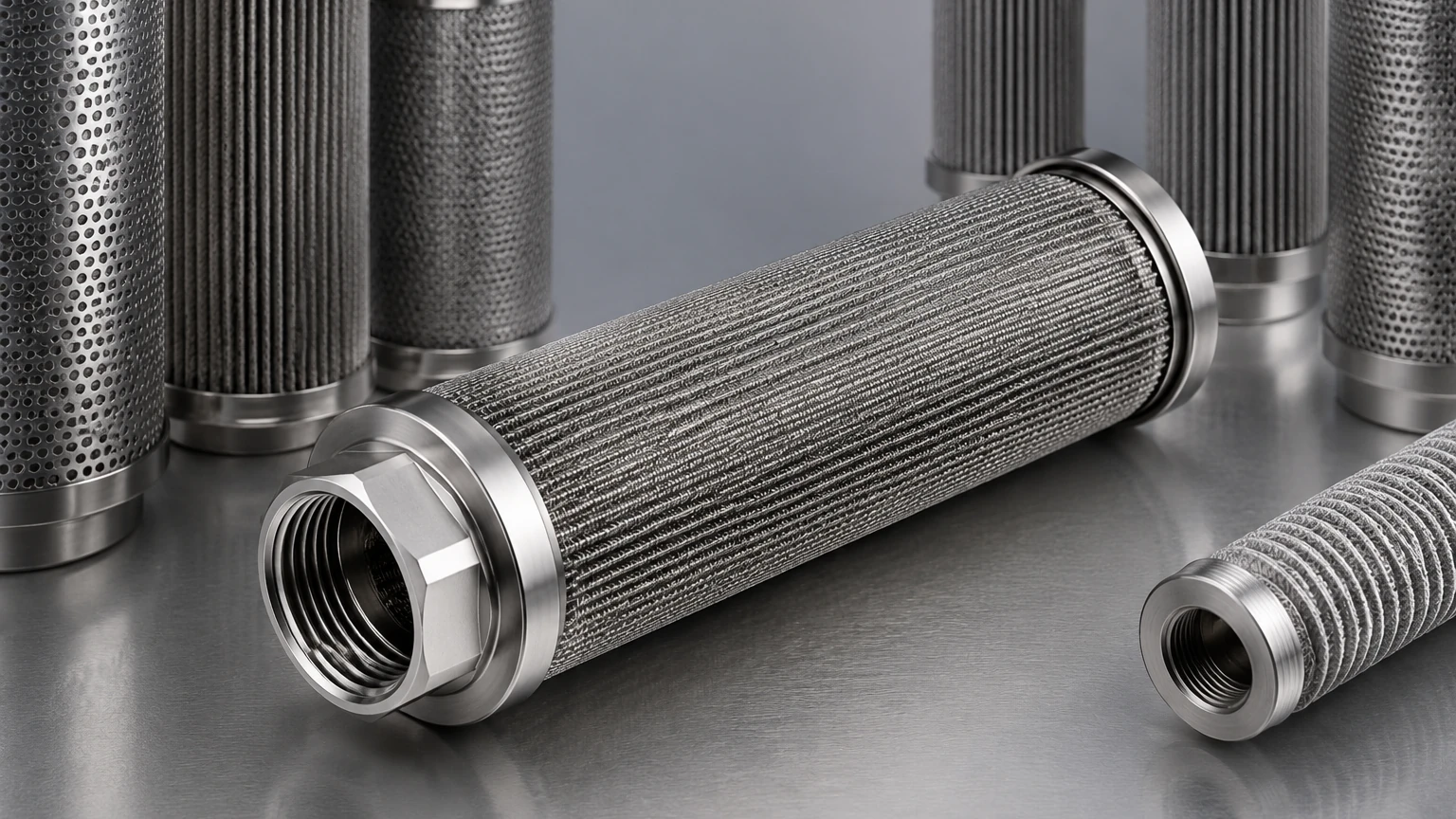
Kaifil specializes in the production of stainless steel filtration components using grades such as 304, 316L, and specialized alloys. Stainless steel wire mesh and sintered metal fibers offer several distinct advantages for coalescing applications:
* Thermal Stability: Unlike synthetic fibers, stainless steel can operate in extreme temperature ranges without losing structural integrity or off-gassing.
* Chemical Resistance: In chemical processing and oil and gas applications, the presence of H2S, CO2, or acidic condensates can degrade standard filter media. Stainless steel provides superior resistance to corrosion and chemical attack.
* Mechanical Strength: High-pressure gas streams can exert significant differential pressure on filter elements. Metal media can be pleated or reinforced to withstand high collapse pressures, ensuring the filter does not bypass or fail during pressure surges.
* Cleanability: In certain applications where solid particulate loading is also present, stainless steel elements can be cleaned and reused, reducing the total cost of ownership compared to disposable cartridges.
Critical Performance Metrics for Industrial Evaluation
When evaluating a gas coalescing filter for a specific project, engineers must look beyond simple micron ratings. Several technical metrics provide a clearer picture of how the filter will perform under real-world conditions.
Saturated Pressure Drop
As a coalescing filter operates, the media becomes saturated with liquid. This saturation increases the resistance to gas flow, resulting in a higher pressure drop (delta P) compared to a dry filter. It is essential to calculate the system's compressor or blower capacity based on the saturated pressure drop rather than the initial clean pressure drop to ensure consistent process flow.
Liquid Loading Capacity
The ability of a filter to handle high concentrations of liquid without "re-entrainment" is vital. Re-entrainment occurs when the gas velocity is so high that it strips liquid off the outer surface of the filter before it can drain into the sump. High-quality coalescing elements are designed with an outer drainage layer (often a coarse mesh or foam) to prevent this phenomenon.
Beta Ratio and Efficiency
The Beta ratio ($β$) provides a quantitative measure of filtration efficiency. For a gas coalescing filter, the efficiency is typically expressed as the percentage of liquid aerosols removed at a specific micron size (e.g., 99.97% at 0.3 μm). This is often verified using the DOP (Dioctyl Phthalate) test or similar aerosol challenge methods.
Selection Criteria for Technical Purchasing Teams
To ensure the optimal performance of a filtration system, purchasing teams and engineers should confirm the following parameters before finalizing a design:
1. Gas Composition and Density: The molecular weight and density of the gas affect the velocity and the drag forces acting on the liquid droplets. Natural gas, hydrogen, and compressed air all require different media configurations.
2. Operating Pressure and Temperature: High pressure increases gas density, which can impact the coalescing efficiency. Temperature affects the viscosity and surface tension of the liquid contaminants, influencing how easily they coalesce and drain.
3. Liquid Type and Concentration: Is the contaminant water, synthetic oil, or a complex hydrocarbon? The surface tension of the liquid dictates the "wettability" of the filter media. In some cases, oleophobic or hydrophobic coatings may be required to facilitate drainage.
4. Flow Rate (ACFM vs. SCFM): Filters must be sized based on Actual Cubic Feet per Minute (ACFM) at operating conditions, as this reflects the true velocity of the gas through the media.
Operational Risks and Maintenance Protocols
The most common cause of failure in a gas coalescing filter is not the liquid it is designed to remove, but solid particulate matter. If a gas stream contains high levels of dust, scale, or rust, these solids will lodge in the fine interstitial spaces of the coalescing media, leading to rapid pressure drop and premature blinding.
The Importance of Pre-filtration
To protect the high-efficiency coalescing element, a particulate pre-filter should be installed upstream. This pre-filter captures the bulk of solid debris, allowing the coalescer to focus solely on liquid separation. This dual-stage approach significantly extends the service life of the more expensive coalescing elements.
Monitoring and Replacement Cycles
Coalescing filters should be monitored using differential pressure gauges. A sudden drop in delta P may indicate a ruptured element or a bypass, while a steady increase beyond the recommended terminal pressure drop (typically 10-15 psi) indicates the need for replacement or cleaning. In critical applications, automated drain valves should be used on the filter housing to ensure that the collected liquid does not back up into the filter element.
Industrial Applications and Custom OEM Solutions
Gas coalescing technology is utilized across a broad spectrum of industries where gas purity is non-negotiable:
* Natural Gas Processing: Removing water and liquid hydrocarbons before the gas enters pipelines or liquefaction plants to prevent hydrate formation and corrosion.
* Chemical and Petrochemical: Protecting catalysts in reactor feed streams and recovering valuable solvents from vent gases.
* Power Generation: Ensuring dry, clean fuel gas for gas turbines to prevent nozzle fouling and blade erosion.
* Compressed Air Systems: Removing oil aerosols from lubricated compressors to provide high-quality air for pneumatic tools and food-grade packaging.
At Kaifil, we understand that standard off-the-shelf components are often insufficient for specialized industrial requirements. We provide comprehensive OEM and customized filtration solutions, working closely with engineering teams to develop stainless steel filter cartridges and precision metal components tailored to specific flow rates, housing dimensions, and environmental challenges.
Our commitment to quality and technical precision ensures that every filtration component we produce meets the rigorous demands of modern industrial processes. For detailed specifications on our manufacturing capabilities or to discuss a custom filtration project, please visit our Main Page to review product options and application support.
By integrating advanced material science with proven coalescing principles, Kaifil helps global industries achieve higher process efficiency, lower maintenance costs, and superior gas quality. Whether you are designing a new system or optimizing an existing process, selecting a high-performance gas coalescing filter is a critical step in ensuring long-term operational success.
