


Gas Filtration Equipment
Gas filtration equipment is a critical component in modern industrial processes, designed to remove particulate matter, aerosols, and contaminants from compressed air, process gases, and steam. Unlike liquid filtration, gas phase separation requires a deep understanding of fluid dynamics, gas compressibility, and the specific behavior of particles suspended in a gaseous medium. For engineers and procurement specialists, selecting the right filtration system is not merely about choosing a micron rating; it involves balancing pressure drop, thermal stability, chemical compatibility, and the total cost of ownership.
In demanding environments such as chemical processing, pharmaceutical manufacturing, and food production, the durability of the filter media is paramount. Stainless steel filtration solutions have emerged as the industry standard for high-performance gas applications due to their ability to withstand extreme temperatures and corrosive atmospheres while maintaining structural integrity. As a specialist in precision metal filtration, Kaifil provides the engineering expertise required to navigate these complex selection criteria.
Fundamental Principles of Gas Phase Filtration
To effectively specify gas filtration equipment, it is necessary to understand the three primary mechanisms by which particles are captured within a filter medium: inertial impaction, interception, and diffusion.
1. Inertial Impaction: This occurs when larger particles (typically those greater than 1 micron) possess enough momentum that they cannot follow the gas streamlines as they curve around the filter fibers. Instead, the particles continue on a straight path and collide with the fiber, where they are captured.
2. Interception: This mechanism applies to particles that follow the gas streamlines but pass close enough to a fiber that they come into contact with it. Interception is a dominant factor for mid-sized particles.
3. Diffusion (Brownian Motion): For very small particles (often sub-micron), the random motion caused by collisions with gas molecules causes the particles to deviate from the streamlines. This increased movement increases the probability that the particle will contact a filter fiber. Diffusion is most effective at lower gas velocities.
In industrial gas filtration, the goal is to optimize the filter structure—often through sintered metal or multi-layered wire mesh—to maximize these capture mechanisms while minimizing the resistance to flow, known as pressure drop.
Material Selection for Industrial Gas Filters
The choice of material for gas filtration equipment is dictated by the operating environment. While polymer-based filters are common in light-duty applications, industrial processes often involve conditions that would cause synthetic materials to fail. Stainless steel, specifically Grades 304 and 316L, is the preferred choice for several reasons.
Thermal Resistance
Many gas processes, such as steam filtration or exhaust gas treatment, operate at temperatures exceeding 200°C. Stainless steel filter cartridges can maintain their mechanical properties at temperatures up to 500°C or higher, depending on the specific alloy and structural design. This thermal stability prevents the media from softening or off-gassing, which could contaminate the process stream.
Chemical Compatibility
In chemical processing and petrochemical refining, gases may contain corrosive elements like hydrogen sulfide, chlorine, or acidic vapors. 316L stainless steel, with its molybdenum content, provides superior resistance to pitting and crevice corrosion. For even more aggressive environments, specialized alloys like Hastelloy or Inconel can be utilized in the same wire mesh or sintered formats.
Structural Integrity and High Pressure
Gas filtration often involves high differential pressures, especially during system start-up or when the filter becomes loaded with contaminants. Metal filter elements possess high collapse strength, ensuring that the filter does not rupture and bypass contaminants into the downstream equipment. This is particularly vital in protecting sensitive components like turbines, compressors, and high-precision sensors.
Engineering Considerations: Pressure Drop and Flow Rates
One of the most critical metrics in evaluating gas filtration equipment is the initial and terminal pressure drop (ΔP). In a gas system, a high pressure drop equates to higher energy consumption by the compressor or blower. Engineers must size the filtration system to ensure that the gas velocity through the media remains within the optimal range for the target micron rating.
When calculating the required surface area, it is important to consider the "face velocity"—the velocity of the gas as it approaches the filter surface. If the velocity is too high, it can lead to particle re-entrainment or premature clogging. To combat this, many high-performance gas filters utilize pleated designs. By pleating the stainless steel wire mesh or sintered fiber felt, the effective filtration area is significantly increased within the same housing footprint, allowing for higher flow rates at lower pressure drops.
To explore specific configurations and technical data for these systems, engineers can Review product options and application support on the Kaifil Main Page, which details the performance characteristics of various metal media types.
Types of Metal Media in Gas Filtration
There are several ways to construct the filtration layer within gas filtration equipment, each offering distinct advantages depending on the application.
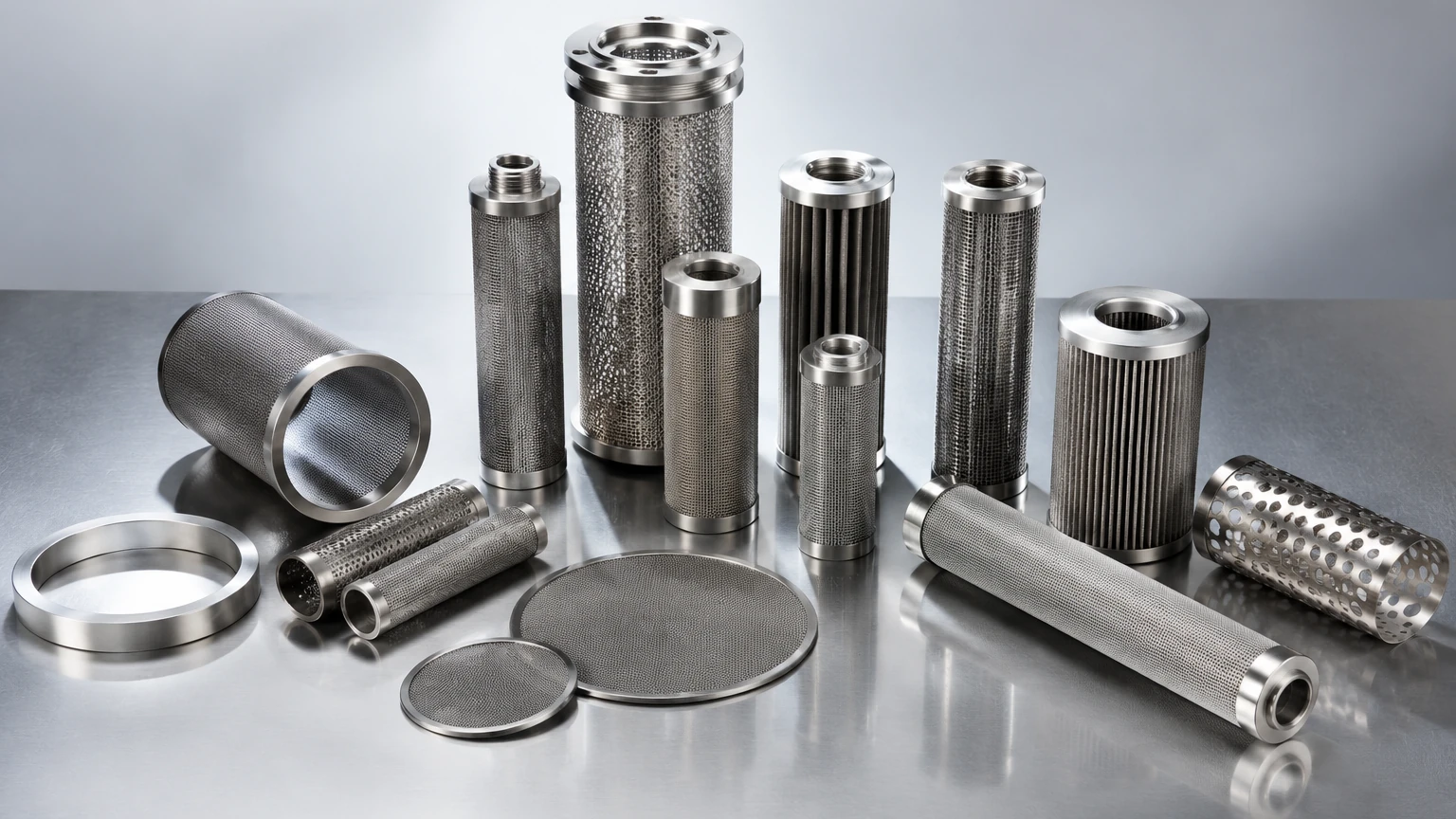
Sintered Metal Fiber Felt
Sintered fiber felt is produced by compressing and heat-treating non-woven stainless steel fibers. This creates a highly porous (up to 80% porosity) medium that offers exceptional dirt-holding capacity and low resistance to gas flow. It is particularly effective for high-efficiency gas filtration where sub-micron particles must be removed.
Sintered Wire Mesh
This media consists of multiple layers of woven wire mesh that are sintered together to form a monolithic structure. The layers are chosen to provide a specific filtration rating (the fine mesh) supported by coarser layers for mechanical strength. Sintered mesh is highly predictable in its pore size and is exceptionally easy to clean, making it ideal for process gas applications where the filter must be reused.
Wedge Wire and Perforated Metal
For coarse gas filtration or as a pre-filter to protect finer stages, wedge wire or perforated metal tubes are used. These are designed to remove large scale, rust, or debris from gas pipelines. Their robust construction allows them to withstand significant mechanical stress and high-velocity flows.
Applications Across Key Industrial Sectors
Gas filtration equipment is not a one-size-fits-all solution; the design must be tailored to the specific industry requirements.
Pharmaceutical and Biotechnology
In these sectors, gas filtration is often used for tank venting and the delivery of sterile air to fermenters. The filter must not only remove bacteria and viruses but also be capable of withstanding repeated In-Situ Steam (SIP) sterilization cycles. Stainless steel cartridges are preferred here because they do not shed fibers and can be validated for integrity over many sterilization cycles.
Food and Beverage
Culinary steam filtration is a major application. Steam used for direct injection into food products or for cleaning surfaces must be free of pipe scale and other particulates. Metal filters compliant with food-grade standards ensure that the steam meets the necessary purity levels without introducing plasticizers or other chemicals found in some synthetic filters.
Chemical and Petrochemical
Gas filtration in chemical plants often involves catalyst recovery. Valuable catalyst particles suspended in a gas stream can be captured using high-temperature sintered metal filters and then recovered through back-pulsing or back-washing. This not only protects the environment but also provides significant cost savings by recycling expensive materials.
Maintenance, Cleaning, and Lifecycle Management
A primary advantage of stainless steel gas filtration equipment is that it is cleanable and reusable. While polymer filters are typically disposed of once they reach their terminal pressure drop, metal filters can be restored to near-original performance levels through various cleaning methods:
* Back-pulsing: Using a high-pressure burst of gas in the reverse direction to dislodge accumulated dust cake.
* Ultrasonic Cleaning: Using high-frequency sound waves in a cleaning solvent to remove fine particles embedded deep within the media pores.
* Chemical Cleaning: Using acids, alkalis, or surfactants to dissolve organic or inorganic deposits that cannot be removed mechanically.
By implementing a proper cleaning regimen, the service life of a stainless steel filter can extend for several years, significantly reducing the total cost of ownership compared to frequent replacements of disposable elements. Engineers should establish a replacement cycle based on the physical condition of the media and the results of integrity testing rather than a fixed time interval.
Customization and OEM Solutions
Every industrial facility has unique piping configurations, flow requirements, and space constraints. Off-the-shelf filtration units often require expensive modifications to fit into existing systems. Working with a manufacturer like Kaifil allows for the development of customized gas filtration equipment. This includes custom end-cap configurations (such as 222, 226, or threaded connections), specialized housing designs, and optimized media layers tailored to the specific particle size distribution of the process gas.
When consulting with a manufacturer, technical teams should be prepared to provide data on gas composition, operating temperature, maximum flow rate, and the desired effluent purity. This collaborative approach ensures that the resulting filtration system is not only effective but also optimized for energy efficiency and long-term reliability.
In conclusion, gas filtration equipment is a sophisticated engineering necessity that protects process integrity and equipment longevity. By prioritizing high-quality materials like stainless steel and understanding the technical nuances of gas flow and particle capture, industrial operators can achieve superior filtration performance in even the most challenging environments.
