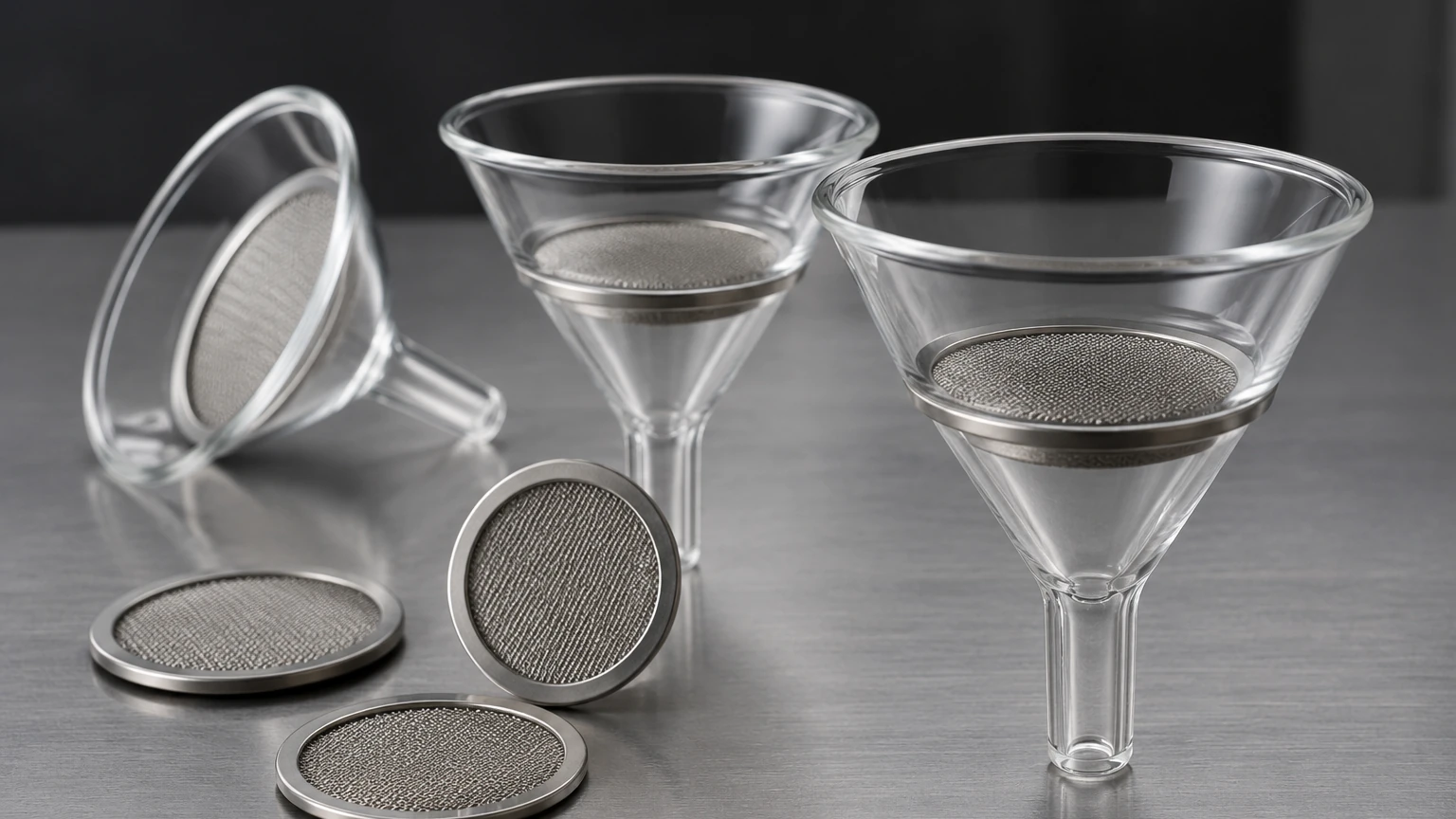
Glass Funnel Filter
In laboratory and small-scale industrial processing, the glass funnel filter is a fundamental component used for the separation of solids from liquids. Characterized by its chemical inertness and transparency, this tool allows engineers and technicians to observe the filtration process in real-time, ensuring that precipitates are collected efficiently and filtrates are clear of contaminants. However, as applications scale from the benchtop to the production floor, the technical requirements for filtration equipment become significantly more demanding. Understanding the mechanics, limitations, and selection criteria of glass filtration systems is essential for professionals in the chemical, pharmaceutical, and food and beverage industries.
The Mechanics of Glass Funnel Filtration
A glass funnel filter typically consists of a conical or cylindrical glass body with an integrated filtration medium. In most professional settings, this medium is a sintered glass disc (also known as a frit). Sintered glass is produced by heating glass powder until the particles bond together without melting into a solid mass, creating a porous structure that acts as a depth filter.
When a mixture is poured into the funnel, the liquid phase passes through the tortuous paths within the sintered disc, while solid particles are trapped on the surface or within the pores. This process is often accelerated using vacuum filtration (Büchner-style), where a vacuum pump reduces the pressure beneath the filter, creating a pressure differential that drives the liquid through the medium at a much higher rate than gravity alone would allow.
Material Science and Chemical Compatibility
The primary material used in a high-quality glass funnel filter is borosilicate glass 3.3. This material is favored in industrial and laboratory environments for several technical reasons:
1. Chemical Resistance: Borosilicate glass is highly resistant to water, neutral and acid solutions, concentrated acids and acid mixtures, as well as to chlorine, bromine, iodine, and organic substances. This makes it an ideal choice for filtering aggressive chemicals that might degrade plastics or certain low-grade metals.
2. Thermal Stability: It has a very low coefficient of linear expansion, which grants it excellent resistance to thermal shock. This is critical when filtering hot solutions or when the filter must be sterilized in an autoclave.
3. Hydrolytic Resistance: Unlike standard soda-lime glass, borosilicate glass does not leach significant amounts of alkali into the filtrate, preserving the purity of sensitive pharmaceutical or analytical samples.
Despite these advantages, engineers must remain aware of the limitations regarding hydrofluoric acid, concentrated phosphoric acid, and strong caustic solutions at elevated temperatures, all of which can etch or weaken the glass structure over time.
Understanding Porosity Grades
One of the most critical decisions in selecting a glass funnel filter is determining the appropriate porosity grade. Porosity refers to the maximum pore size of the sintered disc, which dictates the size of the particles that will be retained. In the international standard (ISO 4793), these are typically categorized as follows:
* P160 (Grade 0): Pore size 160–250 µm. Used for coarse filtration and gas dispersion.
* P100 (Grade 1): Pore size 100–160 µm. Suitable for coarse precipitates and large-scale filtration.
* P40 (Grade 2): Pore size 40–100 µm. Used for medium precipitates and preparative work.
* P16 (Grade 3): Pore size 16–40 µm. An industry standard for analytical filtration and fine precipitates.
* P10 (Grade 4): Pore size 10–16 µm. Used for very fine precipitates and analytical work requiring high retention.
* P1.6 (Grade 5): Pore size 1.0–1.6 µm. Often used for bacterial filtration or ultra-fine clarification.
Selecting a pore size that is too small for the application will result in excessively slow flow rates and premature clogging (blinding), while a pore size that is too large will allow solids to pass through into the filtrate. Engineers must balance retention efficiency with the required throughput.
Operational Limits and Safety Considerations
While the glass funnel filter is versatile, it is a brittle component subject to mechanical failure if mishandled. In a B2B industrial context, safety protocols must address the following risks:
* Pressure Differentials: Glass funnels are generally designed for vacuum use rather than positive pressure. Exceeding a pressure differential of 1 bar (14.5 psi) can lead to catastrophic failure of the glass. If an application requires high-pressure filtration, engineers should look toward stainless steel filter cartridges or reinforced metal housings available on the Main Page.
* Thermal Stress: Although borosilicate glass is heat-resistant, rapid temperature changes (e.g., placing a hot funnel on a cold stainless steel bench) can cause cracking. Gradual heating and cooling cycles are recommended.
* Mechanical Impact: Glass is susceptible to chipping, especially at the rim or the stem. Even minor chips can act as stress concentrators, leading to failure under vacuum.
Transitioning from Glass to Industrial Metal Filtration
In many industrial workflows, the glass funnel filter serves as the proof-of-concept tool during the R&D phase. However, as the process moves into pilot plants and full-scale production, the limitations of glass—fragility, limited surface area, and lack of pressure resistance—often necessitate a transition to stainless steel filtration solutions.
Stainless steel wire mesh filters and sintered metal components offer several advantages over glass in a production environment:
1. Durability: Metal filters can withstand high-pressure environments and mechanical shocks that would shatter glass.
2. Cleanability: Stainless steel components can be subjected to rigorous Clean-in-Place (CIP) and Steam-in-Place (SIP) cycles, including high-pressure backpulsing, which is not possible with sintered glass.
3. Customization: Industrial manufacturers like Kaifil can produce custom stainless steel filter cartridges with specific micron ratings and geometries that integrate directly into large-scale piping and vessel systems.
4. Flow Rates: Metal mesh provides a higher open area percentage compared to sintered glass frits of the same micron rating, allowing for higher flow rates and reduced processing times.
Maintenance and Cleaning Protocols
To maintain the performance of a glass funnel filter, a strict cleaning regimen is required. Unlike disposable paper filters, the sintered disc is a permanent part of the funnel. Over time, fine particles can become trapped within the depth of the frit.
* Initial Rinse: Immediately after use, the filter should be rinsed with a solvent that can dissolve the filtrate.
* Chemical Cleaning: For organic residues, a mixture of concentrated sulfuric acid and an oxidizing agent (like potassium nitrate) may be used, though this requires extreme caution. For proteinaceous matter, enzymatic cleaners or dilute hydrochloric acid are often effective.
* Ultrasonic Cleaning: Placing the funnel in an ultrasonic bath can help dislodge trapped particles from the pores of the sintered disc. However, excessive power or duration can potentially weaken the glass-to-frit bond.
* Drying: Funnels should be dried in a dust-free environment. If using an oven, temperatures should be increased and decreased gradually.
Engineering Selection Checklist
Before purchasing or specifying a glass funnel filter for a technical application, engineers should confirm the following data points:
1. Chemical Environment: Identify all solvents, acids, and bases involved, including their concentrations and operating temperatures.
2. Particle Size Distribution: Determine the smallest particle size that must be retained to select the correct porosity grade.
3. Batch Volume: Ensure the funnel capacity (e.g., 100ml, 500ml, 2000ml) is sufficient for the batch size without requiring constant refilling.
4. Connection Type: Verify if the funnel requires a ground glass joint (e.g., 24/40) for airtight connection to a receiving flask or a simple rubber stopper interface.
5. Scaling Potential: If the process is expected to scale up, consider whether the filtration characteristics of the glass frit can be accurately replicated using stainless steel wire mesh or sintered metal media later in the project lifecycle.
Conclusion
The glass funnel filter remains an indispensable tool for precision filtration where chemical purity and visibility are paramount. By understanding the technical nuances of porosity, material limits, and maintenance, engineers can ensure reliable performance in the laboratory. For industrial applications where the fragility of glass poses a risk to operational continuity or where high-pressure performance is required, transitioning to robust stainless steel filtration components is the logical engineering progression. For more information on high-performance industrial filtration solutions, including custom metal mesh and cartridges, visit the Kaifil Main Page to explore technical specifications and application support.