


High Pressure Filtration
In industrial engineering, high pressure filtration refers to the process of removing contaminants from fluids—liquids or gases—operating under significantly elevated pressure levels, typically ranging from 500 PSI to upwards of 10,000 PSI depending on the application. Unlike low-pressure or gravity-fed systems, high-pressure environments place extreme mechanical stress on filtration components. For engineers and procurement teams, selecting the right filtration solution is not merely a matter of particle retention; it is a critical decision involving structural integrity, fluid dynamics, and long-term operational safety.
High pressure filtration is essential in protecting sensitive downstream components such as high-pressure pumps, precision nozzles, fuel injectors, and hydraulic actuators. Failure to maintain fluid cleanliness in these systems can lead to catastrophic component failure, unplanned downtime, and significant financial losses. This guide examines the technical requirements, material considerations, and engineering challenges associated with filtration in high-pressure industrial environments.
Understanding the Mechanics of High Pressure Filtration
The primary challenge of high pressure filtration is the management of differential pressure (ΔP). Differential pressure is the difference in pressure between the upstream (inlet) and downstream (outlet) sides of the filter media. As contaminants accumulate on the filter surface or within its depth, the resistance to flow increases, causing the ΔP to rise.
In high-pressure systems, the absolute system pressure is high, but the filter must also be designed to withstand high differential pressures. If a filter is not engineered for these loads, the media may deform, pleats may collapse, or the entire element may rupture. This is why high-pressure filters often utilize reinforced structures, such as internal support cores and external cages, to maintain the geometry of the filtration media under stress.
Furthermore, fluid velocity in high-pressure systems is often high, which can lead to turbulent flow. Turbulence increases the likelihood of "particle migration," where captured contaminants are forced through the media due to high kinetic energy. Effective high-pressure filtration requires media that can maintain its pore structure and capture efficiency even when subjected to these high-velocity flows.
Material Engineering: Why Stainless Steel is the Standard
For high-pressure applications, material selection is the foundation of performance. While polymer or paper-based filters may suffice for low-pressure, disposable applications, they lack the mechanical strength and thermal stability required for high-pressure industrial processes. Stainless steel, specifically in the form of woven wire mesh or sintered metal, is the industry standard for several reasons:
Mechanical Strength and Durability
Stainless steel provides the tensile strength necessary to resist deformation under high pressure. This allows for the construction of thin-walled yet robust filter elements that maximize flow area without sacrificing structural safety. In systems prone to pressure surges or "water hammer" effects, the elasticity and toughness of stainless steel prevent the brittle fractures often seen in ceramic filters.
Corrosion and Chemical Resistance
High-pressure systems in chemical processing or oil and gas often handle aggressive fluids. Grades such as AISI 304 and AISI 316L offer excellent resistance to a wide range of chemicals and oxidation. 316L, in particular, contains molybdenum, which enhances resistance to pitting and crevice corrosion in chloride-rich environments. For specialized requirements, engineers can review product options and application support on the Main Page to determine which alloy grade best suits their specific chemical environment.
Thermal Stability
High pressure often correlates with high temperature, either as a result of the process itself or due to the heat generated by friction in hydraulic systems. Stainless steel filters maintain their mechanical properties at temperatures where polymers would soften or degrade, ensuring consistent filtration performance across a broad thermal envelope.
Structural Design and Integrity in High-Pressure Environments
The design of a high-pressure filter element must account for more than just the micron rating. Engineers must evaluate the entire assembly to ensure it can handle the intended operating conditions.
Pleated vs. Cylindrical Designs
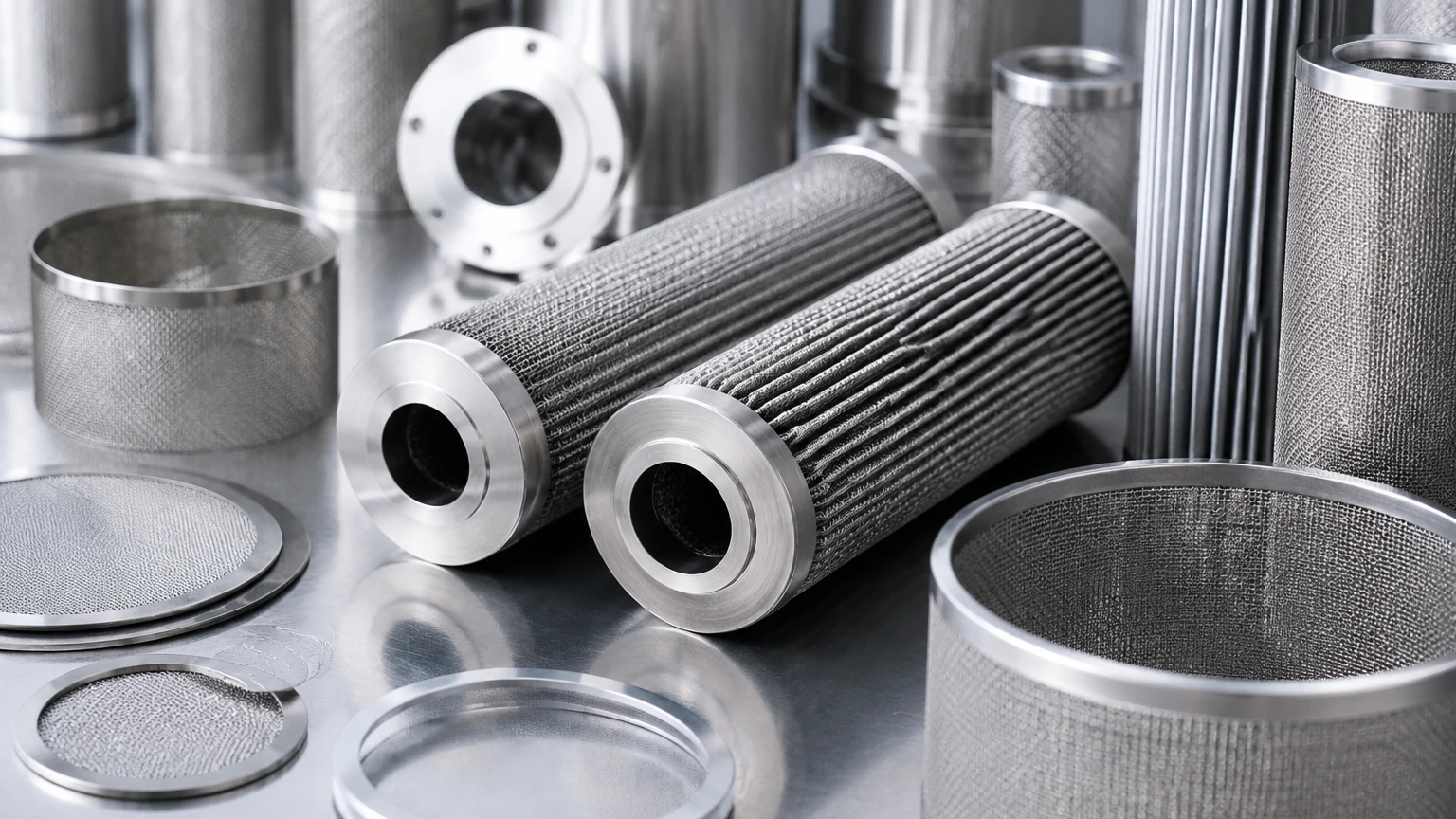
To handle high flow rates at high pressure, surface area is key. Pleating the stainless steel wire mesh increases the available filtration area within a compact footprint. This reduces the flux (flow per unit area), which in turn lowers the initial differential pressure and extends the service life of the filter. However, in extremely high-pressure applications where mechanical cleaning (such as backpulsing) is required, a reinforced cylindrical design might be preferred to avoid pleat fatigue.
Support Structures
High-pressure filter cartridges typically feature a heavy-duty inner core. This core, often made of perforated or spiral-welded stainless steel, prevents the filter media from collapsing inward as the differential pressure increases. In some designs, an outer shroud or cage is also used to protect the media during installation and to provide additional support during reverse-flow or backwashing cycles.
Joining and Sealing Techniques
In high-pressure filtration, the method used to join the filter media to the end caps is a common point of failure. Traditional adhesives or epoxies may fail under high pressure or chemical exposure. High-quality industrial filters utilize TIG (Tungsten Inert Gas) welding or plasma welding to create a seamless, all-metal bond. This ensures that there are no bypass paths and that the entire assembly can withstand the same pressures and temperatures as the media itself.
Key Performance Metrics: Micron Rating and Differential Pressure
When specifying a filter for high pressure filtration, two metrics are paramount: filtration accuracy and the clean pressure drop.
Absolute vs. Nominal Micron Ratings
In critical high-pressure systems, an "absolute" rating is usually required. An absolute rating signifies that the filter will capture 99.9% (or a specific Beta ratio) of particles at the specified micron size. A "nominal" rating is less precise and may allow larger particles to pass through under the increased force of a high-pressure flow. For protecting precision components like servo valves, absolute filtration is non-negotiable.
The Importance of Beta Ratios
The Beta ratio (β) is a more technical way of expressing filtration efficiency. It is the ratio of particles of a given size in the upstream fluid to the number of particles of the same size in the downstream fluid. For high-pressure hydraulic systems, a Beta ratio of βx ≥ 200 or βx ≥ 1000 is often specified, indicating high efficiency and superior protection for downstream hardware.
Calculating Pressure Drop
The total pressure drop across a filter housing and element is the sum of the housing loss and the element loss. In high-pressure systems, the fluid density and viscosity play a significant role in these calculations. Engineers must ensure that the "clean" pressure drop is low enough to allow for a reasonable "dirt-holding capacity" before the system reaches its maximum allowable differential pressure.
Common Risks and Failure Modes in High-Pressure Systems
Designing for high pressure requires an understanding of how systems fail. Ignoring these risks can lead to safety hazards and equipment damage.
1. Fatigue Failure: High-pressure systems often experience cyclic loading or pressure pulsations (e.g., from a reciprocating pump). Over time, these pulsations can cause metal fatigue in the filter mesh or the welded joints. Selecting a filter with adequate fatigue strength is essential for long-term reliability.
2. Bypass Leakage: If the seals between the filter element and the housing are not rated for high pressure, fluid will take the path of least resistance, bypassing the filter media entirely. High-pressure housings typically use O-rings made of Viton, EPDM, or PTFE, housed in precision-machined grooves to prevent extrusion under pressure.
3. Media Migration: In inferior filters, the high-velocity flow of a high-pressure system can actually break off small pieces of the filter media itself, sending "clean" contaminants downstream. This is why sintered or securely woven stainless steel is preferred over fiber-shedding materials.
4. Channeling: In depth-filtration media, high pressure can force channels through the material, allowing unfiltered fluid to pass. Using rigid, fixed-pore structures like sintered metal mesh eliminates this risk.
Selection Criteria for Industrial High-Pressure Filters
To select the appropriate filter, engineers should confirm the following parameters before procurement:
* Maximum Operating Pressure: The steady-state pressure the housing and element must withstand.
* Design Pressure: Usually 1.5x the operating pressure to account for safety margins.
* Flow Rate: The volume of fluid passing through the filter per unit of time, which dictates the required surface area.
* Fluid Properties: Viscosity, density, and chemical compatibility with stainless steel and seal materials.
* Contaminant Type: Is the debris hard (metal shavings), soft (sludge), or fibrous? This determines whether surface or depth filtration is more effective.
* Allowable Clean ΔP: The maximum pressure drop the system can tolerate when the filter is new.
* Terminal ΔP: The pressure drop at which the filter must be cleaned or replaced.
By addressing these factors, technical professionals can ensure that the chosen high pressure filtration solution provides the necessary protection without becoming a bottleneck in the process.
Maintenance and Lifecycle Considerations
One of the significant advantages of using stainless steel components in high pressure filtration is that they are often cleanable and reusable. Unlike disposable cartridges, stainless steel mesh and sintered elements can be cleaned using ultrasonic baths, chemical cleaning, or high-pressure backwashing. This significantly reduces the total cost of ownership (TCO) by eliminating the need for frequent replacement and reducing waste disposal costs.
However, cleaning must be performed according to strict protocols to ensure the pore structure is not damaged. Periodic bubble-point testing is recommended for cleaned elements to verify that the filtration integrity has not been compromised. In high-stakes environments, such as pharmaceutical or aerospace applications, maintaining a detailed log of cleaning cycles and pressure drop performance is a standard part of quality management.
Effective filtration is a balance of engineering precision and material science. By focusing on the structural demands of the application and the specific characteristics of the fluid, engineers can implement high-pressure systems that are both efficient and resilient. For those seeking detailed technical specifications or custom-engineered components, the Main Page serves as a primary resource for industrial filtration expertise.
