


Hirsch Filter Funnel
In the landscape of laboratory and industrial-scale filtration, the Hirsch filter funnel represents a specialized geometry designed for the efficient recovery of small quantities of solids from liquids. While traditionally associated with laboratory glassware, the transition of this design into industrial applications—particularly when constructed from high-grade stainless steel and integrated with precision wire mesh—has expanded its utility in chemical processing, pharmaceuticals, and specialized manufacturing. Understanding the technical nuances of the Hirsch filter funnel is essential for engineers and procurement teams who must balance filtration accuracy with the durability required for demanding industrial environments.
Understanding the Geometry and Function of the Hirsch Filter Funnel
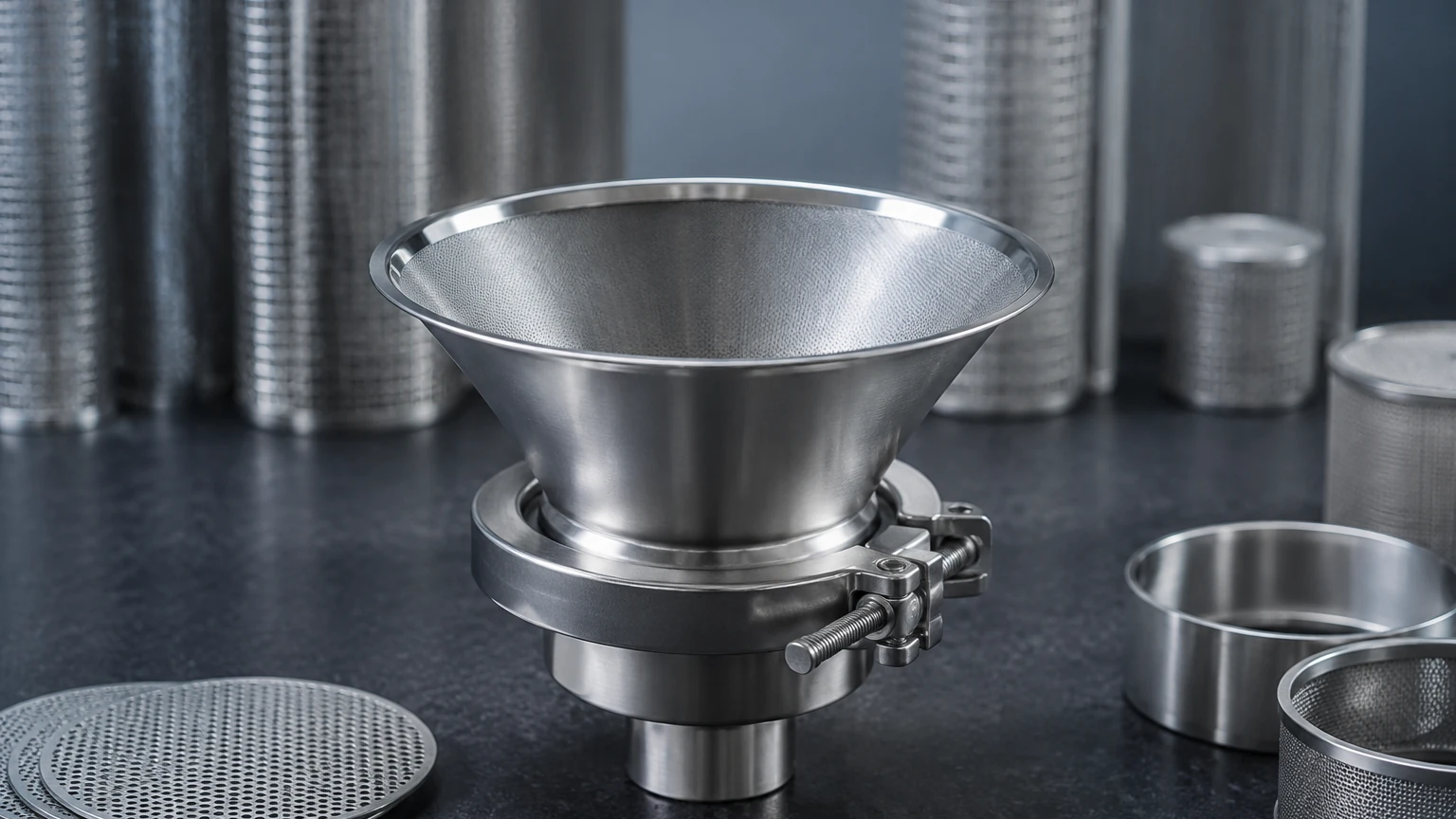
The primary distinguishing feature of a Hirsch filter funnel is its conical shape and sloped walls, which converge toward a small-diameter perforated plate at the base. This design differs significantly from the more common Buchner funnel, which features vertical walls and a larger, flat filtration surface.
The sloped walls of the Hirsch funnel are engineered specifically for "micro-scale" or small-batch filtration. By concentrating the precipitate into a smaller area, the design minimizes the loss of valuable solids that might otherwise be trapped in the corners or across the broader surface area of a flat-bottomed funnel. In an industrial context, this geometry is particularly advantageous when handling expensive catalysts, rare chemical compounds, or high-purity pharmaceutical ingredients where every milligram of yield impacts the total cost of production.
From an engineering perspective, the Hirsch funnel operates on the principle of vacuum filtration. The stem of the funnel is typically inserted into a filtering flask via a rubber bung or ground glass joint. As a vacuum is applied, the atmospheric pressure forces the liquid through the filter media and the perforated plate, leaving the solid residue (the filter cake) concentrated on the small surface of the plate.
Material Selection: The Shift from Ceramic to Stainless Steel
Historically, Hirsch funnels were manufactured from porcelain or glass. While these materials offer excellent chemical resistance, they are inherently fragile and prone to thermal shock. In modern industrial settings, where equipment must withstand mechanical stress, high-pressure differentials, and rigorous cleaning cycles, stainless steel has become the material of choice for high-performance filtration components.
At Kaifil, the focus remains on providing robust, metallic filtration solutions that overcome the limitations of traditional materials. Stainless steel 304 and 316L are the standard alloys used for industrial Hirsch-style components.
1. Stainless Steel 304: Suitable for general industrial applications where basic corrosion resistance is required. It is cost-effective and provides the structural integrity needed for vacuum-assisted filtration.
2. Stainless Steel 316L: The "L" denotes low carbon content, which improves weldability and resistance to intergranular corrosion. The addition of molybdenum makes 316L highly resistant to chlorides and acidic environments, making it the preferred choice for pharmaceutical and chemical processing.
Beyond durability, metal Hirsch funnels offer superior thermal conductivity. This allows for filtration at elevated temperatures or the use of heated jackets to maintain the viscosity of the fluid during the process—a feat difficult to achieve safely with glass or ceramic counterparts.
Integrating Precision Wire Mesh for Enhanced Performance
The effectiveness of a Hirsch filter funnel is largely determined by the filter media placed over the perforated plate. In laboratory settings, circular filter paper is used. However, in industrial applications, paper is often insufficient due to chemical incompatibility or the risk of fiber shedding, which can contaminate the filtrate.
To address these challenges, industrial Hirsch funnels often utilize integrated stainless steel wire mesh. This mesh can be customized to specific micron ratings, ensuring that the filtration accuracy meets the exact requirements of the application. Engineers must consider several weave types when selecting the internal mesh for a filter component:
* Plain Weave: Offers a simple, straight-through path for fluids and is easy to clean. It is suitable for larger particle sizes.
* Twill Weave: Allows for a heavier wire diameter in a given mesh count, providing increased strength and finer filtration capabilities.
* Dutch Weave: This dense weave provides high pressure resistance and extremely fine filtration, often used in high-pressure vacuum applications where the integrity of the filter cake is critical.
By incorporating these mesh types directly into the funnel structure—often through sintering or precision welding—manufacturers like Kaifil create a permanent, reusable filtration surface. This eliminates the recurring cost and waste associated with disposable filter papers while providing a more consistent and verifiable filtration grade.
Engineering Considerations for Industrial Vacuum Filtration
When specifying a Hirsch filter funnel or a related filtration component for an industrial system, several engineering factors must be evaluated to ensure performance and safety.
Pressure Differentials and Structural Integrity
Vacuum filtration subjects the funnel to significant pressure differentials. The perforated plate at the base of the Hirsch funnel must be thick enough to resist bowing or cracking under vacuum. Furthermore, the transition between the sloped walls and the base plate must be seamlessly welded and polished to prevent "dead zones" where bacteria or cross-contaminants could accumulate. This is particularly vital in Food and Beverage or Pharmaceutical applications where Clean-in-Place (CIP) protocols are standard.
Flow Rates and Surface Area
Because the Hirsch funnel has a smaller filtration surface area compared to a Buchner funnel of the same top diameter, the flow rate (flux) will be lower. Engineers must calculate the expected volume of liquid and the concentration of solids to determine if the Hirsch geometry will cause a bottleneck in the production line. If high throughput is required alongside high recovery of small solids, multiple funnels or a customized multi-stage filtration system may be necessary.
Seal Integrity and Connection Types
In an industrial environment, a simple rubber stopper is rarely sufficient. Components must often be integrated into closed systems using Tri-Clamp fittings, NPT threads, or flanged connections. Ensuring a vacuum-tight seal is critical to maintaining the pressure differential required for efficient separation. For more information on how these components can be integrated into your specific system, you can Review product options and application support on our Main Page.
Customization and OEM Capabilities
No two industrial processes are identical, and off-the-shelf laboratory equipment often fails to meet the specific rigors of a factory floor. This is where customization becomes a critical factor in procurement. When working with a professional manufacturer like Kaifil, engineers can specify exact dimensions and performance characteristics for their filtration components.
Customization options for Hirsch-style filtration components include:
* Variable Micron Ratings: Tailoring the wire mesh to capture specific particle sizes ranging from several millimeters down to 1 micron.
* Jacketed Designs: Adding an outer layer for steam or coolant circulation to control the temperature of the fluid during filtration.
* Multi-Layer Sintered Mesh: Combining multiple layers of wire mesh (e.g., a fine filtration layer, a drainage layer, and a support layer) to provide maximum strength and permeability.
* Surface Finishes: Specifying Ra values (roughness average) for the internal surfaces to meet stringent sanitary standards.
By opting for a custom-engineered solution, companies can ensure that the Hirsch filter funnel integrates perfectly with their existing piping and vessels, reducing the need for adapters that can introduce leak points or contamination risks.
Maintenance, Cleaning, and Total Cost of Ownership
One of the primary drivers for moving from disposable or fragile filtration materials to stainless steel is the reduction in the total cost of ownership (TCO). While the initial investment in a stainless steel Hirsch filter funnel is higher than glass or ceramic, the longevity and reusability of the metal component provide significant long-term savings.
Cleaning Protocols
Unlike porcelain, which can be porous and difficult to sterilize, stainless steel is non-porous. It can be subjected to aggressive chemical cleaning agents, high-pressure steam (autoclaving), or ultrasonic cleaning. Ultrasonic cleaning is particularly effective for wire mesh components, as it uses cavitation bubbles to dislodge particles trapped deep within the weave, restoring the funnel’s flow rate to near-original levels.
Replacement Cycles
A well-maintained stainless steel filter can last for years, whereas glass funnels are frequently replaced due to breakage, and disposable filters represent a continuous operational expense. When evaluating the TCO, procurement teams should factor in:
1. Reduced Downtime: Less frequent replacement of filter media.
2. Waste Reduction: Eliminating the disposal costs of contaminated paper filters.
3. Consistency: Metal mesh does not swell or degrade like paper, ensuring repeatable filtration results over hundreds of cycles.
Conclusion: Selecting the Right Filtration Partner
The Hirsch filter funnel is a specialized tool that, when engineered correctly, provides unparalleled efficiency in small-batch solid recovery. For industrial applications, the transition to stainless steel construction and integrated wire mesh is not merely an upgrade in durability—it is a requirement for process stability and purity.
When selecting a filtration component, engineers should prioritize manufacturers who understand the technical balance between flow rate, pressure resistance, and material compatibility. Whether you are refining a chemical process or developing a new pharmaceutical product, the precision of your filtration equipment directly correlates to the quality of your final output. For a comprehensive look at how custom stainless steel solutions can optimize your operations, visit the Kaifil Main Page to explore our engineering capabilities and product range.
