


Hirsch Funnel Vacuum Filtration
In the realm of industrial and laboratory separation processes, hirsch funnel vacuum filtration stands as a critical technique for the recovery of small-scale solid precipitates from liquid phases. While often associated with bench-top chemistry, the principles of vacuum-assisted filtration are foundational to high-precision industrial applications, particularly in the pharmaceutical, fine chemical, and specialized material sectors. For engineers and procurement professionals, understanding the technical nuances of this process is essential for optimizing yield, ensuring product purity, and selecting the appropriate filtration media.
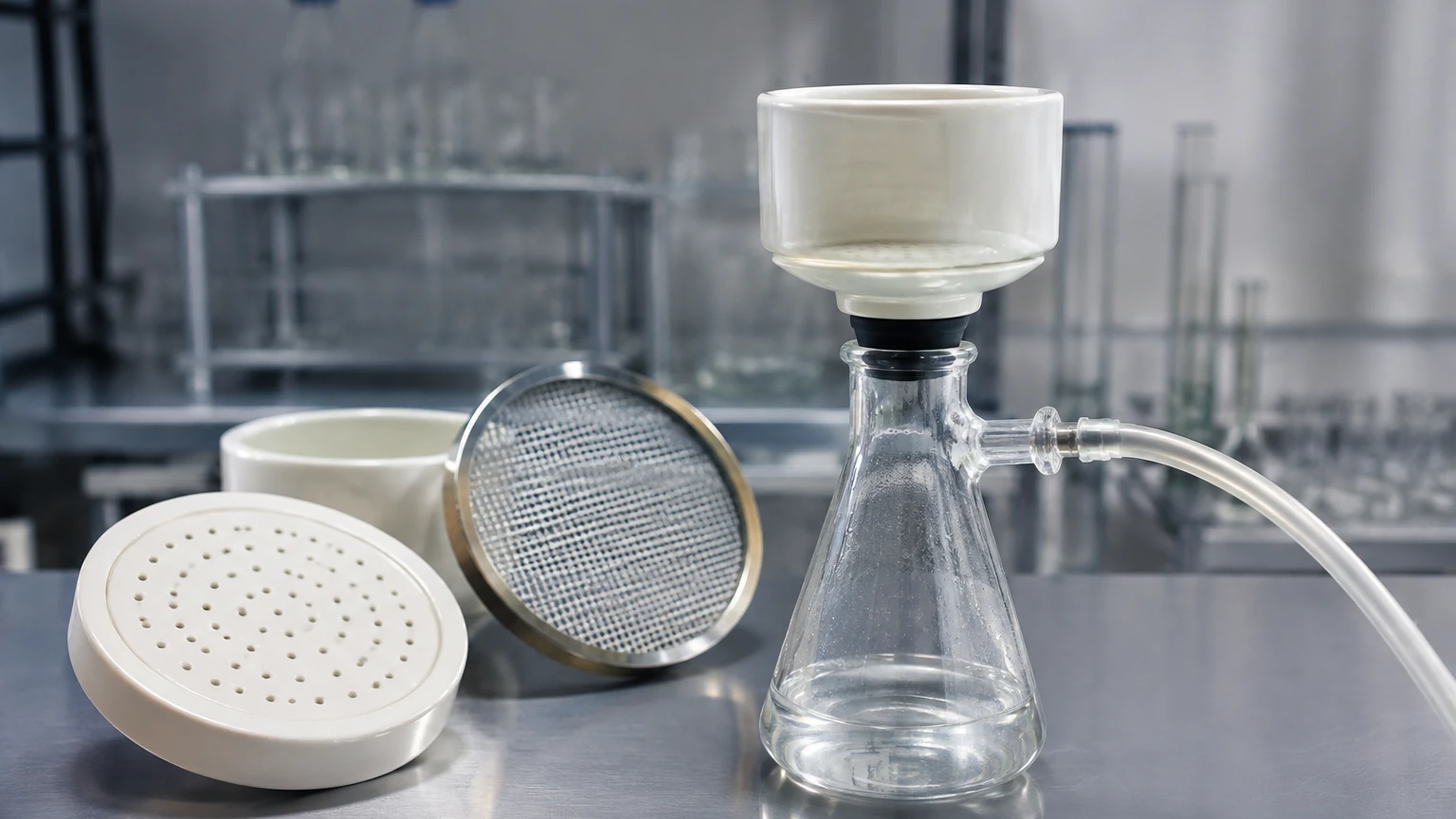
At its core, vacuum filtration utilizes a pressure differential to drive liquid through a porous medium. The Hirsch funnel is distinguished by its specific geometry—featuring sloped walls and a much smaller perforated plate than the more common Buchner funnel. This design is intentionally engineered to facilitate the collection of small amounts of solids, minimizing the loss of high-value materials that might otherwise become trapped in the corners or larger surface areas of standard industrial filters.
The Fundamentals of Hirsch Funnel Vacuum Filtration
The efficacy of hirsch funnel vacuum filtration relies on the synergy between the funnel design, the vacuum source, and the filter media. Unlike gravity filtration, which depends solely on the weight of the liquid to pass through a filter, vacuum filtration applies a negative pressure beneath the filter plate. This significantly accelerates the flow rate and results in a drier "filter cake," which is often a primary objective in industrial processing.
From an engineering perspective, the sloped sides of the Hirsch funnel reduce the surface area of the filter medium relative to the volume of the slurry. This is particularly advantageous when working with expensive catalysts or active pharmaceutical ingredients (APIs). By concentrating the solid on a smaller diameter, the thickness of the cake increases, which can actually improve filtration efficiency by acting as a secondary filter bed. However, this also requires a more robust filter medium that can withstand the concentrated pressure without deforming or allowing particles to bypass the seal.
Material Science in Industrial Filtration Components
In demanding industrial environments, the choice of filter material is as important as the funnel geometry. Traditional laboratory setups often use cellulose filter paper, but industrial-scale hirsch funnel vacuum filtration frequently requires more durable, chemically resistant alternatives. This is where stainless steel filtration solutions become indispensable.
Stainless steel wire mesh and sintered metal filters offer several advantages over disposable media:
1. Chemical Compatibility: Industrial processes often involve aggressive solvents, high-pH bases, or acidic solutions that would degrade cellulose or polymer-based filters. Stainless steel (typically 304 or 316L grades) provides exceptional resistance to corrosion.
2. Thermal Stability: Vacuum filtration may be performed at elevated temperatures to maintain the solubility of certain components or to reduce the viscosity of the mother liquor. Metal filters maintain their structural integrity across a wide temperature range.
3. Mechanical Strength: Under high vacuum, paper filters can tear or "blow out." Sintered stainless steel mesh provides a rigid structure that supports the pressure differential without the risk of media migration into the filtrate.
4. Reusability and Sterilization: In pharmaceutical and food-grade applications, the ability to clean-in-place (CIP) and sterilize components is vital. Stainless steel filters can be ultrasonically cleaned, autoclaved, or chemically sanitized, reducing the total cost of ownership over time.
For those looking to optimize their systems, you can Review product options and application support to see how custom metal components integrate into professional filtration setups.
Performance Metrics: Evaluating Efficiency and Throughput
When specifying components for a vacuum filtration system, engineers must evaluate several performance metrics to ensure the system meets production requirements. The primary considerations include micron rating, flow rate (flux), and cake discharge characteristics.
Micron Rating and Pore Distribution
The micron rating determines the size of the particles that the filter will retain. In hirsch funnel vacuum filtration, achieving a balance between high retention and acceptable flow rates is key. A "nominal" rating indicates that the filter will catch most particles of a certain size, while an "absolute" rating guarantees retention. For precision applications, sintered wire mesh is often preferred because it offers a highly uniform pore size distribution, ensuring consistent results across multiple batches.
Flow Rate and Pressure Drop
The rate at which the liquid (filtrate) passes through the medium is influenced by the viscosity of the fluid, the thickness of the filter cake, and the available vacuum pressure. As the cake builds up on the Hirsch funnel plate, the resistance to flow increases. Engineers must calculate the "clean pressure drop" of the filter medium to ensure the vacuum pump has sufficient capacity to maintain flow as the cake thickens.
Cake Discharge and Recovery
The goal of using a Hirsch funnel is often the recovery of the solid. If the solid adheres too strongly to the filter media, recovery rates drop and the risk of cross-contamination between batches increases. Stainless steel mesh with specific weave patterns, such as plain Dutch weave or twilled weave, can provide a smooth surface that facilitates easy cake removal and minimizes residual solids.
Operational Risks and Mitigation Strategies
While hirsch funnel vacuum filtration is a standard procedure, it is not without operational risks. Understanding these risks allows for better system design and the implementation of preventative measures.
* Media Blinding: This occurs when particles become trapped within the pores of the filter medium, permanently reducing flow. To mitigate this, engineers should select a micron rating slightly smaller than the average particle size to encourage cake formation on the surface rather than depth filtration within the media.
* Vacuum Leaks: A poor seal between the Hirsch funnel and the receiving flask or manifold can significantly reduce filtration speed. Industrial systems often use precision-machined stainless steel flanges and high-performance gaskets to ensure an airtight seal.
* Evaporative Cooling: The vacuum process can cause volatile solvents to evaporate rapidly, cooling the slurry. In some cases, this can lead to premature crystallization of solutes, which may clog the filter or contaminate the desired solid. Controlled-temperature jackets or specialized vacuum regulators may be required for sensitive processes.
* Structural Failure: In larger industrial adaptations of the Hirsch design, the pressure exerted on the filter plate can be substantial. Using reinforced sintered mesh laminates ensures that the filter does not bow or crack under the stress of continuous vacuum cycles.
Integrating Custom Stainless Steel Solutions
As industrial processes scale from the laboratory to pilot plants and full-scale production, the limitations of standard off-the-shelf equipment become apparent. Customization is often necessary to meet specific spatial constraints, flow requirements, or material standards.
Manufacturers like Kaifil specialize in bridging the gap between standard laboratory principles and industrial-grade execution. By providing custom-fabricated stainless steel wire mesh filters and precision metal components, they allow engineers to adapt the efficiency of hirsch funnel vacuum filtration to larger, more demanding environments. Whether it is a custom-diameter sintered disc for a specialized vacuum manifold or a multi-layered mesh assembly for high-pressure recovery, these solutions ensure that the filtration process is both repeatable and durable.
When considering a custom solution, it is important to confirm the following with your manufacturer:
* Specific Alloy Requirements: Does the process require 316L for superior acid resistance, or is 304 sufficient?
* Layer Configuration: For high-vacuum applications, a five-layer sintered mesh (providing filtration, drainage, and support layers) may be necessary.
* Edge Treatments: Should the filter disc be raw, bound with a metal ring, or welded into a housing to prevent bypass?
Total Cost of Ownership and Maintenance Considerations
While the initial investment in stainless steel components for vacuum filtration is higher than that for disposable paper or plastic alternatives, the long-term economics often favor metal. The total cost of ownership (TCO) includes not only the purchase price but also the costs associated with downtime, waste disposal, and replacement frequency.
Disposable filters generate a significant waste stream, which can be costly to manage if the materials are hazardous. In contrast, a permanent stainless steel filter, when maintained correctly, can last for years. Maintenance involves regular cleaning cycles tailored to the specific contaminants. For example, in the chemical industry, solvent backwashing or thermal cleaning may be used to remove organic residues from the mesh pores.
Furthermore, the reliability of metal filters reduces the risk of batch failure. A single torn paper filter can result in the loss of an entire production run or necessitate expensive re-filtration steps. By investing in high-quality metal filtration components, companies protect their operational continuity and product integrity.
Conclusion: Making Informed Purchasing Decisions
Hirsch funnel vacuum filtration remains a vital technique for precision solid-liquid separation. By moving beyond basic laboratory equipment and embracing industrial-grade materials and engineering principles, organizations can achieve higher yields and more consistent product quality. When selecting components, focus on material compatibility, mechanical strength, and the ability to customize the solution to your specific process needs.
For technical professionals and purchasing teams, the transition to robust, stainless steel filtration media is a strategic move toward operational excellence. For more information on how to optimize your industrial filtration systems, visit the Main Page to explore professional product information and selection advice tailored to your industry’s unique challenges.
