


Hirsch Funnel.
In the landscape of precision filtration, the hirsch funnel. remains a fundamental tool for laboratory-scale separations, particularly when dealing with small volumes of material. While often associated with academic chemistry, the design principles of the Hirsch funnel have significant implications for industrial R&D, pilot plant operations, and the development of custom stainless steel filtration components. For engineers and procurement specialists at firms like Kaifil, understanding the nuances of vacuum filtration at this scale is the first step toward designing robust, industrial-grade filtration systems.
Understanding the Hirsch Funnel in Laboratory and Industrial R&D
A hirsch funnel. is a specialized piece of laboratory equipment used primarily for vacuum-assisted filtration. It is characterized by its relatively small diameter and, most notably, its outward-sloping walls. This design distinguishes it from the more common Büchner funnel, which features vertical walls and a larger surface area.
In an industrial R&D setting, the Hirsch funnel is utilized when the quantity of the solid product (the precipitate) is small. The sloped walls serve a critical engineering function: they direct the liquid and solid mixture toward a small-diameter perforated plate at the base. This concentrates the solid material onto a smaller filter medium, such as a circular filter paper or a precision-engineered stainless steel mesh disc. By concentrating the solids, the Hirsch funnel reduces the loss of material that might otherwise occur if it were spread thinly across a larger surface area. For high-value pharmaceutical intermediates or specialized chemical catalysts, this efficiency is paramount.
Engineering Design: The Advantage of Sloped-Wall Filtration
The geometry of the hirsch funnel. is not arbitrary; it is optimized for the physics of vacuum filtration. When a vacuum is applied to the receiving flask below the funnel, a pressure differential is created across the filter medium. This differential $(\Delta P)$ is the driving force that pulls the filtrate through the medium while retaining the solids.
The Role of Wall Angle
In a standard Hirsch funnel, the walls are typically angled at approximately 60 degrees. This angle facilitates several key processes:
1. Cake Formation: As the liquid is drawn through, the solids settle onto the filter plate. The sloped walls help in forming a thicker "cake" of material relative to the total volume, which can actually improve filtration efficiency by acting as a secondary filter bed.
2. Cake Recovery: For engineers, the ease of recovering the final product is a vital consideration. The open, sloping design allows for easier access with a spatula or recovery tool compared to deep, straight-sided vessels.
3. Washing Efficiency: When the precipitate requires washing to remove impurities, the concentrated cake in a Hirsch funnel allows for more effective displacement washing with minimal solvent volumes.
The Perforated Plate
The base of the funnel contains a perforated plate that supports the filter medium. In traditional lab settings, this is often a fixed part of a ceramic funnel. However, in industrial-style applications or when transitioning to custom metal solutions, this support plate must be engineered to withstand the mechanical stress of the vacuum without deforming, while providing a high percentage of open area to minimize flow resistance.
Material Selection: From Porcelain to Industrial Stainless Steel
While standard laboratory Hirsch funnels are made of porcelain or glass, industrial applications often demand more resilient materials. This is where the expertise of a specialized manufacturer becomes essential. When scaling up processes or dealing with aggressive chemical environments, porcelain may be prone to thermal shock or mechanical breakage.
Stainless Steel Advantages
For demanding industrial environments, stainless steel—specifically grades like 304, 316, or 316L—is the preferred material for filtration components. Transitioning the geometry of a hirsch funnel. into a stainless steel assembly offers several technical advantages:
* Corrosion Resistance: Stainless steel 316L provides superior resistance to organic acids, chlorides, and high-temperature environments common in chemical processing.
* Durability: Unlike ceramic, metal components do not crack under mechanical impact or rapid temperature fluctuations.
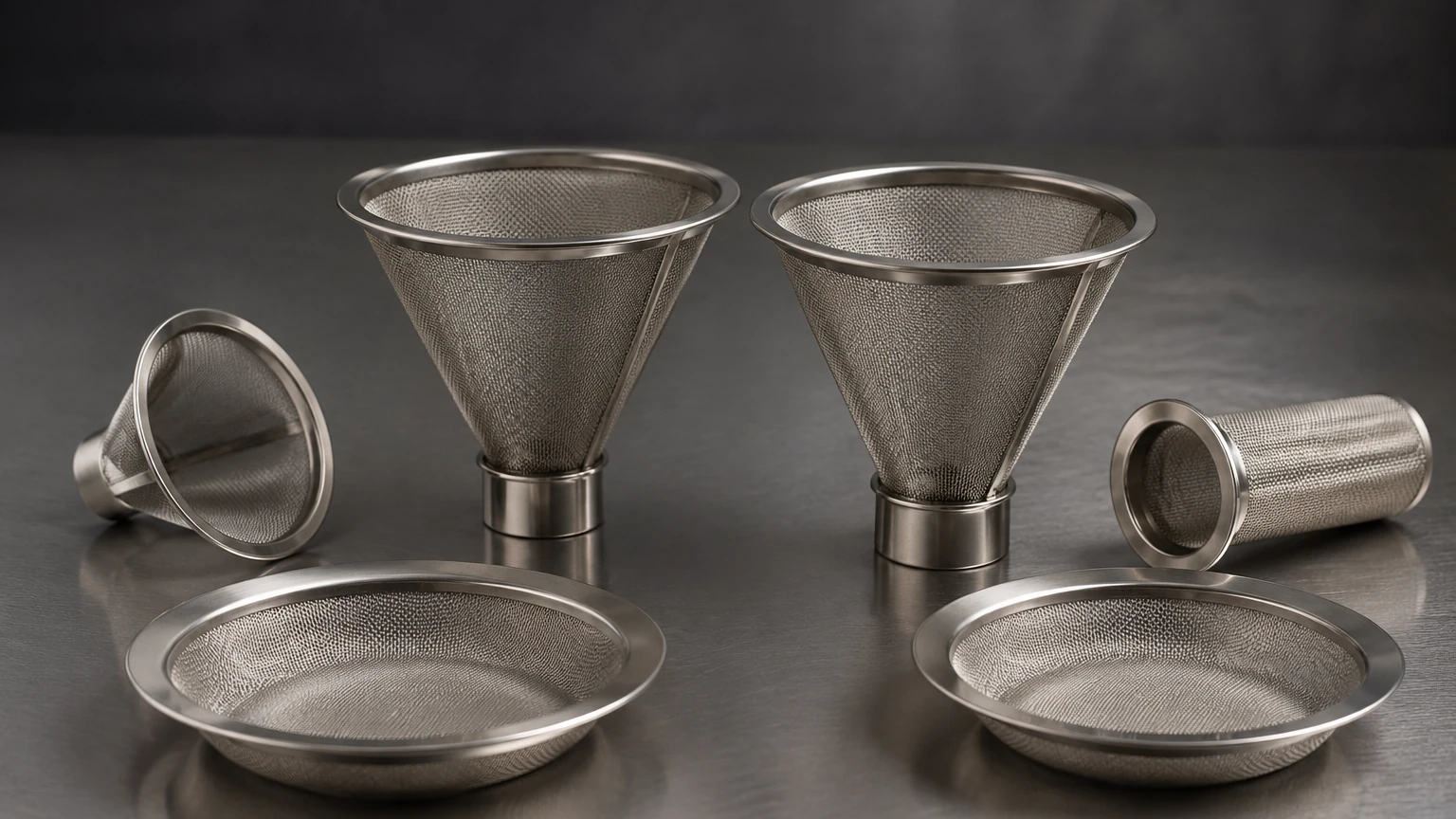
* Precision Mesh Integration: Instead of relying on disposable paper filters, industrial metal funnels can integrate permanent, multi-layered sintered wire mesh. This allows for precise micron ratings and eliminates the risk of paper fibers contaminating the filtrate.
* Sterilization: For pharmaceutical and food-grade applications, stainless steel components are compatible with Autoclave and Steam-in-Place (SIP) protocols, ensuring total sterility.
Scaling Vacuum Filtration: From the Hirsch Funnel to Industrial Cartridges
The transition from a lab-scale hirsch funnel. to a full-scale production line is a critical phase in process engineering. The data gathered during small-scale vacuum filtration—such as flow rates, cake compressibility, and filtration time—informs the design of larger industrial filter cartridges and wire mesh systems.
Pilot Plant Considerations
In the pilot plant stage, engineers often require "scaled-up" versions of the Hirsch principle. This might involve custom-fabricated stainless steel vacuum leaf filters or small-batch nutsche filters. These systems maintain the vacuum-driven efficiency of the lab funnel but add features like heating jackets for temperature-sensitive filtrations or agitation systems to assist in cake washing.
As requirements move toward continuous or high-volume batch processing, the focus shifts to Main Page products such as stainless steel filter cartridges. These cartridges utilize pleated or cylindrical wire mesh designs to provide a much larger surface area within a compact footprint, effectively translating the precision of lab filtration into industrial-scale throughput.
Critical Performance Factors: Micron Ratings and Pressure Differentials
When specifying filtration components inspired by the hirsch funnel. design, engineers must evaluate several technical parameters to ensure performance and longevity.
Filtration Accuracy (Micron Rating)
The choice of filter medium determines the size of particles retained. In industrial metal filtration, this is categorized into:
* Nominal Rating: An approximate value indicating the ability to retain the majority of particles of a certain size.
* Absolute Rating: The diameter of the largest hard spherical particle that will pass through the filter under specified test conditions. For critical pharmaceutical applications, absolute ratings are mandatory.
Vacuum and Pressure Limits
In vacuum filtration, the maximum theoretical pressure differential is 1 atmosphere (approx. 14.7 psi or 1 bar). However, in practice, the structural integrity of the filter support is vital. If the support plate of a hirsch funnel. or its industrial equivalent is too thin, the vacuum can cause it to bow, leading to "bypass"—where unfiltered liquid escapes around the edges of the filter medium. Kaifil addresses this by engineering reinforced support structures for all custom metal filter components.
Flow Rate and Viscosity
The rate of filtration is governed by the viscosity of the fluid and the resistance of both the filter medium and the accumulated cake. Engineers use the following relationship to estimate performance:
$$Q = \frac{A \cdot \Delta P}{\mu \cdot (R_m + R_c)}$$
Where:
* $Q$ is the flow rate.
* $A$ is the filtration area.
* $\Delta P$ is the pressure differential.
* $\mu$ is the dynamic viscosity of the fluid.
* $R_m$ is the resistance of the filter medium.
* $R_c$ is the resistance of the filter cake.
Understanding these variables allows for the selection of the optimal mesh weave—whether it be a plain weave for high flow or a Dutch weave for fine particle retention.
Maintenance and Longevity of Precision Metal Filters
One of the primary reasons industrial users move away from standard lab-style hirsch funnel. setups toward custom stainless steel solutions is the total cost of ownership and ease of maintenance. Disposable filters and fragile ceramic funnels incur ongoing costs and waste.
Cleaning Protocols
Stainless steel filtration components are designed for reuse. Effective cleaning is essential to maintain flow rates and prevent cross-contamination between batches. Common methods include:
* Ultrasonic Cleaning: Using high-frequency sound waves in a solvent bath to dislodge particles from deep within the wire mesh.
* Backwashing: Reversing the flow of fluid through the filter to push out trapped contaminants.
* Chemical Cleaning: Using caustic or acidic solutions to dissolve organic or inorganic fouling, a process made possible by the high chemical resistance of 316L stainless steel.
Inspection and Integrity Testing
In regulated industries, the integrity of the filter must be verified regularly. For metal filters, this often involves bubble point testing, which measures the pressure required to force air through a liquid-saturated filter. This ensures that the mesh has not been damaged and that the micron rating remains within specification.
Custom Engineering Solutions for Specialized Filtration Needs
Every industrial process has unique requirements that a standard hirsch funnel. cannot meet. Whether it is a specific flange connection for a vacuum line, a requirement for high-pressure housing, or a need for a non-standard micron rating, customization is the key to operational efficiency.
Kaifil specializes in bridging the gap between theoretical filtration needs and practical, durable hardware. By applying the principles of the Hirsch funnel—precision, concentration of solids, and efficient vacuum usage—to the manufacture of stainless steel wire mesh filters and cartridges, they provide solutions that stand up to the rigors of industrial use.
When engineers prepare to transition from laboratory R&D to production, they should confirm several factors with their filtration partner:
1. Chemical Compatibility: Will the filter housing and mesh withstand the specific solvents and pH levels of the process?
2. Thermal Requirements: Are there extreme temperatures involved that require specific alloy selections?
3. Mechanical Interface: How will the filtration unit integrate into existing vacuum or pressure systems?
4. Regulatory Compliance: Does the component need to meet FDA, GMP, or other industry-specific standards?
Conclusion: Optimizing Filtration Efficiency
The hirsch funnel. serves as an enduring model for efficient, small-scale vacuum filtration. By understanding its design strengths—specifically its ability to concentrate small amounts of solids and facilitate easy recovery—engineers can better specify the industrial-scale components needed for larger operations. Whether you are refining a chemical process in the lab or scaling up to a full production facility, the choice of filtration media and the engineering of the support structure are the most critical factors in achieving high-purity results.
For those seeking to implement these principles in a professional industrial environment, exploring advanced stainless steel options is the next logical step. By moving from fragile labware to precision-engineered metal components, facilities can achieve greater durability, better sterilization capabilities, and more consistent filtration performance. To explore the full range of custom industrial filtration components and technical support, visit the Main Page for detailed product specifications and application guidance.
