


Hirsch vs Büchner Funnel
In the realm of laboratory-scale filtration and industrial process development, the selection of appropriate equipment is critical for achieving high-purity results and efficient solid-liquid separation. Two of the most common tools used for vacuum-assisted filtration are the Hirsch funnel and the Büchner funnel. While they share a common purpose—separating a solid precipitate from a liquid filtrate—their design differences make them suitable for vastly different scales and types of applications.
For engineers and laboratory managers, understanding the nuances of the hirsch vs büchner funnel debate is essential when transitioning from bench-top experimentation to pilot-scale production. This article provides a technical analysis of both funnel types, their engineering considerations, and how these principles translate into the durable, high-performance stainless steel filtration solutions required in industrial environments.
Understanding the Büchner Funnel: Large-Scale Efficiency
The Büchner funnel is the standard workhorse for vacuum filtration in most chemical and pharmaceutical laboratories. Named after the industrial chemist Ernst Büchner, it is characterized by its cylindrical shape and a flat, perforated plate at the bottom. Traditionally manufactured from porcelain, it is also available in glass, plastic, and, for industrial applications, high-grade stainless steel.
Design and Geometry
The primary feature of the Büchner funnel is its vertical side walls and a large, flat surface area for the filter medium. This geometry is designed to hold a significant volume of slurry. The perforated plate supports the filter paper or a sintered metal mesh, ensuring that the vacuum pressure is distributed across the entire surface area. This design promotes the formation of a uniform "filter cake," which is essential for efficient washing and drying of the solids.
Typical Applications
Büchner funnels are preferred when dealing with large quantities of material, typically ranging from 50 mL to several liters. They are ideal for:
* Bulk chemical synthesis where large volumes of precipitate need to be recovered.
* Coarse filtration where the goal is to remove large amounts of solid impurities.
* Processes requiring extensive cake washing to remove residual solvents or contaminants.
Understanding the Hirsch Funnel: Precision for Microscale Filtration
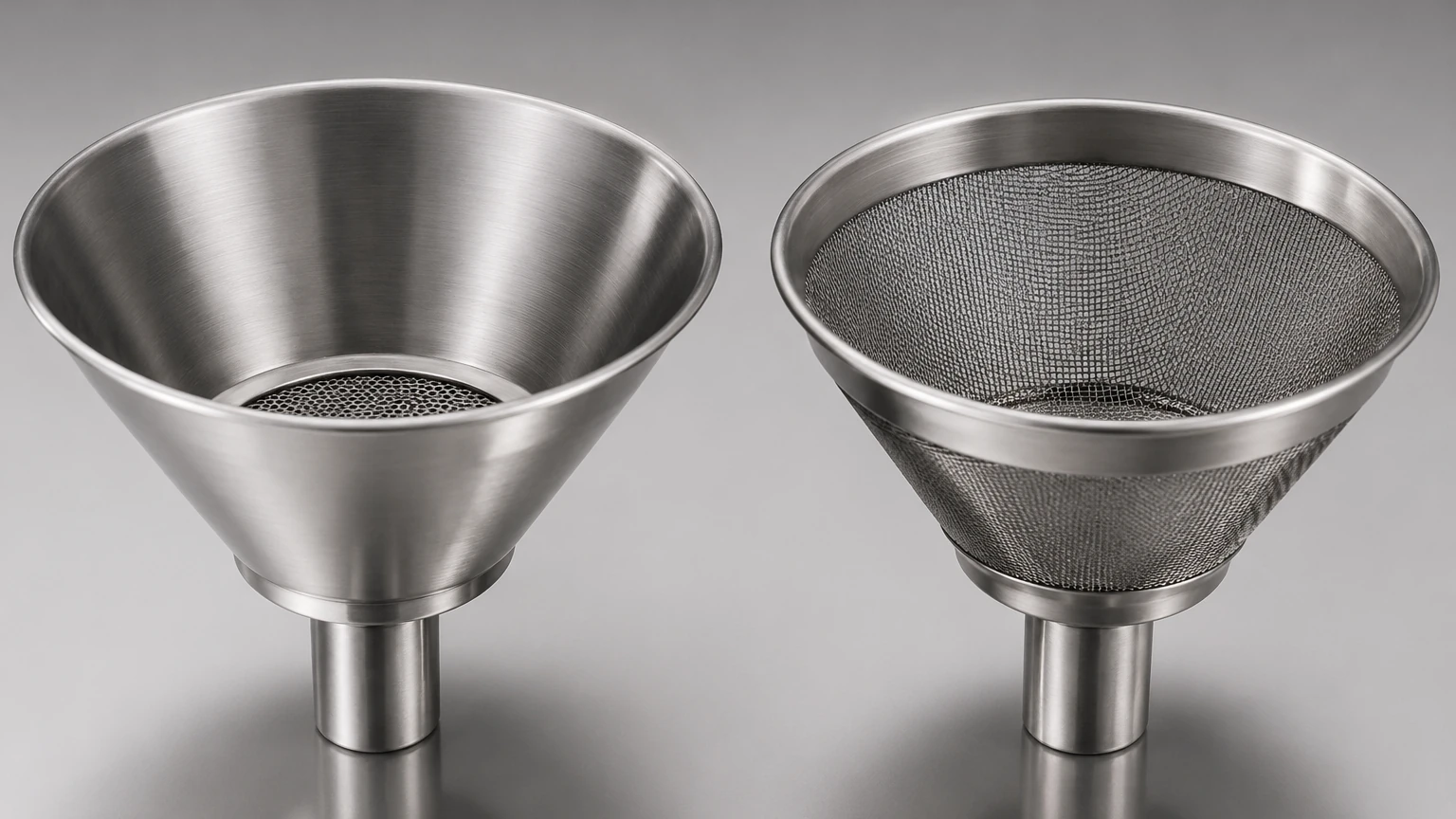
The Hirsch funnel is essentially a smaller, specialized version of the Büchner funnel, designed specifically for microscale or small-scale operations. While it operates on the same vacuum principle, its geometry is optimized for the recovery of very small amounts of solid material.
Design and Geometry
Unlike the cylindrical Büchner funnel, the Hirsch funnel features outward-sloping (conical) walls. The perforated plate at the bottom is significantly smaller in diameter. This conical shape serves a critical purpose: it directs the precipitate toward the center of the filter medium, making it much easier to scrape and recover small quantities of solids (often less than 1 gram) without significant loss to the side walls.
Typical Applications
Hirsch funnels are the go-to choice for:
* Recrystallization processes where only a few milligrams of purified product are expected.
* Analytical chemistry where precise solid recovery is mandatory for weight calculations.
* Educational settings and R&D labs focusing on expensive or rare reagents where minimizing waste is a priority.
Key Differences: Hirsch vs Büchner Funnel
When evaluating the hirsch vs büchner funnel for a specific project, several technical factors must be compared to ensure the chosen equipment matches the process requirements.
| Feature | Büchner Funnel | Hirsch Funnel |
| :— | :— | :— |
| Geometry | Cylindrical with vertical walls | Conical with sloped walls |
| Scale | Macroscale (50mL to several liters) | Microscale (0.5mL to 50mL) |
| Filter Plate Size | Large (typically 40mm to 300mm+) | Small (typically 10mm to 30mm) |
| Solid Recovery | Best for large cakes | Optimized for minimal loss of small amounts |
| Filter Media | Large circular papers or mesh | Small circular discs |
| Vacuum Distribution | Broad distribution across a flat plane | Concentrated at the narrow base |
Fluid Dynamics and Pressure Differentials
In a Büchner funnel, the vertical walls allow for a deeper slurry bed, which can lead to higher pressure drops as the filter cake thickens. In contrast, the Hirsch funnel’s sloped walls reduce the depth of the liquid column relative to the surface area of the slurry surface, though the actual filtration occurs through a much smaller exit point. Engineers must account for these flow characteristics when calculating the necessary vacuum strength to prevent "blinding" of the filter media.
Engineering Considerations for Media Selection
Regardless of whether a Hirsch or Büchner design is used, the performance of the filtration system depends heavily on the filter media. In laboratory settings, cellulose filter paper is common, but industrial processes often require more robust solutions.
Chemical Compatibility
In aggressive chemical processing, standard porcelain or glass funnels may be susceptible to thermal shock or chemical etching (especially with strong bases or hydrofluoric acid). This is where stainless steel components become superior. Utilizing 304 or 316L stainless steel ensures resistance to corrosion and allows for high-temperature filtration that would crack standard labware.
Filtration Accuracy (Micron Rating)
In industrial filtration, the "pore size" of the media is a critical specification. While lab paper has nominal ratings, precision metal filter components, such as those found on the Main Page of specialized manufacturers, offer absolute micron ratings. This precision is vital for pharmaceutical and food-grade applications where consistency is non-negotiable.
Transitioning from Lab to Industrial Scale
As a project moves from the laboratory (using Hirsch or Büchner funnels) to full-scale production, the filtration requirements evolve. The principles of vacuum filtration remain, but the equipment must become more durable, cleanable, and capable of handling continuous or large-batch flow.
From Funnels to Filter Cartridges
In many industrial sectors, the "open" filtration of a Büchner funnel is replaced by "closed" systems using stainless steel filter cartridges or wire mesh filters. These systems offer several advantages:
1. Containment: Prevents evaporation of volatile solvents and protects operators from hazardous fumes.
2. Surface Area: Pleated wire mesh filters provide significantly more surface area than a flat Büchner plate, allowing for higher flow rates in a smaller footprint.
3. Durability: Stainless steel filtration components can withstand high pressure differentials that would rupture filter paper.
Customization in Industrial Filtration
Just as a Hirsch funnel is a "customized" version of a Büchner funnel for small-scale work, industrial filtration often requires bespoke designs. This includes custom-sized wire mesh filters, specific flange connections, and specialized alloys for extreme environments. Manufacturers like Kaifil specialize in these transitions, providing the engineering expertise needed to scale up from a simple lab funnel to a complex industrial filtration assembly.
Maintenance and Total Cost of Ownership
One of the primary differences between lab-scale funnels and industrial metal filters is the lifecycle of the equipment. Porcelain Büchner funnels are often considered semi-disposable or prone to breakage. In contrast, stainless steel filtration solutions are designed for long-term use.
Cleaning and Sterilization
In pharmaceutical and food applications, the ability to perform Clean-in-Place (CIP) or Sterilization-in-Place (SIP) is mandatory. Stainless steel components can be autoclaved or chemically cleaned without degrading the structural integrity of the filter. This reduces the total cost of ownership by eliminating the constant need for replacement filter paper and reducing the risk of batch contamination.
Preventing Bypass and Leakage
A common issue in both Hirsch and Büchner filtration is "bypass," where the liquid flows around the edges of the filter paper rather than through it. In industrial settings, precision-engineered seals and support structures in metal filter housings eliminate this risk, ensuring that 100% of the fluid passes through the rated filtration media.
Selecting the Right Solution for Your Application
When deciding on the appropriate filtration setup, engineers should ask the following questions:
* What is the expected volume of the solid precipitate? (Small volumes favor Hirsch; large volumes favor Büchner or industrial cartridges.)
* What is the chemical nature of the solvent? (Aggressive solvents require 316L stainless steel.)
* What is the required purity level? (Precision wire mesh offers more consistent results than standard filter paper.)
* Is the process batch or continuous? (Continuous processes typically move away from funnel-style filtration toward automated filter housings.)
By understanding the fundamental differences in the hirsch vs büchner funnel comparison, technical teams can better define their initial laboratory protocols. However, for long-term industrial success, the focus must shift toward robust, high-performance metal filtration components that offer reliability, precision, and ease of maintenance.
For those looking to optimize their industrial filtration processes, exploring the range of custom stainless steel solutions is the next logical step. Whether you need a specific wire mesh configuration or a heavy-duty filter cartridge, choosing a partner with deep manufacturing expertise ensures that your filtration system will meet the demanding requirements of your specific industry. Review product options and application support on the Main Page to find the right technical fit for your project's scaling needs.
