


Horizontal Cyclone Separator
In industrial process engineering, the efficient separation of solids from gas or liquid streams is fundamental to protecting downstream equipment and ensuring product purity. While vertical cyclones are common, the horizontal cyclone separator offers a specialized solution for applications where vertical headspace is limited or where specific flow orientations are required. This guide examines the engineering principles, design considerations, and integration strategies for horizontal cyclone separators, particularly when used in conjunction with high-precision stainless steel filtration components.
Principles of Horizontal Centrifugal Separation
A horizontal cyclone separator operates on the principle of centrifugal sedimentation. Unlike gravity settlers that rely on the weight of particles to overcome fluid buoyancy, a cyclone generates a high-velocity vortex to accelerate separation. In a horizontal configuration, the fluid—typically a gas or a low-viscosity liquid—enters the cylindrical chamber through a tangential inlet. This creates a rotating flow field.
As the fluid rotates, centrifugal force pushes denser particles toward the outer wall of the cylinder. These particles lose kinetic energy through friction with the wall and are eventually directed toward a collection hopper. The cleaned fluid, meanwhile, forms an inner vortex that exits through a centrally located vortex finder.
The primary challenge in horizontal designs is managing the effect of gravity, which acts perpendicular to the axis of the vortex rather than parallel to it, as seen in vertical units. Engineers must ensure that the centrifugal force significantly outweighs the gravitational force (often by a factor of 100 or more) to maintain separation efficiency and prevent the "settling out" of particles at the bottom of the horizontal run before they reach the discharge point.
Engineering and Design Considerations
Designing a horizontal cyclone separator requires a precise balance between separation efficiency and pressure drop. For engineers and procurement teams, several key parameters must be evaluated to ensure the equipment meets the specific needs of the process.
1. Inlet Velocity and Geometry
The velocity at which the fluid enters the cyclone determines the strength of the centrifugal field. If the velocity is too low, the centrifugal force will be insufficient to move particles to the wall. If it is too high, the pressure drop (energy cost) becomes prohibitive, and turbulence may cause re-entrainment of already separated particles. Most industrial horizontal cyclones are designed for inlet velocities between 15 and 25 meters per second for gas-solid separation.
2. The Cut Point (d50)
The performance of a cyclone is often defined by its "cut point," or d50. This represents the particle size at which 50% of the particles are collected and 50% escape. A smaller diameter cyclone generally provides a higher centrifugal force and a finer cut point, but it also handles lower flow volumes. In large-scale industrial applications, multiple smaller horizontal cyclones are often arranged in parallel (multicyclones) to achieve fine separation while maintaining high throughput.
3. Length-to-Diameter (L/D) Ratio
The length of the cyclone body relative to its diameter dictates the residence time of the fluid within the vortex. A longer body allows more time for smaller particles to reach the wall, improving collection efficiency. However, increased length also increases the footprint of the equipment, which may negate the space-saving benefits of a horizontal orientation.
Material Selection: The Role of Stainless Steel
In demanding industrial environments, the material of construction is as critical as the geometric design. Horizontal cyclone separators are frequently subjected to abrasive particles, high temperatures, and corrosive chemicals.
Kaifil specializes in the manufacturing of custom stainless steel filtration solutions that complement these systems. When a horizontal cyclone is constructed from high-grade stainless steel (such as 304 or 316L), it offers several advantages:
* Corrosion Resistance: Essential for chemical processing and offshore oil and gas applications where salt air or acidic process fluids are present.
* Thermal Stability: Stainless steel maintains structural integrity at temperatures that would compromise polymer-based or lower-grade metal separators.
* Sanitary Standards: In the food, beverage, and pharmaceutical industries, stainless steel allows for Clean-in-Place (CIP) procedures and prevents bacterial growth. Internal surfaces can be polished to specific Ra (Roughness Average) values to ensure no material buildup occurs within the vortex chamber.
For more information on high-performance metal components for industrial systems, you can Review product options and application support on our Main Page.
Horizontal vs. Vertical Cyclone Separators
The choice between a horizontal and vertical orientation is usually driven by the physical constraints of the facility and the specific nature of the process flow.
| Feature | Horizontal Cyclone | Vertical Cyclone |
| :— | :— | :— |
| Space Requirements | Requires low overhead clearance; longer floor footprint. | Requires significant height; small floor footprint. |
| Gravity Impact | Gravity acts cross-flow; requires high centrifugal force. | Gravity assists particle movement toward the hopper. |
| Installation | Ideal for skid-mounted systems and mobile units. | Standard for stationary plant installations. |
| Maintenance | Often easier to access for internal inspection. | May require scaffolding or high-reach equipment. |
Horizontal separators are particularly favored in the oil and gas industry for "wellhead" separation, where equipment is often mounted on trailers or compact offshore platforms. They are also integrated into industrial vacuum systems where the height of the ceiling prevents the use of a tall vertical silo.
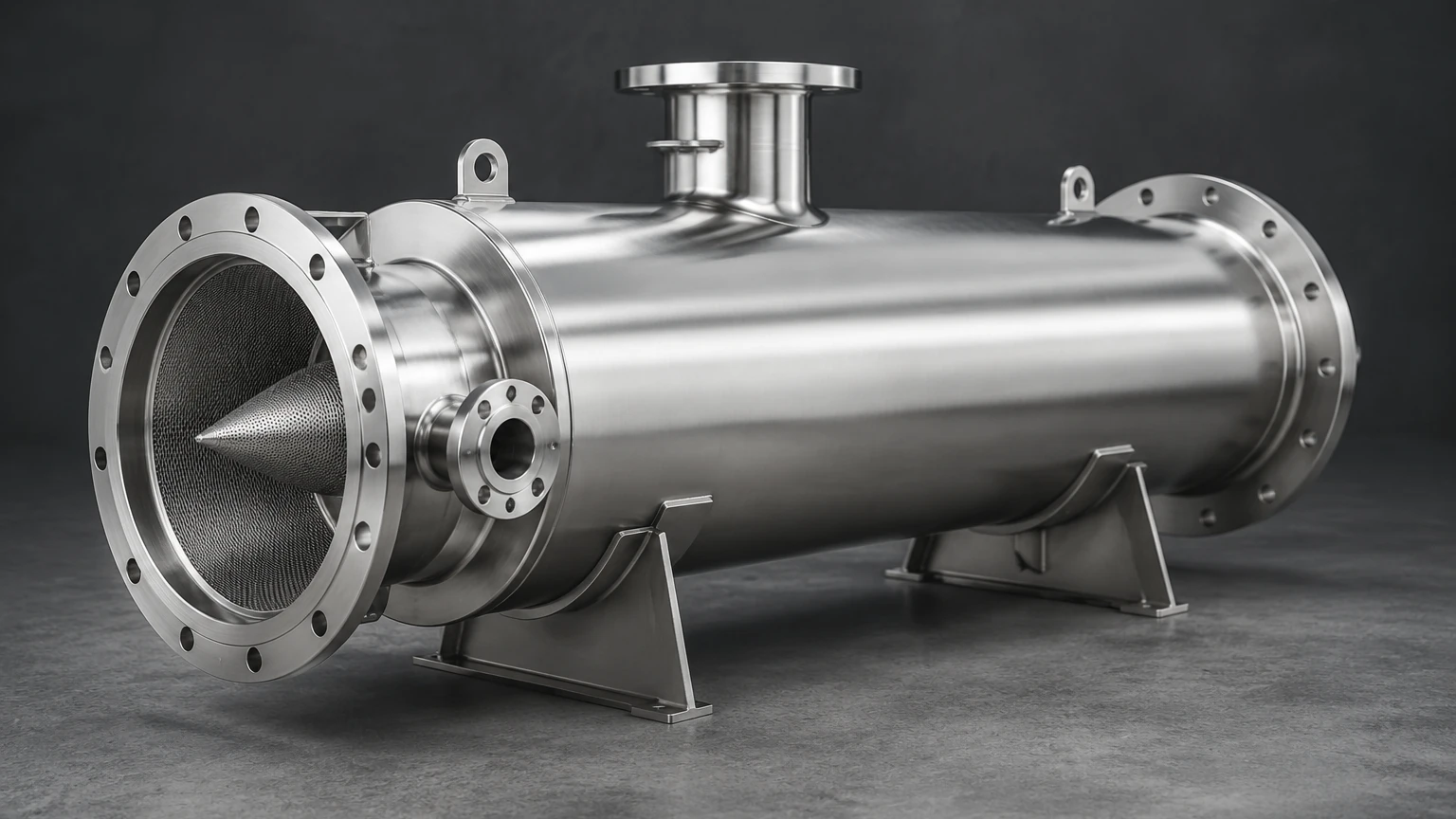
Integration with Secondary Filtration Systems
A horizontal cyclone separator is rarely the final stage of filtration. While highly effective at removing bulk solids (typically 5 microns and larger), they are less efficient at capturing sub-micron particles or aerosols.
In a typical industrial process, the horizontal cyclone acts as a "pre-filter." By removing 90% to 95% of the heavy particulate load, it protects more sensitive downstream components. This is where precision stainless steel filter cartridges and wire mesh filters become essential.
Integrating a Kaifil stainless steel filter cartridge after a horizontal cyclone provides several benefits:
1. Extended Filter Life: Because the cyclone handles the bulk of the solids, the fine mesh filters do not clog as quickly, reducing the frequency of replacement cycles.
2. System Reliability: The combination of centrifugal separation and mechanical barrier filtration ensures that even during process upsets (where a surge of solids might occur), the downstream equipment remains protected.
3. Total Cost of Ownership: While the initial investment in a cyclone and a high-quality stainless steel filter housing is higher, the reduction in maintenance labor and the elimination of frequent disposable filter purchases result in lower long-term costs.
Common Risks and Performance Optimization
Engineers must be aware of potential failure modes in horizontal cyclone systems to ensure long-term operational stability.
Erosion and Wear
High-velocity particles hitting the walls of the cyclone can lead to localized erosion, particularly near the inlet and the bottom of the cylinder. Utilizing hardened stainless steel or applying wear-resistant coatings can mitigate this. Regular ultrasonic thickness testing is recommended for systems handling abrasive materials like sand or metal shavings.
Re-entrainment
If the collection hopper is not properly sealed or if the vortex extends too far into the discharge area, separated solids can be picked back up by the inner vortex and carried out through the clean fluid exit. This is often caused by improper pressure balancing or blockages in the solids discharge valve.
Pressure Drop Monitoring
An unexpected increase in pressure drop usually indicates a blockage or a build-up of material on the vortex finder. Conversely, a sudden drop in pressure might indicate a breach in the internal components or a failure of the inlet seals. Continuous monitoring via differential pressure transmitters is a best practice for industrial filtration skids.
Information Confirmation for Purchasing Teams
Before finalizing a specification for a horizontal cyclone separator or its associated stainless steel filtration components, technical professionals should confirm the following data points:
* Particle Size Distribution (PSD): What is the smallest particle size that must be removed? This determines if a cyclone is sufficient or if a secondary stainless steel mesh filter is required.
* Fluid Properties: Confirm the density, viscosity, and chemical composition of the carrier fluid at operating temperature and pressure.
* Solids Loading: What is the concentration of solids (e.g., mg/m³ or ppm)? High loading may require a larger collection hopper or continuous discharge mechanisms.
* Regulatory Compliance: Does the unit need to meet ASME, PED, or FDA standards? This will dictate the welding procedures and material certifications required during manufacturing.
Conclusion
The horizontal cyclone separator is a robust and space-efficient tool for industrial phase separation. By leveraging centrifugal forces, it provides a low-maintenance solution for bulk solids removal. However, for applications requiring high-purity outputs, the cyclone should be viewed as one part of a comprehensive filtration strategy. Combining the primary separation power of a cyclone with the precision and durability of custom stainless steel wire mesh and cartridges ensures an optimized process that protects equipment and maintains product quality.
For engineers seeking to optimize their filtration systems with custom-engineered metal components, exploring the technical resources and product capabilities available on the Main Page is the recommended next step in the procurement process.
