


Hot Gas Filters
In industrial processing, the management of high-temperature gas streams is a critical engineering challenge. Hot gas filtration refers to the removal of particulate matter from gas streams at temperatures typically exceeding 250°C (480°F), and often reaching as high as 600°C to 900°C. At these temperatures, conventional polymer-based filter media fail, necessitating the use of advanced metallic or ceramic materials. For engineers and procurement teams, selecting the right hot gas filters is not merely about particle capture; it is about ensuring structural integrity, chemical resistance, and operational longevity in environments that would compromise standard filtration systems.
Industrial applications for hot gas filtration are diverse, ranging from catalyst recovery in chemical plants to emission control in waste-to-energy facilities and the protection of downstream equipment like gas turbines. As a specialized manufacturer of stainless steel filtration solutions, Kaifil provides the technical expertise and manufacturing precision required to develop components that withstand these rigorous thermal and mechanical stresses.
The Engineering Necessity of Hot Gas Filtration
The primary driver for implementing hot gas filters is the protection of downstream processes and compliance with environmental regulations. In many chemical and petrochemical processes, gases are produced at high temperatures and contain valuable catalysts or abrasive particulates. Filtering these gases while they are still hot—rather than cooling them first—offers several process advantages:
1. Energy Efficiency: Maintaining the gas at process temperature avoids the energy loss associated with cooling and subsequent reheating. It also prevents the condensation of acid gases or hydrocarbons, which can lead to severe corrosion or fouling of equipment.
2. Equipment Protection: High-velocity particulates in a hot gas stream can cause rapid erosion of turbine blades, heat exchanger tubes, and compressors. Effective filtration extends the mean time between failures (MTBF) for these expensive assets.
3. Environmental Compliance: Strict air quality standards require the removal of fine particulates (PM2.5 and PM10) from flue gases before they are discharged into the atmosphere. Hot gas filters provide a robust barrier that ensures consistent emission levels even during process upsets.
Material Selection and Metallurgical Considerations
When designing filters for high-temperature service, material selection is the most critical factor. The chosen material must exhibit high creep strength, resistance to oxidation, and compatibility with the chemical composition of the gas stream. Stainless steel is the industry standard for most applications up to 500°C–600°C, while specialized alloys are used for higher ranges.
Stainless Steel (304 and 316L)
Stainless steel remains the most common choice due to its balance of mechanical strength and cost-effectiveness. Grade 316L is particularly favored in chemical processing because the addition of molybdenum enhances resistance to pitting and crevice corrosion. In hot gas applications, these materials are typically used in the form of sintered wire mesh or sintered metal fibers.
High-Nickel Alloys
For environments involving extreme temperatures or highly corrosive gases (such as those containing high concentrations of sulfur or chlorides), alloys like Inconel 600, Hastelloy C276, or Monel are utilized. These materials maintain their mechanical properties at temperatures where standard stainless steels would undergo rapid oxidation or lose structural rigidity.
Sintered Metal Media
Sintered metal media are preferred for hot gas filters because the sintering process fuses the metal contact points, creating a rigid, porous structure. This structure prevents media migration—a common failure mode in fiber-based filters where individual fibers break loose and contaminate the downstream flow. Sintered media can be engineered with specific pore sizes to provide precise filtration ratings from 1 micron to over 100 microns.
Structural Design and Filtration Mechanisms
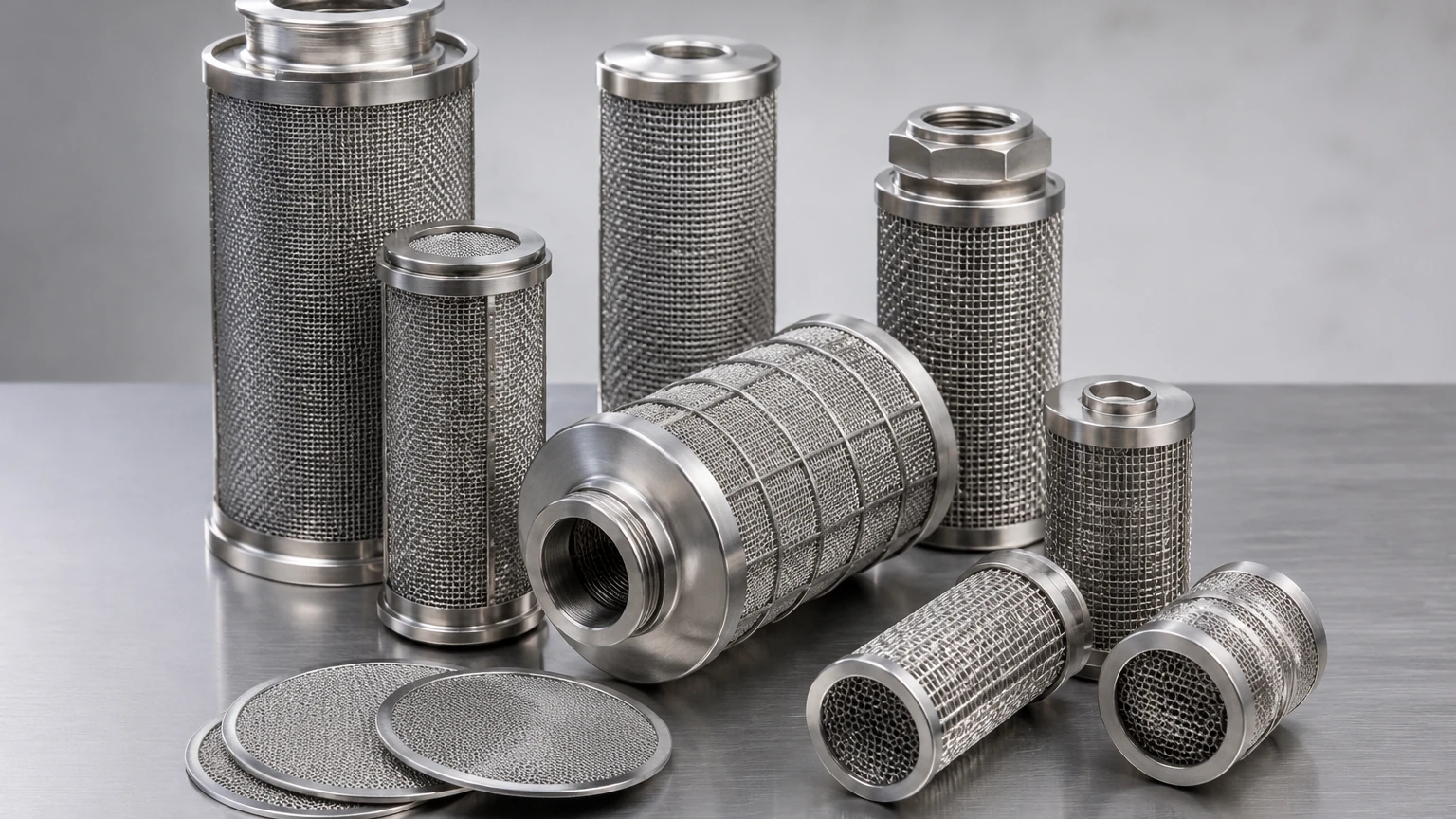
Hot gas filters must be designed to handle significant pressure differentials and thermal expansion cycles. The most common configuration is the "filter candle" or cylindrical cartridge. These components often feature a multi-layer construction:
* The Control Layer: This is the primary filtration medium, such as a fine sintered wire mesh or metal fiber felt, which determines the filtration accuracy.
* The Support Layer: A coarser mesh or perforated metal core provides the mechanical strength necessary to prevent the filter from collapsing under high differential pressure.
* The Drainage Layer: This layer ensures an even distribution of flow across the filter surface, reducing localized high-velocity zones that could lead to premature wear.
In hot gas systems, filtration primarily occurs through three mechanisms: inertial impaction, interception, and diffusion. For larger particles at high velocities, inertial impaction is dominant. For sub-micron particles, Brownian diffusion plays a larger role. Engineers must evaluate the particle size distribution (PSD) of the gas stream to determine the optimal pore size and media thickness.
Managing Pressure Drop and Cleaning Cycles
The performance of hot gas filters is measured by their ability to maintain a low pressure drop while effectively capturing particulates. As particles accumulate on the filter surface, a "filter cake" forms. While this cake actually improves filtration efficiency, it also increases the resistance to flow (differential pressure).
To maintain continuous operation, hot gas filtration systems often employ an online cleaning mechanism known as pulse-jet cleaning. A high-pressure pulse of inert gas (usually nitrogen or compressed air) is released into the clean side of the filter, momentarily reversing the flow and dislodging the filter cake.
For this cleaning method to be effective, the filter media must be robust enough to withstand the mechanical shock of the pulse. This is where the engineering of the Main Page products becomes vital. Custom-designed stainless steel cartridges from Kaifil are engineered with reinforced support structures to ensure that repeated pulsing does not lead to fatigue failure or permanent deformation of the media.
Common Risks and Mitigation Strategies
Operating at high temperatures introduces specific risks that must be addressed during the design phase:
Thermal Shock
Rapid changes in temperature, such as during start-up or shut-down, can cause differential expansion between the filter element and the housing. This can lead to cracking or seal failure. Using materials with similar coefficients of thermal expansion and incorporating flexible sealing mechanisms can mitigate this risk.
Chemical Corrosion
High-temperature gases can be highly reactive. For example, in reducing atmospheres, some metals may undergo "metal dusting," a catastrophic form of corrosion. Engineers must perform a thorough chemical compatibility analysis, considering not just the primary gas components but also trace elements like vanadium, sulfur, or alkalis that can form low-melting-point salts.
Particulate Bridging
If the particulate load is too high or the cleaning cycle is poorly timed, particles can bridge the gap between adjacent filter elements, leading to a permanent blockage that cannot be cleared by pulsing. Proper spacing of filter elements within the vessel and optimized pulse-jet timing are essential to prevent this.
Selection Criteria for Engineers and Purchasing Teams
When sourcing hot gas filters, providing detailed application data to the manufacturer is essential for a successful installation. Engineers should confirm the following parameters:
* Operating and Design Temperature: Include both the steady-state temperature and any potential excursions.
* Gas Composition: Identify all chemical components, including moisture content and the presence of corrosive agents.
* Particle Characteristics: Specify the particle size distribution, concentration (mg/Nm³), and whether the particles are abrasive, sticky, or friable.
* Flow Rate: Define the actual flow rate at operating conditions (Am³/h) rather than just standard conditions (Nm³/h).
* Allowable Pressure Drop: Establish the maximum clean and dirty pressure drop limits for the system.
Kaifil works closely with technical teams to translate these requirements into customized filtration solutions. By controlling the manufacturing process from material selection to final assembly, we ensure that each filter component meets the specific demands of the industrial environment.
Total Cost of Ownership (TCO) Considerations
While the initial capital expenditure for stainless steel hot gas filters is higher than for disposable or lower-grade alternatives, the total cost of ownership is significantly lower in the long run. The durability of metal filters allows for multiple cleaning cycles and a service life that can span several years.
Factors contributing to a lower TCO include:
* Reduced Downtime: High-quality filters require less frequent replacement, minimizing process interruptions.
* Lower Maintenance Costs: Automated cleaning systems reduce the need for manual intervention.
* Recovered Value: In applications like catalyst recovery, the high efficiency of metal filters allows for the capture of valuable materials that would otherwise be lost.
Conclusion
Hot gas filters are essential components for modern industrial processes that demand high efficiency, environmental responsibility, and equipment protection. The transition from standard filtration to high-temperature metallic solutions requires a deep understanding of material science, fluid dynamics, and mechanical engineering.
By focusing on precision-engineered stainless steel and alloy solutions, Kaifil provides the reliability needed for these demanding applications. Whether you are designing a new system or looking to optimize an existing process, selecting the right filtration partner is the first step toward achieving stable and cost-effective performance. To explore our full range of custom filtration capabilities and technical support, visit our Main Page.
