


Hot Gas Filtration
Hot gas filtration is a critical process in modern industrial engineering, designed to remove particulate matter from gas streams at elevated temperatures. Unlike standard ambient-air filtration, hot gas filtration typically operates in environments ranging from 250°C to over 1000°C. These conditions are common in sectors such as petrochemical processing, waste-to-energy plants, biomass gasification, and metallurgical smelting. The primary objective is to protect downstream equipment, recover valuable catalysts, or comply with stringent environmental emission standards without the need for energy-intensive cooling of the gas stream.
Selecting the appropriate filtration system for high-temperature applications requires a deep understanding of material science, fluid dynamics, and the specific chemical composition of the process gas. As a specialized manufacturer, Kaifil provides engineered solutions that address the unique challenges of these demanding environments. For more information on our full range of industrial filtration components, you may visit our Main Page.
Understanding the Fundamentals of Hot Gas Filtration
The fundamental principle of hot gas filtration involves the separation of solid particles from a gaseous medium using a porous barrier. In high-temperature settings, this barrier must maintain its mechanical integrity and filtration efficiency despite thermal expansion and potential chemical attack.
In many industrial processes, maintaining the gas at a high temperature is thermodynamically advantageous. For instance, in gasification or catalytic cracking, cooling the gas to use conventional fabric filters would result in significant energy loss and potential condensation of corrosive vapors or tars. By employing hot gas filtration, engineers can process the gas at its operating temperature, improving overall thermal efficiency and reducing the footprint of the heat exchange equipment.
Mechanically, the filtration process relies on several capture mechanisms: inertial impaction, interception, and diffusion. For larger particles at high velocities, inertial impaction is dominant. For sub-micron particles, Brownian diffusion plays a larger role. In industrial hot gas applications, the formation of a "filter cake"—a layer of captured particles on the surface of the media—often provides the highest level of filtration efficiency, though it also increases the pressure drop across the system.
Material Engineering for High-Temperature Environments
The choice of material is the most significant factor in the success of a hot gas filtration system. Standard polymers and low-grade metals fail rapidly under the combined stress of heat and corrosion. Therefore, stainless steel and high-performance alloys are the industry standard for these applications.
Stainless Steel 316L and 310S
Stainless steel 316L is frequently used for applications up to 400°C due to its excellent corrosion resistance and mechanical strength. However, when temperatures exceed 500°C, oxidation becomes a concern. In these instances, 310S stainless steel is preferred. With higher chromium and nickel content, 310S offers superior oxidation resistance at temperatures up to 800°C, making it suitable for furnace components and heat treatment equipment.
Nickel-Based Alloys
In extreme environments where temperatures exceed 800°C or where the gas stream contains highly corrosive elements like sulfur or chlorides, nickel-based alloys such as Inconel 600 or Hastelloy are utilized. These materials provide exceptional creep resistance and maintain their structural stability under cyclic thermal loading, which is common in pulse-jet cleaning systems.
Porous Ceramics
For temperatures exceeding 1000°C, ceramic filters are sometimes employed. While they offer unmatched thermal resistance, they are inherently brittle and susceptible to thermal shock. Consequently, metal-based filtration remains the preferred choice for most industrial applications where durability and resistance to mechanical vibration are required.
Sintered Metal Media: The Core of Efficient Gas Purification
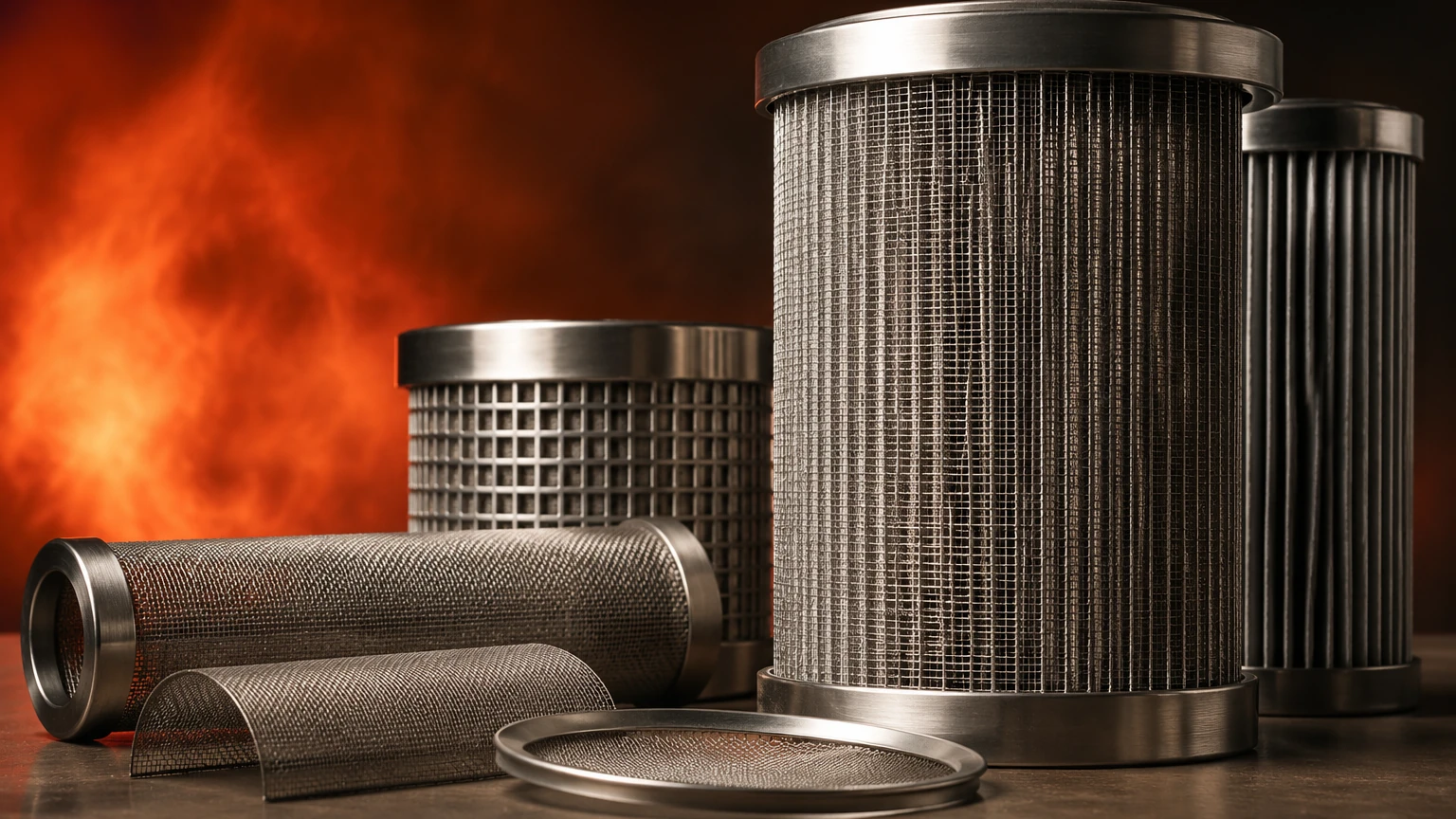
Hot gas filtration systems typically utilize sintered metal media due to their robustness and precise pore structures. Sintering is a process where metal powders or fibers are heated below their melting point to bond the particles together, creating a rigid and porous structure.
1. Sintered Wire Mesh: This media consists of multiple layers of woven wire mesh that are sintered together. It provides excellent mechanical strength and a predictable pore size. It is ideal for surface filtration where the filter cake can be easily removed through backpulsing.
2. Sintered Metal Fiber (Felt): Made from non-woven stainless steel fibers, this media offers high porosity (up to 80%) and a high dirt-holding capacity. The random orientation of the fibers creates a tortuous path for the gas, facilitating deep-bed filtration and high efficiency for fine particulates.
3. Sintered Porous Metal: Created from metal powders, these components offer high structural rigidity and are often used in the form of filter cartridges or tubes. They are particularly effective in high-pressure applications where the filter must withstand significant differential pressure.
Each of these structures offers different advantages regarding permeability and filtration rating. Engineers must balance the need for high efficiency (low micron rating) with the requirement for low pressure drop to minimize energy consumption by the system's blowers or compressors.
Critical Performance Metrics and Engineering Considerations
When designing or specifying a system for hot gas filtration, several technical parameters must be evaluated to ensure long-term reliability.
Pressure Drop (Delta P)
The pressure drop across the filter media is a function of the gas velocity (face velocity), gas viscosity, and the permeability of the filter media. In hot gas applications, gas viscosity increases with temperature, which inherently increases the pressure drop compared to ambient conditions. Engineers use Darcy’s Law to calculate the initial pressure drop and must account for the additional resistance caused by the accumulating filter cake.
Filtration Rating and Efficiency
Filtration efficiency is typically defined by the percentage of particles of a specific size that the media can capture. In hot gas streams containing catalysts, high-efficiency filtration (often 99.9% or higher) is required to prevent the loss of expensive materials and to protect downstream turbines from erosion.
Thermal Expansion
Metals expand when heated. In a large filtration vessel containing hundreds of filter elements, the cumulative thermal expansion can be significant. The housing and the filter supports must be designed to accommodate this movement without compromising the seals or causing mechanical fatigue in the filter elements.
Operational Challenges: Thermal Shock and Chemical Corrosion
Hot gas filtration systems face two primary operational threats: thermal shock and chemical degradation.
Thermal Shock occurs during rapid temperature changes, such as during system start-up, shut-down, or the injection of cool cleaning gas (pulse-jet). If the temperature gradient is too steep, the resulting internal stresses can lead to cracking or warping of the filter media. Using materials with low thermal expansion coefficients and designing controlled ramp-up procedures are essential mitigation strategies.
Chemical Corrosion is exacerbated by high temperatures. In many gasification processes, the presence of hydrogen sulfide (H2S) can lead to sulfidation of the metal. Similarly, in waste incineration, the presence of chlorine can cause rapid pitting and intergranular corrosion. Selecting the correct alloy—such as moving from 316L to a high-nickel alloy—is the primary defense against these chemical threats. Furthermore, the gas must remain above its acid dew point to prevent the condensation of corrosive liquids on the filter surface, which can lead to rapid "blinding" of the media and accelerated corrosion.
Maintenance and Cleaning Strategies for Extended Service Life
To maintain a sustainable pressure drop, hot gas filtration systems utilize an in-situ cleaning mechanism, most commonly the pulse-jet system. During this process, a high-pressure pulse of clean gas (often nitrogen or compressed air) is injected in the reverse direction of the flow. This pulse dislodges the filter cake, which then falls into a hopper for collection.
Effective cleaning depends on several factors:
* Pulse Pressure and Duration: Must be sufficient to overcome the forward flow without damaging the media.
* Gas Compatibility: The cleaning gas must be compatible with the process gas to avoid unwanted reactions or contamination.
* Cycle Timing: Cleaning cycles are usually triggered by a timer or a pre-set differential pressure limit.
Regular inspection of the filter elements is necessary to identify signs of "bridging" (where the filter cake becomes too thick to be removed) or mechanical wear. In many industrial settings, stainless steel filter cartridges can be removed and cleaned ultrasonically or through chemical baths to restore their original permeability, significantly extending their service life compared to disposable alternatives.
Selecting a Custom Filtration Solution for Industrial Applications
Every industrial process has unique requirements regarding gas flow rates, particle size distribution, and chemical environment. A one-size-fits-all approach is rarely successful in hot gas filtration. Customization is often required in the following areas:
* Filter Geometry: Custom lengths, diameters, and end-cap configurations (such as threaded, flange, or 222/226 fittings) to fit existing housings.
* Multi-Stage Filtration: Combining a coarse pre-filter with a fine sintered fiber secondary filter to optimize dirt-holding capacity.
* Reinforced Structures: Adding internal or external support cores to withstand high differential pressures or mechanical vibrations.
Engineers should work closely with manufacturers to confirm the exact operating parameters before procurement. This includes verifying the peak operating temperature, the chemical composition of the gas (including trace elements), and the required particulate emission levels. By addressing these factors during the design phase, companies can ensure they receive a filtration solution that offers the lowest total cost of ownership through durability and high performance.
For technical support and to explore our range of custom stainless steel filtration components, visit our Main Page. Our team provides expertise in material selection and precision manufacturing to meet the specific needs of your high-temperature gas processing applications.
