


How Do Coalescing Plate Separators Work
In industrial wastewater treatment and process fluid management, the separation of non-emulsified oil from water is a critical requirement for environmental compliance and equipment longevity. Coalescing plate separators (CPS) represent a standard engineering solution for this challenge. Unlike traditional gravity separators that rely solely on residence time in large tanks, coalescing plate separators utilize a series of engineered plates to accelerate the separation process. Understanding how do coalescing plate separators work requires a look into fluid dynamics, specifically Stokes' Law, and the mechanical design of the plate packs themselves.
For engineers and procurement teams, selecting the right filtration and separation technology involves evaluating the physical properties of the influent, the required effluent quality, and the durability of the internal components. As a manufacturer specializing in precision Main Page components and stainless steel filtration solutions, Kaifil provides the technical foundation for high-performance industrial separation systems.
Understanding the Fundamentals of Oil-Water Separation
To answer the question of how do coalescing plate separators work, one must first understand the physics of buoyancy. Most oils are less dense than water, meaning they naturally want to rise to the surface. However, in an industrial flow, oil is often dispersed into millions of tiny droplets. The speed at which these droplets rise is governed by Stokes' Law.
Stokes' Law states that the rise rate of an oil droplet is proportional to the square of its diameter. Small droplets (e.g., 10 to 20 microns) rise incredibly slowly—often so slowly that they would be carried out of a standard gravity separator by the horizontal flow of water before they ever reached the surface.
There are three ways to increase the efficiency of this separation:
1. Increase the surface area available for separation.
2. Decrease the distance a droplet must rise before it is captured.
3. Increase the droplet size through a process called coalescence.
Coalescing plate separators are designed to address all three of these factors simultaneously within a compact footprint.
The Mechanics of the Coalescing Plate Pack
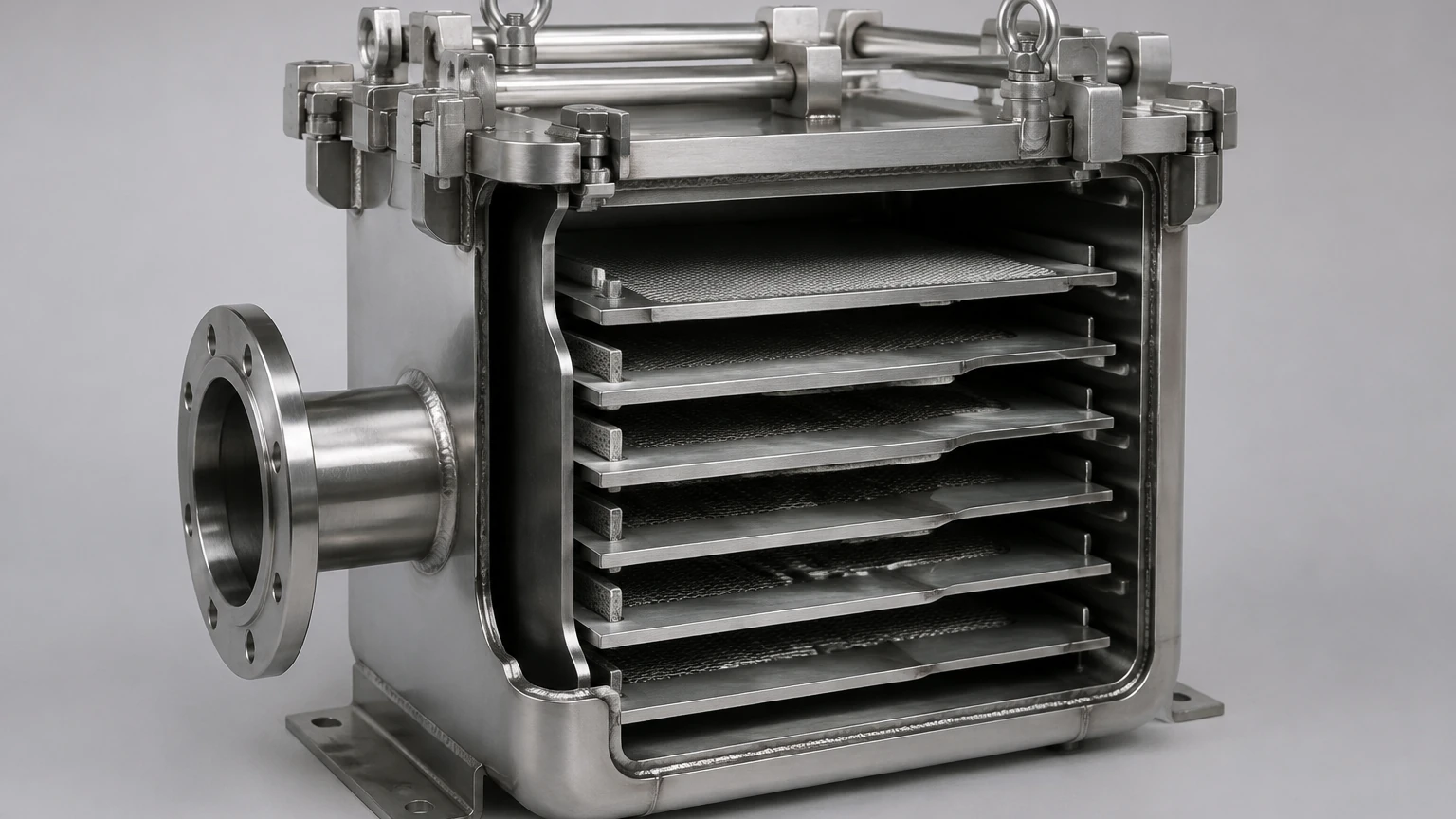
The core of the system is the plate pack. This assembly consists of a series of parallel plates, often corrugated or slanted at an angle (typically 45 to 60 degrees). When oily water enters the separator, it is directed through these plate gaps.
The Capture Phase
As the fluid flows through the narrow spaces between the plates, the distance an oil droplet must rise to reach a solid surface is drastically reduced—often to less than an inch. Once a droplet hits the underside of a plate, it is effectively "captured." It is no longer subject to the turbulent or high-velocity flow of the main water stream.
The Coalescence Phase
This is the pivotal stage in how do coalescing plate separators work. As more droplets hit the underside of the plate, they begin to merge or "coalesce" with one another. Because Stokes' Law dictates that larger droplets rise faster, the merging of many 10-micron droplets into a single 100-micron droplet increases the buoyancy force exponentially.
The Migration Phase
Because the plates are slanted, the newly formed larger oil masses slide upward along the smooth surface of the plate. They eventually reach the top of the plate pack, where they break free and rise rapidly to the surface of the separator tank to form a concentrated oil layer that can be skimmed off. Conversely, heavy solids and sludge hit the top side of the plates and slide downward into a collection hopper.
Material Selection and Engineering Durability
The efficiency of a coalescing plate separator is not just a result of its geometry, but also the materials used in its construction. While some low-cost separators use plastic or PVC plates, industrial applications in chemical processing or high-temperature environments require more robust materials.
Stainless steel is often the preferred material for high-performance coalescing plates. Using 304 or 316L stainless steel ensures that the plates can withstand corrosive chemicals, high pressures, and thermal cycling without warping or degrading. Furthermore, the surface energy of the material affects how droplets attach and move. Precision-manufactured metal surfaces can be treated or finished to optimize the coalescence of specific oil types.
At Kaifil, our expertise in custom stainless steel filtration components allows us to support the manufacturing of separators that require high-precision internal structures. Whether it is the wire mesh used for pre-filtration to protect the plate pack or the plates themselves, material integrity is paramount to maintaining the design flow rate and separation efficiency over time.
Key Factors Influencing Separation Efficiency
While the mechanical design explains how do coalescing plate separators work in theory, several real-world variables dictate their actual performance in an industrial setting. Engineers must account for these factors during the specification phase:
1. Specific Gravity of the Oil
The closer the density of the oil is to the density of the water, the more difficult the separation becomes. If the specific gravity of the oil is 0.95, the buoyancy force is much lower than if the oil has a specific gravity of 0.85. Coalescing plates are essential in these "tight" density applications because they maximize the opportunity for droplets to merge and gain buoyancy.
2. Operating Temperature
Temperature affects the viscosity of the water. According to Stokes' Law, lower viscosity (which occurs at higher temperatures) allows oil droplets to rise faster. However, higher temperatures can also damage plastic internal components, which is why stainless steel plate packs are often required for process water that exceeds 140°F (60°C).
3. Droplet Size Distribution
If the oil is chemically emulsified (often due to surfactants or detergents), coalescing plates cannot separate it. CPS units are designed for "free" or "dispersed" oil. If the influent contains a high percentage of droplets smaller than 20 microns, the plate spacing must be tighter, and the flow velocity must be lower to allow for sufficient capture time.
Maintenance and Operational Considerations
A common question regarding how do coalescing plate separators work is how they handle solids. Because the plates provide a large surface area, they are susceptible to fouling if the wastewater contains high levels of suspended solids, biological growth, or "sticky" contaminants.
To maintain performance, the following maintenance protocols are typically required:
* Pre-filtration: Installing a stainless steel wire mesh filter or a perforated metal screen upstream can capture large debris and heavy solids before they reach the plate pack. This prevents the narrow gaps between the plates from clogging.
* Cleaning Cycles: Depending on the application, plate packs may need to be pulled and pressure-washed. Systems designed with removable stainless steel plate modules make this process significantly faster and reduce downtime.
* Monitoring Pressure Drop: An increase in the pressure differential across the plate pack usually indicates fouling. Monitoring this helps operators determine the optimal cleaning schedule.
Technical Checklist for Industrial Procurement
Before investing in a coalescing plate separator system, engineering teams should confirm several technical parameters to ensure the equipment matches the application requirements. Relying on a manufacturer like Kaifil for the internal filtration components ensures that these specifications are met with precision.
1. Flow Rate (GPM/LPM): Does the separator handle the peak flow without exceeding the design velocity? If the water moves too fast, it will pull oil droplets through the plates before they can coalesce.
2. Effluent Requirements: What is the target oil concentration (e.g., <10 ppm)? This determines the necessary plate surface area.
3. Chemical Compatibility: Are the oils or chemicals in the water aggressive toward polymers? If so, stainless steel internals are mandatory.
4. Solids Loading: What is the concentration of suspended solids? This will dictate whether a pre-filtration stage is necessary and what type of plate spacing is required.
5. Customization Options: Does the application require a specific footprint? Custom-designed plate packs can often be retrofitted into existing tanks to improve efficiency without the cost of a full system replacement.
Why Precision Manufacturing Matters
The effectiveness of the coalescence process depends on the uniformity of the plate spacing and the smoothness of the material. Inconsistencies in the manufacturing of the plate pack can lead to "channeling," where the fluid takes the path of least resistance, bypassing large sections of the coalescing media. This reduces the effective surface area and leads to poor effluent quality.
By utilizing advanced manufacturing capabilities, Kaifil ensures that every filtration component—from the stainless steel filter cartridges to the custom-engineered metal components—meets the strict tolerances required for industrial separation. High-quality construction translates to a longer service life, lower total cost of ownership, and reliable compliance with environmental regulations.
Conclusion
Coalescing plate separators are an elegant and efficient solution to a complex fluid dynamics problem. By leveraging the principles of Stokes' Law and providing a controlled environment for oil droplets to merge, these systems allow industries to achieve high-purity water discharge and recover valuable oils.
Understanding how do coalescing plate separators work is the first step in optimizing your facility's separation process. By focusing on material durability, precision engineering, and proper maintenance, engineers can ensure their separation systems perform reliably under the most demanding industrial conditions. For those seeking specialized components to enhance their filtration systems, exploring the options available on our Main Page can provide the technical support needed for your next project.
