


How Do You Backwash a Cartridge Filter
In industrial filtration, the ability to regenerate filter media is a critical factor in determining the total cost of ownership (TCO) and operational efficiency of a system. For engineers and maintenance teams managing high-flow or high-solids applications, the question of how do you backwash a cartridge filter is central to reducing downtime and waste. Unlike disposable depth or pleated polymer cartridges, which must be discarded once they reach their terminal differential pressure, specialized stainless steel cartridge filters are designed for repeated cleaning through backwashing.
This technical guide explores the mechanics, engineering requirements, and procedural steps involved in backwashing industrial cartridge filters, focusing on the performance of metal media in demanding environments.
The Fundamental Principles of Backwashing Cartridge Filters
Backwashing is a process of flow reversal. In standard filtration mode, the process fluid enters the filter housing, passes through the exterior of the cartridge to the interior (out-to-in), and exits as clean filtrate. During this process, contaminants are trapped on the surface or within the depth of the filter media.
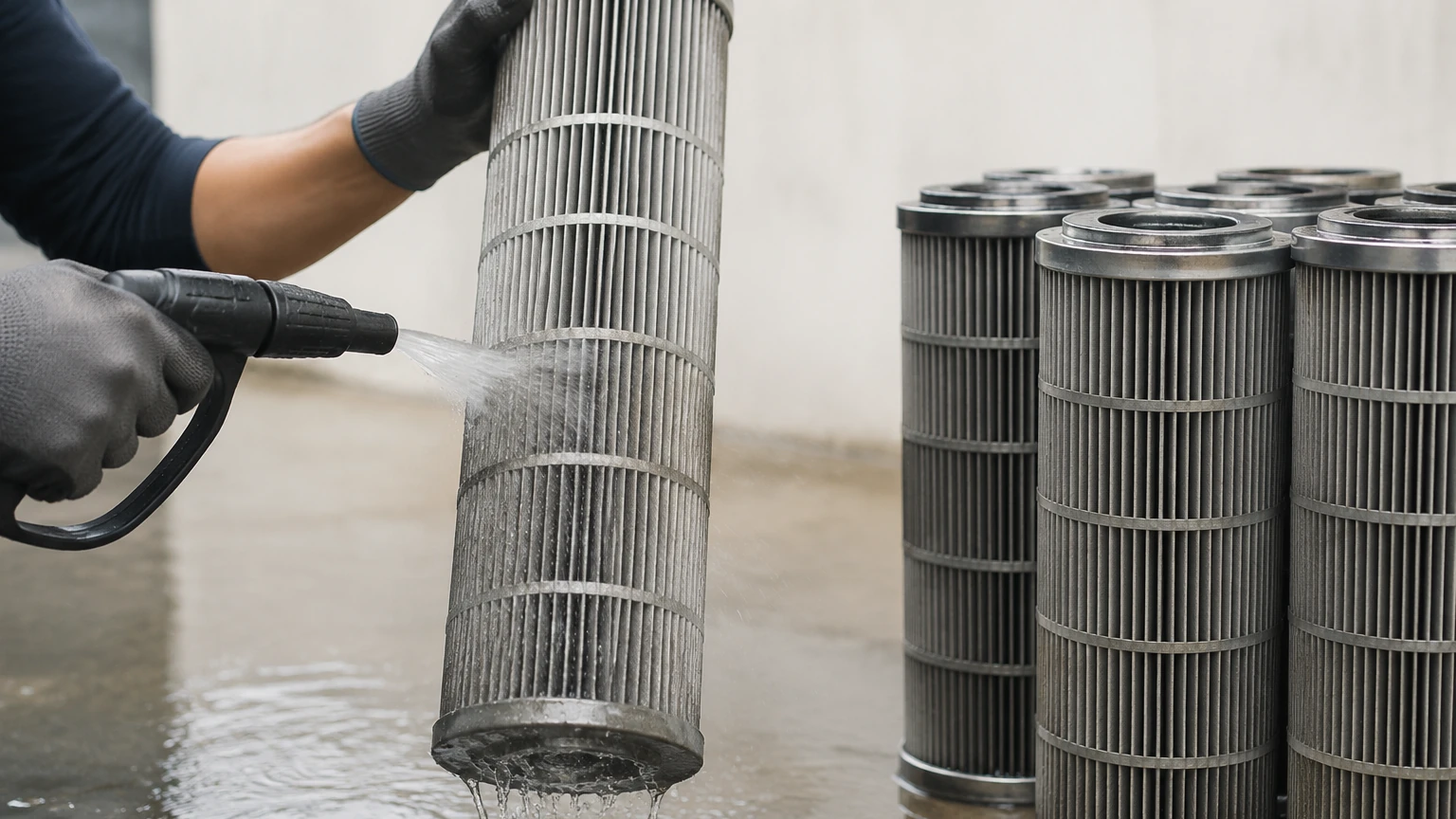
To backwash the filter, the flow is reversed. Clean fluid (or a dedicated backwash agent) is pumped from the inside of the cartridge toward the outside (in-to-out). This reverse pressure dislodges the accumulated "filter cake" or trapped particulates, flushing them out through a dedicated drain or blow-down valve.
The success of this operation depends on two primary factors: the physical strength of the filter media and the velocity of the reverse flow. Because backwashing subjects the filter to internal pressure that could cause a standard cartridge to burst or deform, only cartridges with a rigid internal support core and high-strength exterior—such as those found on the Main Page of specialized manufacturers—are suitable for this process.
Determining if Your Cartridge is Backwashable
Before implementing a backwash protocol, it is essential to confirm that the filter media is compatible with reverse-flow cleaning. Most industrial filters fall into two categories: consumable and cleanable.
1. Media Material and Structure
Disposable cartridges made from melt-blown polypropylene, string-wound fibers, or pleated paper are generally not backwashable. The fibers in these filters are designed to trap particles deep within the media; reversing the flow often compresses the fibers further or causes the media to rupture.
Conversely, stainless steel wire mesh, sintered metal fiber, and wedge wire cartridges are specifically engineered for backwashing. These materials offer the structural integrity required to withstand the reverse pressure (back-pressure) without losing their pore geometry or filtration accuracy.
2. Surface vs. Depth Filtration
Backwashing is most effective on surface-loading filters. When contaminants form a cake on the surface of a stainless steel mesh, the reverse flow can easily lift and remove the layer. Depth filtration media, which traps particles throughout the thickness of the material, is more challenging to backwash and may require ultrasonic cleaning or chemical soaking for full regeneration.
Engineering Requirements for a Backwash System
Implementing an effective backwash cycle requires more than just reversing a pump. The system must be engineered to handle the specific hydraulic demands of the cleaning cycle.
* Differential Pressure (DP) Monitoring: The system should be equipped with DP sensors. Backwashing is typically initiated when the pressure drop across the filter reaches a pre-set limit (e.g., 15–22 psi), indicating that the media is loaded with contaminants.
* Backwash Fluid Source: You must decide whether to use the filtered process fluid or an external clean fluid (such as deionized water or a solvent) for the backwash. Using the filtrate simplifies the piping but reduces the net yield of the system.
* Flow Velocity: To effectively dislodge particles, the backwash flow velocity often needs to be significantly higher than the forward filtration velocity. A common engineering rule of thumb is a backwash flow rate of 1.5 to 3 times the process flow rate.
* Valve Automation: In automated systems, a series of three-way valves or automated ball valves are used to isolate the filter from the process stream and open the backwash and drain lines simultaneously.
Step-by-Step Procedure: How Do You Backwash a Cartridge Filter?
If you are operating a manual or semi-automated system, following a precise sequence is vital to prevent water hammer or media damage. Here is the standard industrial procedure for how do you backwash a cartridge filter:
Step 1: Isolation
Close the inlet and outlet valves to isolate the filter housing from the main process line. Ensure the system is depressurized if necessary, though many backwash systems rely on maintained pressure to drive the reverse flow.
Step 2: Opening the Drain
Open the backwash drain valve (also known as the sludge or blow-down valve). This creates a low-pressure exit point for the contaminants and the backwash fluid.
Step 3: Initiating Reverse Flow
Slowly open the backwash inlet valve (located on the clean side of the filter). By introducing fluid from the clean side, you force the particulates off the exterior of the cartridge. It is critical to increase the flow gradually to avoid a pressure spike that could fatigue the metal mesh.
Step 4: Duration and Observation
Continue the backwash for a set duration—typically 30 to 120 seconds, depending on the solids loading. In systems with sight glasses, the operator can observe the clarity of the flush water. The cycle is complete when the discharge fluid runs clear.
Step 5: Return to Service
Close the backwash inlet and the drain valve. Slowly open the main inlet valve to fill the housing, then open the outlet valve to resume normal filtration. Monitor the initial differential pressure to ensure it has returned to the "clean" baseline.
Key Performance Indicators and Evaluation Criteria
To determine if the backwash was successful, engineers track specific metrics. The most important is the Clean Differential Pressure (Clean DP). If a new filter starts at 2 psi and the backwashed filter returns to 3 psi, the cleaning was successful. However, if the DP remains high (e.g., 10 psi) after backwashing, it indicates "blinding" or "plugging," where particles are permanently lodged in the media.
Another KPI is the Recovery Percentage. This measures how much of the original flow capacity is restored after each cycle. Over dozens of cycles, this percentage may slowly decline, eventually indicating that the cartridge requires professional cleaning or replacement.
Potential Risks and Operational Challenges
While backwashing extends the life of stainless steel cartridges, it is not without risks. Understanding these challenges is part of mastering how do you backwash a cartridge filter effectively.
* Media Fatigue: Repeated cycles of pressure reversal can cause mechanical stress on the wire mesh. Over time, this can lead to work hardening and eventual cracking of the metal. High-quality sintered media is often preferred for high-frequency backwash applications due to its superior structural bond.
* Incomplete Cleaning: If the backwash flow is too low, or if the contaminants are oily/sticky, the backwash may only clear the path of least resistance. This results in "channeling," where only a portion of the filter is cleaned, leading to rapid pressure buildup once the system returns to service.
* Contaminant Re-entrainment: If the drain line is not properly sized, dislodged particles may settle back onto the filter media before they can be flushed out of the housing.
Economic and Environmental Considerations for Reusable Filters
For purchasing teams, the decision to move to a backwashable cartridge system is usually driven by long-term cost savings. While a stainless steel cartridge has a higher upfront cost than a disposable one, the elimination of frequent replacement costs, labor for filter changes, and hazardous waste disposal fees often results in a payback period of less than 12 months.
Furthermore, in industries like chemical processing or pharmaceutical manufacturing, reducing the frequency of opening the filter housing minimizes the risk of environmental exposure and product contamination. By mastering the backwash process, facilities can achieve a more sustainable and closed-loop filtration operation.
Conclusion
Knowing how do you backwash a cartridge filter is essential for optimizing industrial filtration systems. By selecting the correct rigid media—specifically stainless steel or sintered alloys—and implementing a robust hydraulic reversal protocol, engineers can significantly extend the service life of their filtration components.
Successful backwashing relies on precise engineering, from monitoring differential pressure to ensuring adequate reverse flow velocity. For those seeking to implement these high-performance solutions, reviewing the technical capabilities and customization options available on the Main Page is the first step toward a more efficient, cost-effective filtration strategy.
