


Filter Reactor
In modern industrial processing, the integration of multiple chemical and mechanical operations into a single vessel has become a standard for efficiency and purity. The filter reactor, often referred to as a Nutsche filter dryer in pharmaceutical and fine chemical contexts, represents a critical piece of equipment that combines reaction, filtration, washing, and drying. By consolidating these steps, engineers can minimize material handling, reduce the risk of environmental exposure, and maintain the integrity of sensitive compounds.
For technical professionals and procurement teams, understanding the nuances of the filtration components within these reactors is essential for ensuring long-term operational reliability and product quality. As a specialized manufacturer of stainless steel filtration solutions, Kaifil provides the precision-engineered components that enable these complex systems to function under high-pressure and corrosive conditions.
The Functional Evolution of the Filter Reactor
The primary advantage of a filter reactor is its ability to perform solid-liquid separation immediately following a chemical reaction without transferring the slurry to a separate filtration unit. This "closed-system" approach is particularly vital in the production of Active Pharmaceutical Ingredients (APIs) and hazardous chemicals where containment is a priority.
In a typical cycle, the reactor vessel facilitates the chemical synthesis under controlled temperature and agitation. Once the reaction is complete, the vessel transitions into filtration mode. By applying either positive pressure to the top of the vessel or a vacuum to the bottom, the liquid phase (mother liquor) is forced through a filter plate located at the base of the reactor. The solid particles are retained on the surface of the filter media, forming a "filter cake."
This integration requires the filtration media to be exceptionally robust. Unlike standard inline filters, the media in a filter reactor must withstand the mechanical stresses of an agitator, which often moves vertically to smooth the filter cake or assist in the re-slurrying process during washing phases. For those seeking comprehensive details on specialized filtration components, visiting the Main Page of a dedicated manufacturer can provide insights into the material grades and designs available for these demanding environments.
Core Components and Engineering Requirements
A filter reactor is a sophisticated assembly where every component must be compatible with both the chemical process and the physical demands of filtration. The vessel itself is typically jacketed for temperature control, but the heart of the separation process lies in the filter base.
The Filter Plate Assembly
The filter plate is the structural foundation that supports the filter media. In industrial applications, this is usually a heavy-duty stainless steel plate perforated to allow high flow rates while providing the necessary rigidity to prevent deformation under pressure. In many custom designs, the filter plate is removable to facilitate thorough cleaning and inspection, which is a requirement in GMP-regulated industries.
Agitation Systems
The agitator in a filter reactor is not merely for mixing. It is often designed with S-shaped blades or specialized paddles that can be raised or lowered. During the filtration stage, the agitator can be used to "smooth" the cake, closing cracks that might lead to gas bypass and ensuring uniform washing. The proximity of the agitator to the filter mesh means that the filtration media must be perfectly flat and securely fastened to avoid mechanical interference.
Material Selection
Given the diverse range of chemicals processed in a filter reactor, material compatibility is non-negotiable. While Stainless Steel 316L is the industry standard due to its excellent corrosion resistance and mechanical strength, more aggressive environments may require specialized alloys like Hastelloy C22 or C276. These materials ensure that the filter media does not leach metallic ions into the product and remains resistant to pitting and crevice corrosion during long-term exposure to acidic or alkaline slurries.
Selecting Filtration Media for Reactor Applications
The choice of filtration media is perhaps the most critical decision in the design of a filter reactor. The media determines the filtration rating (micron size), the flow rate, and the ease of cake discharge.
Sintered Metal Mesh
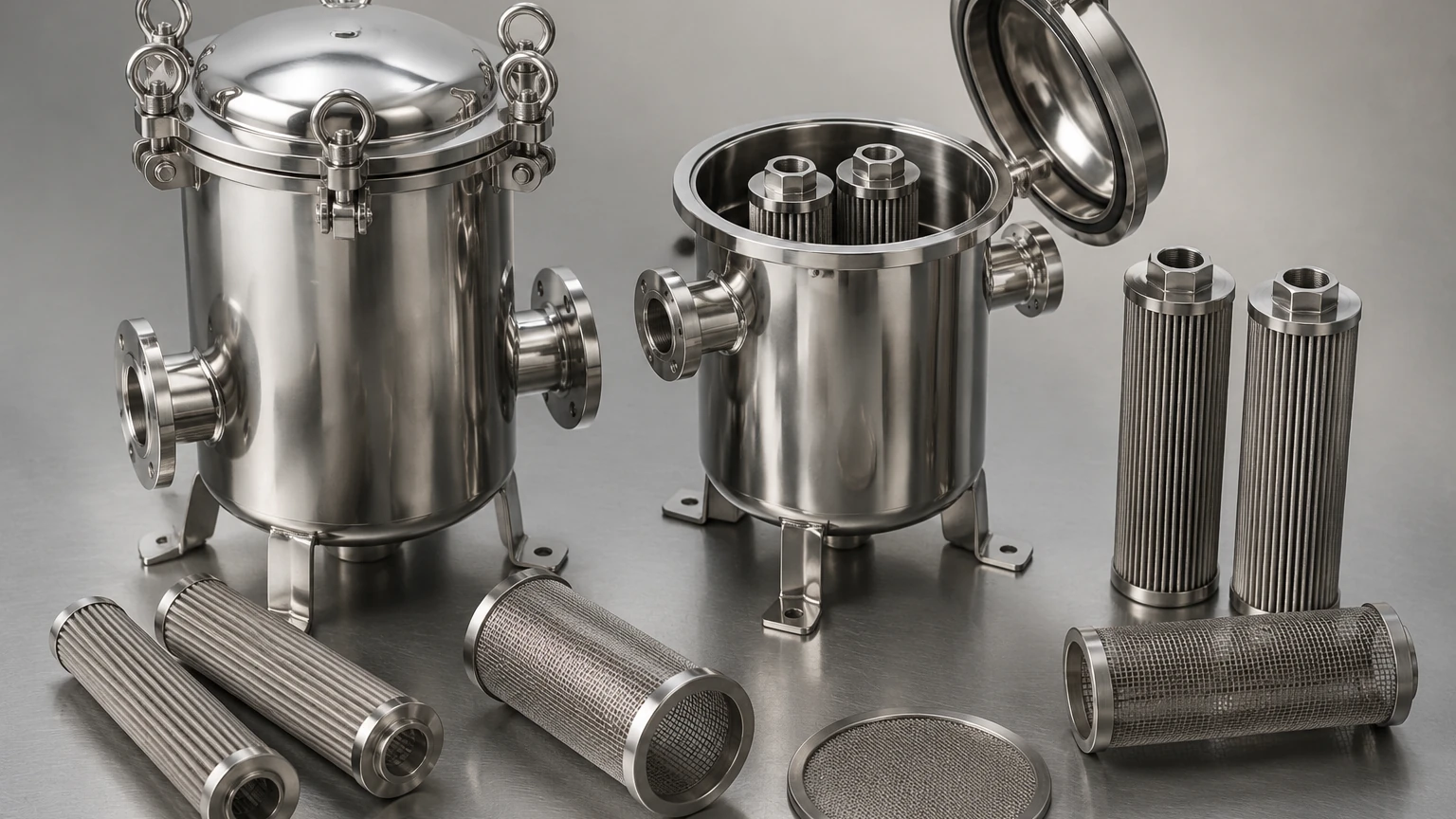
For most high-performance filter reactor applications, multi-layer sintered wire mesh is the preferred choice. This material is created by laminating several layers of stainless steel wire cloth and bonding them through a vacuum sintering process. The result is a porous metal sheet that combines the precise filtration rating of fine mesh with the mechanical strength of heavier support layers.
Sintered mesh offers several advantages for reactor systems:
* Structural Integrity: It does not migrate or deform under high differential pressure.
* Surface Filtration: Unlike felt or fabric, sintered mesh acts as a surface filter, making it easier to scrape or discharge the filter cake completely.
* Thermal Stability: It can withstand the high temperatures often required during the drying phase of the reactor cycle.
Wedge Wire Screens
In applications involving coarse particles or where high-velocity backwashing is required, wedge wire (V-wire) screens may be utilized. These provide a non-clogging surface and high open-area ratios, although they are generally limited to higher micron ratings compared to sintered mesh.
When specifying the media for a filter reactor, engineers must confirm the particle size distribution of the solids. Selecting a mesh that is too fine can lead to premature blinding and slow cycle times, while a mesh that is too coarse will allow "fines" to pass into the filtrate, compromising yield and purity.
Operational Efficiency and Cake Management
The efficiency of a filter reactor is measured by its cycle time and the purity of the final solid product. After the initial filtration, the filter cake often contains residual mother liquor, which may include impurities or unreacted reagents.
Cake Washing
Filter reactors excel at cake washing. The system can perform "displacement washing," where a wash solvent is passed through the cake, or "re-slurry washing," where the agitator is lowered to mix the wash solvent with the solids. The durability of the stainless steel filter base is vital here, as it must withstand the turbulence and mechanical force of the re-slurrying process without losing its seal or integrity.
Drying and Discharge
Following the wash cycles, the filter reactor often functions as a dryer. By applying a vacuum and heating the vessel jacket, the residual moisture in the cake is evaporated. The agitator may continue to rotate slowly to break up clumps and ensure uniform heat distribution. Once dry, the agitator or a side-discharge valve is used to remove the solids. The smooth surface of a precision-manufactured metal filter mesh is essential at this stage to ensure maximum product recovery and minimal residue.
Maintenance Protocols for Stainless Steel Filter Elements
To maintain the performance of a filter reactor, a rigorous maintenance and cleaning schedule is required. Over time, fine particles can become lodged within the pores of the filter media, a phenomenon known as blinding.
Cleaning-in-Place (CIP)
Most modern filter reactors are equipped with CIP spray balls. However, the filter mesh itself often requires targeted cleaning. Back-pulsing with a clean solvent or gas from the underside of the filter plate can help dislodge trapped particles. For stainless steel components, ultrasonic cleaning or chemical baths (such as nitric acid passivation) can be used to restore the original flow characteristics and ensure the surface remains passive and corrosion-resistant.
Inspection Cycles
Engineers should regularly inspect the filter media for signs of mechanical wear, such as fraying of the mesh or thinning of the support structures. In high-cycle environments, the constant pressure fluctuations can lead to fatigue. Utilizing high-quality sintered components from a reliable manufacturer ensures that these replacement cycles are extended, reducing the total cost of ownership.
Customization and OEM Integration in Reactor Design
Every chemical process is unique, and a "one-size-fits-all" approach to filtration rarely yields optimal results. Customization is often necessary to align the filtration media with specific flow rates, pressure drops, and chemical sensitivities.
When collaborating with a manufacturer like Kaifil, engineers can specify custom diameters, multi-stage filtration layers, and specialized mounting hardware. Whether the requirement is for a small-scale laboratory filter reactor or a large-scale industrial production unit, the precision of the metal filter component is what ultimately dictates the success of the separation.
Technical teams should confirm the following before finalizing a filter reactor component design:
1. Chemical Compatibility: Ensure the alloy grade matches the most aggressive reagent in the process.
2. Pressure Ratings: The filter plate must handle the maximum differential pressure of the reactor's pump or gas system.
3. Micron Retention: The absolute vs. nominal rating of the mesh must be chosen based on the smallest critical particle size.
4. Seal Integrity: The method of securing the mesh to the plate (welding, mechanical clamping, or sintering) must prevent any bypass of the slurry.
By focusing on these technical boundaries, purchasing and engineering departments can ensure that their filter reactor systems operate at peak efficiency, delivering consistent product quality across every batch. For those looking to explore specialized stainless steel filtration options for their reactor systems, the Main Page serves as a gateway to technical expertise and customized manufacturing solutions.
