


Hydraulic Filter Cart
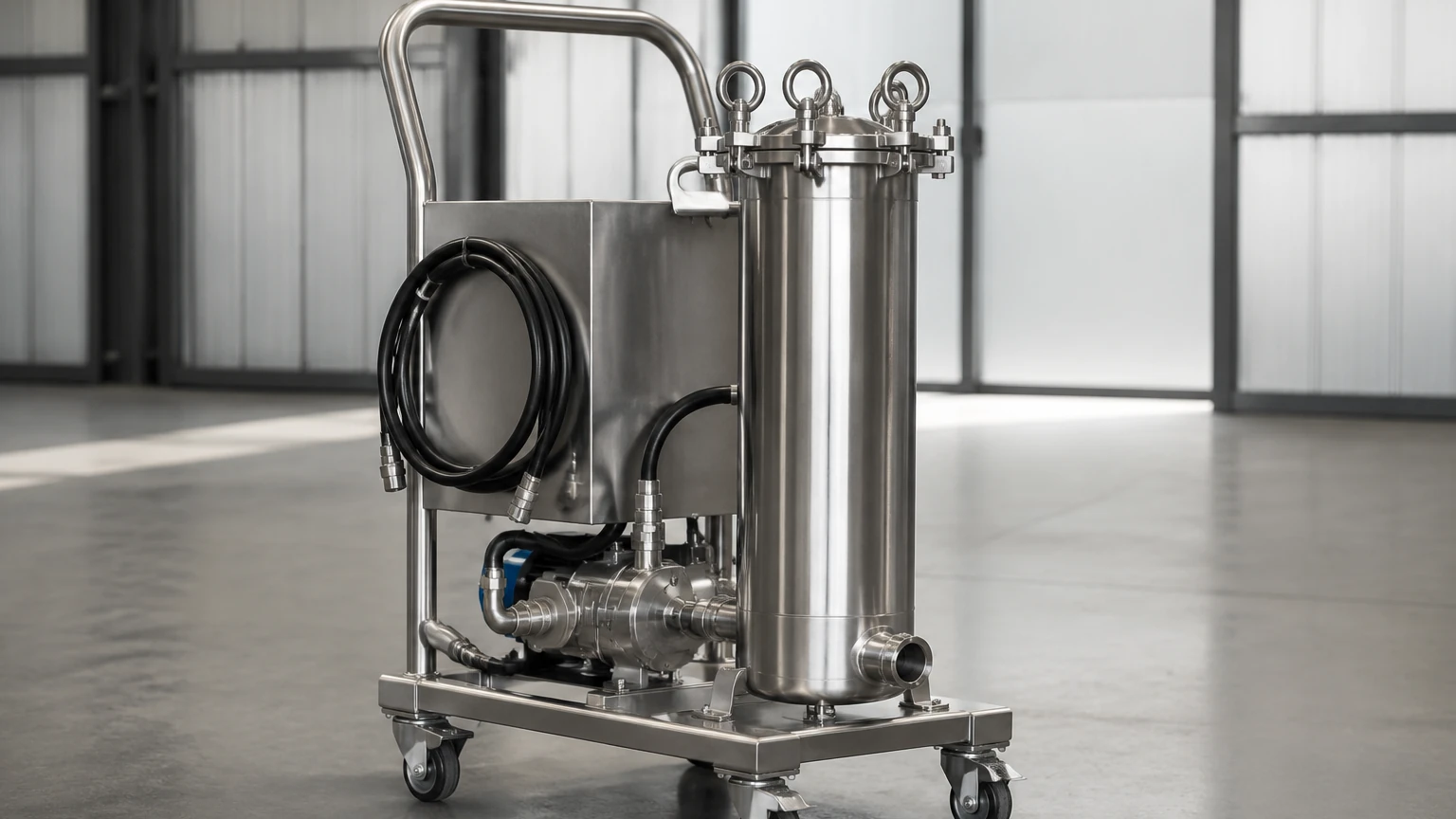
In industrial fluid power systems, the presence of contaminants is the leading cause of hydraulic component failure. While onboard filtration systems are designed to maintain fluid cleanliness during operation, they are often insufficient for handling initial fill contamination, system flushes after repairs, or the ingress of high-volume pollutants in harsh environments. A hydraulic filter cart serves as a mobile, offline filtration system—often referred to as a kidney-loop system—that provides the necessary supplemental filtration to achieve and maintain stringent ISO cleanliness standards.
For engineers and maintenance professionals, selecting or designing a hydraulic filter cart requires a deep understanding of fluid dynamics, material compatibility, and the structural integrity of the filtration media. As a specialist in custom stainless steel filtration solutions, Kaifil provides the precision components that ensure these mobile units perform reliably under demanding industrial conditions. This guide explores the technical nuances of hydraulic filter carts, from engineering considerations to the critical role of high-performance stainless steel filter elements.
The Role of Hydraulic Filter Carts in Fluid Power Systems
A hydraulic filter cart is not merely a pump on wheels; it is a precision engineering tool designed to manage the lifecycle of industrial lubricants and hydraulic fluids. Its primary function is to circulate fluid through high-efficiency filter elements to remove particulate matter and, in some configurations, water.
Offline Filtration Strategy
Offline filtration operates independently of the main hydraulic system’s pump and pressure. This allows the cart to provide continuous cleaning even when the primary machinery is idle. By utilizing a dedicated pump and motor, a filter cart can maintain a constant flow rate, which is essential for maximizing the efficiency of the filter media. This constant flow avoids the pressure spikes and flow surges often found in main system lines, which can sometimes force contaminants through the filter media or cause bypass valves to open.
Applications in Modern Industry
1. New Fluid Pre-filtration: Contrary to common belief, new hydraulic oil delivered in drums is rarely clean enough for modern high-pressure systems. It often contains high levels of particulate from the refining and packaging process. A hydraulic filter cart is used to transfer oil from the drum to the reservoir, ensuring it passes through a high-efficiency filter first.
2. System Flushing: After a component failure (such as a pump or cylinder breakdown) or a major overhaul, the system must be flushed to remove metallic debris. The filter cart provides the high-turnover filtration required to capture these particles before they damage new components.
3. Oil Reclamation: In large-scale operations, oil is a significant expense. Filter carts allow for the periodic cleaning of reservoirs, extending the service life of the fluid and reducing the total cost of ownership (TCO) for the facility.
Technical Specifications and Engineering Considerations
When evaluating a hydraulic filter cart, engineering teams must look beyond the basic flow rate. The effectiveness of the unit is determined by the synergy between the pump, the motor, and the filtration housing.
Flow Rate and Viscosity Management
The flow rate of a filter cart must be balanced against the viscosity of the fluid being treated. High-viscosity fluids (such as gear oils or heavy hydraulic fluids) create significant backpressure. If the pump is too powerful for the filter element’s surface area, the resulting high differential pressure ($ΔP$) can trigger a bypass or damage the filter media. Conversely, if the flow is too slow, the time required to reach the target ISO cleanliness code becomes impractical. For more technical details on component compatibility, engineers can visit the Main Page for specific product data.
Pump and Motor Selection
Most industrial filter carts utilize gear pumps due to their ability to handle varying viscosities and provide a steady flow. The motor must be sized to handle the maximum expected viscosity at the lowest operating temperature. In environments where explosive vapors may be present, such as chemical processing or oil and gas facilities, explosion-proof (ATEX/IECEx) motors and grounded housings are mandatory.
Structural Integrity of the Housing
The filter housing must be robust enough to withstand the mechanical stresses of mobility and the internal pressures of filtration. Stainless steel housings are preferred in many B2B applications due to their corrosion resistance and durability compared to aluminum or plastic alternatives. This is particularly critical in industries like food and beverage or pharmaceutical processing, where hygiene and material stability are paramount.
The Importance of High-Performance Stainless Steel Filter Elements
The core of any hydraulic filter cart is the filter element. While disposable cellulose or synthetic media are common, many industrial applications require the precision and durability of stainless steel wire mesh filters or stainless steel filter cartridges.
Advantages of Stainless Steel Media
Stainless steel filtration components, manufactured by specialists like Kaifil, offer several engineering advantages:
* Chemical Compatibility: Stainless steel (typically 304 or 316L) is compatible with a wide range of synthetic fluids, fire-resistant fluids, and aggressive chemicals that might degrade standard paper filters.
* Temperature Resistance: In applications involving hot oil or high-temperature industrial processes, stainless steel elements maintain their structural integrity where synthetic fibers might soften or fail.
* Cleanability and Longevity: Unlike disposable elements, stainless steel wire mesh filters can often be cleaned and reused, depending on the contaminant type. This reduces long-term waste and replacement costs.
* High Differential Pressure Strength: Stainless steel mesh is inherently stronger than fiber-based media, allowing it to withstand higher $ΔP$ without collapsing or experiencing "media migration" (where the filter material itself breaks off into the fluid).
Precision Pore Size and Mesh Geometry
For a hydraulic filter cart to be effective, the mesh geometry must be precisely controlled. Square weave, Dutch weave, and twilled weaves each offer different flow characteristics and particle retention capabilities. Engineering a custom filter element involves selecting the right weave to balance dirt-holding capacity with the required micron rating.
Evaluating Filtration Efficiency and ISO Cleanliness Codes
The performance of a hydraulic filter cart is measured by its ability to lower the ISO 4406 cleanliness code of a fluid. This code represents the number of particles per milliliter of fluid at three sizes: 4µm, 6µm, and 14µm.
Understanding Beta Ratios
Engineers should evaluate filter elements based on their Beta Ratio ($β$), which is the ratio of particles upstream of the filter to the particles downstream. A filter with a $β_{10} ≥ 200$ is considered high efficiency (99.5% efficient at 10 microns). When selecting components for a hydraulic filter cart, ensuring that the stainless steel cartridges meet the required Beta rating for the specific application is vital for achieving the target ISO code.
Multi-Stage Filtration
Effective filter carts often utilize a multi-stage approach. A primary, coarser filter (e.g., 25-40 microns) captures large debris to protect the pump and extend the life of the secondary filter. The secondary, high-efficiency filter (e.g., 3-10 microns) performs the final polishing of the fluid. Using stainless steel wire mesh for the primary stage is an excellent way to capture large metallic particles that can be easily inspected and removed.
Customization for Specialized Industrial Environments
Standard off-the-shelf filter carts often fail to meet the specific needs of specialized industries. Customization, supported by OEM manufacturing expertise, allows for the integration of features that address unique environmental challenges.
Food and Beverage Applications
In food-grade environments, the filter cart must use food-safe lubricants and 316L stainless steel components to prevent contamination. The design must also allow for easy wash-down procedures. Kaifil’s experience in providing stainless steel filter cartridges for the food industry ensures that these mobile units comply with safety and hygiene standards.
Chemical and Pharmaceutical Processing
When dealing with aggressive solvents or high-purity chemicals, the seals (O-rings) and the filter media must be chosen for maximum chemical resistance. Viton or PTFE seals combined with precision-engineered metal filter components ensure that the filtration process does not introduce leachables or react with the fluid.
Water Removal Capabilities
Hydraulic systems are often plagued by water contamination, which leads to oil oxidation and additive depletion. Custom hydraulic filter carts can be equipped with water-absorbing elements or vacuum dehydration units. For systems where water is a constant threat, utilizing a stainless steel coalescer element can help separate free water from the oil efficiently.
Best Practices for Implementation and Maintenance
To maximize the return on investment for a hydraulic filter cart, companies must implement rigorous operational protocols.
1. Oil Sampling: Before and after using the filter cart, oil samples should be taken to verify that the target ISO cleanliness code has been reached. This provides empirical evidence of the cart’s effectiveness.
2. Monitoring Differential Pressure: Every filter cart should be equipped with a $ΔP$ gauge or indicator. This tells the operator exactly when the filter elements are saturated and need cleaning or replacement. Ignoring these indicators can lead to the filter going into bypass mode, where unfiltered oil is simply recirculated.
3. Proper Hose Management: Hoses should be capped when not in use to prevent the ingress of environmental dust. Furthermore, the suction and discharge hoses should be placed at opposite ends of the reservoir to ensure maximum fluid turnover and prevent "short-circuiting," where the same clean oil is pulled back into the cart.
4. Regular Element Inspection: For carts using stainless steel wire mesh filters, regular inspection of the mesh is necessary. Look for signs of mechanical damage or permanent blinding (where particles are wedged so deeply they cannot be cleaned).
Conclusion
A hydraulic filter cart is an essential asset for any facility that relies on high-performance hydraulic systems. By understanding the engineering principles behind fluid flow, pressure drops, and filtration efficiency, purchasing and engineering teams can select equipment that truly protects their machinery. The integration of high-quality stainless steel filtration components—such as those designed and manufactured by Kaifil—ensures that these carts remain durable, efficient, and capable of handling the most rigorous industrial tasks.
Whether for routine oil maintenance, emergency system flushing, or specialized chemical processing, the right filtration strategy starts with precision-engineered components. For those looking to optimize their industrial filtration systems or explore custom OEM solutions, reviewing the technical capabilities available on the Main Page is the first step toward achieving superior fluid cleanliness and system reliability.
