


Hydraulic Filter Base
In the architecture of a high-performance hydraulic system, the hydraulic filter base serves as the critical mechanical interface between the fluid power circuit and the filtration media. While the filter element is responsible for capturing contaminants, the base provides the structural foundation, fluid routing, and often the safety mechanisms required to maintain system pressure and integrity. For engineers and procurement specialists, selecting the correct hydraulic filter base is not merely a matter of mounting; it involves complex considerations of metallurgy, porting geometry, pressure drop $(\Delta P)$, and environmental compatibility.
As industrial applications move toward higher pressures and more aggressive fluids, the demand for robust, precision-engineered bases has increased. Manufacturers like Kaifil specialize in providing the high-durability stainless steel components necessary to support these demanding environments, ensuring that the filtration assembly can withstand the rigors of chemical processing, pharmaceutical manufacturing, and heavy industrial hydraulics.
Understanding the Functional Role of the Hydraulic Filter Base
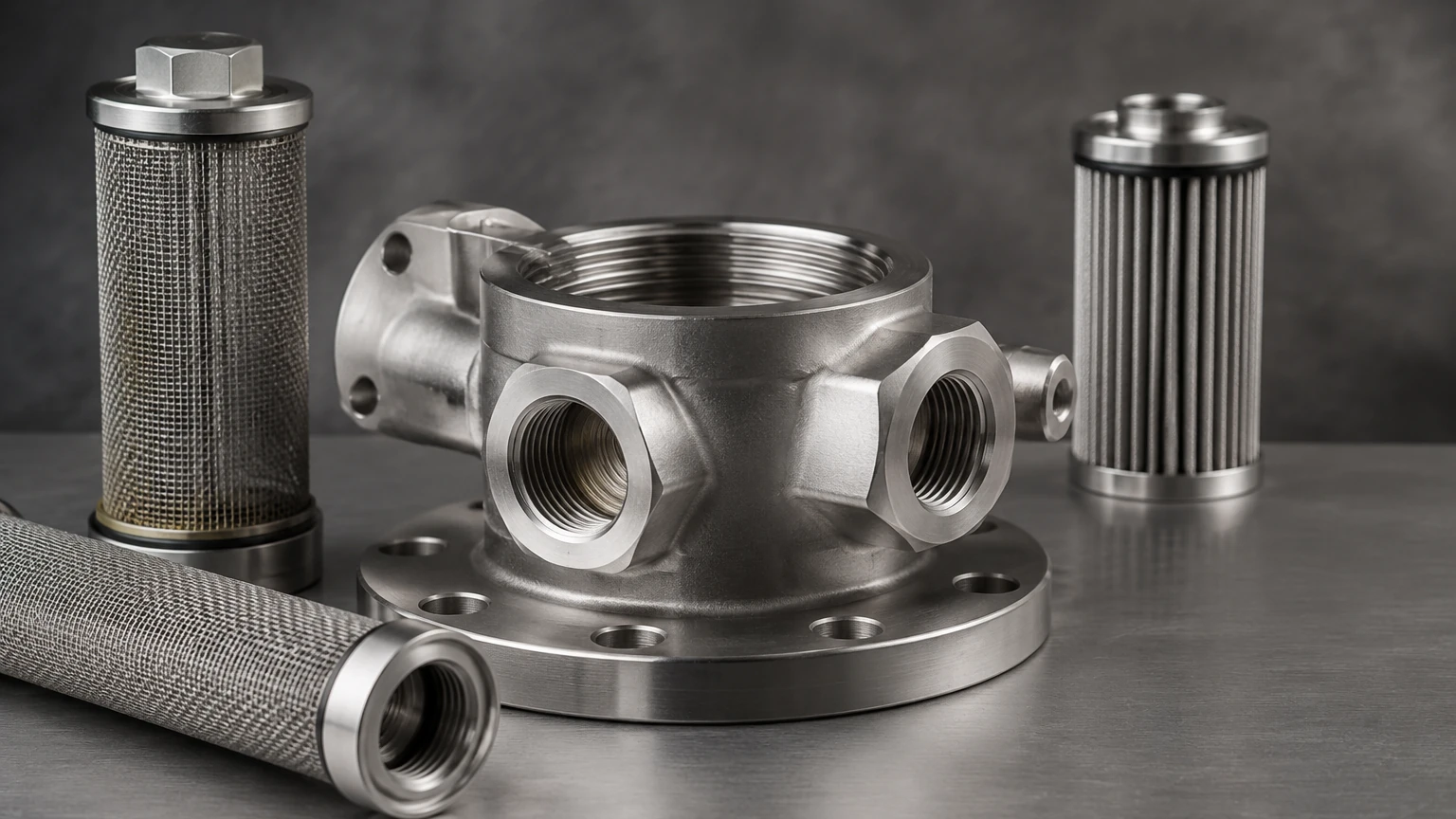
The primary function of a hydraulic filter base is to direct the flow of hydraulic oil or process fluids through the filter media. It acts as a manifold, typically featuring an inlet port, an outlet port, and a threaded or flanged mounting surface for the filter housing or spin-on canister.
Beyond simple fluid routing, the base is responsible for:
- Structural Support: Withstanding the mechanical stress of system vibration and the internal hydraulic forces exerted by high-pressure fluid.
- Sealing Integrity: Providing a machined surface that ensures a leak-proof connection between the base and the filter element or housing.
- Safety Integration: Housing bypass valves that protect the system from over-pressurization during cold starts or when the filter element becomes restricted by debris.
- Monitoring: Providing ports for differential pressure indicators, which allow maintenance teams to monitor the health of the filter element without interrupting the process.
Engineering Considerations: Material Selection
Material choice is perhaps the most significant factor in the longevity and reliability of a hydraulic filter base. While cast iron and aluminum are common in standard mobile hydraulics, industrial and process applications often require materials that can resist corrosion and fatigue.
Aluminum vs. Steel vs. Stainless Steel
- Aluminum: Lightweight and cost-effective, aluminum bases are suitable for low-to-medium pressure applications where weight is a primary concern. However, they are susceptible to thread galling and have lower fatigue limits compared to ferrous metals.
- Ductile Iron/Steel: These materials offer excellent strength and are used in high-pressure systems. They are, however, prone to oxidation unless properly coated or plated.
- Stainless Steel (304/316): For industries such as food and beverage, pharmaceutical, and chemical processing, stainless steel is the gold standard. It offers superior corrosion resistance, high-temperature stability, and the ability to withstand aggressive cleaning agents. Kaifil’s expertise in custom stainless steel filtration solutions ensures that these bases meet the stringent requirements of sanitary and corrosive environments.
Porting Configurations and Mounting Styles
The efficiency of a hydraulic system is heavily influenced by how fluid enters and exits the filter. A poorly designed hydraulic filter base can introduce unnecessary turbulence and pressure drop, leading to energy loss and potential cavitation.
Threaded and Flanged Ports
Common porting standards include SAE (O-ring boss), NPT (National Pipe Thread), and BSPP (British Standard Parallel Pipe). In high-pressure industrial systems, SAE O-ring boss ports are generally preferred because they provide a superior seal that is less likely to leak under vibration compared to tapered threads. For high-flow applications, SAE 4-bolt flanges are often utilized to ensure a secure, high-capacity connection.
Mounting Orientations
- In-Line Bases: These are integrated directly into the piping run. They are ideal for pressure line filtration where space is available along the fluid path.
- Tank-Top Bases: These are mounted directly onto the hydraulic reservoir. They simplify the return line circuit by allowing fluid to pass through the filter and directly into the tank, reducing the need for additional plumbing.
- Manifold Mounting: In complex systems, the filter base may be integrated into a custom hydraulic manifold, reducing the number of external leak points and saving significant space.
Integrated Safety: Bypass Valves and Indicators
A critical engineering feature of many hydraulic filter bases is the integrated bypass valve. This spring-loaded mechanism is designed to open when the pressure differential across the filter element reaches a specific threshold (the "cracking pressure").
The Importance of Bypass Settings
If a filter becomes clogged and no bypass is present, the pressure will rise until either the filter element collapses or a component upstream fails. Conversely, if the bypass opens too early, unfiltered fluid will circulate through the system, potentially damaging sensitive valves and actuators. Engineers must specify a base with a bypass setting that is compatible with the collapse rating of the intended filter element. In some critical applications, such as high-precision servo systems, a "non-bypass" base is used in conjunction with high-collapse strength elements to ensure that no unfiltered fluid ever reaches the downstream components.
Differential Pressure Indicators
To avoid unnecessary bypass events, the hydraulic filter base often includes ports for differential pressure indicators. These devices measure the pressure at the inlet versus the outlet. They can be:
- Visual: A pop-up button or a color-coded gauge.
- Electrical: A switch that sends a signal to a PLC or control room when the filter requires service.
- Electronic: Sensors that provide real-time data for predictive maintenance programs.
Customization and OEM Requirements
Standard off-the-shelf filter bases do not always meet the specific needs of specialized machinery. Customization is often required to accommodate unique flow paths, specific material certifications (such as 3.1 material certificates), or non-standard mounting patterns.
Working with a manufacturer that understands the nuances of metal fabrication and filtration engineering is essential. Custom stainless steel filter bases can be designed to integrate seamlessly into existing equipment while providing the durability required for 24/7 industrial operations. For organizations looking to optimize their filtration hardware, reviewing product options and application support on the Main Page can provide insights into how custom-engineered components improve system reliability.
Evaluation Criteria for Purchasing Teams
When procuring a hydraulic filter base, purchasing teams should look beyond the initial purchase price and consider the total cost of ownership (TCO). A lower-quality base may save costs upfront but can lead to expensive leaks, premature component failure, or difficult maintenance procedures.
Key evaluation points include:
1. Pressure Rating: Ensure the base is rated for the maximum system pressure, including potential pressure spikes.
2. Fluid Compatibility: Confirm that the base material and internal seals (Buna-N, Viton, EPDM) are compatible with the hydraulic fluid or process chemical being used.
3. Flow Capacity: The internal passages of the base must be sized to handle the maximum flow rate without exceeding the allowable pressure drop.
4. Serviceability: Consider how easy it is to access the filter element. Does the base design allow for quick element changes without spilling fluid or requiring specialized tools?
5. Manufacturer Reputation: Partner with suppliers who provide documented technical specifications and have a track record in high-stakes industries like chemical processing or hydraulics.
Maintenance and Replacement Cycles
While the hydraulic filter base is a static component, it is not immune to wear. Over time, threads can become worn, sealing surfaces can become scored, and bypass springs can lose their tension. During routine filter element changes, the base should be inspected for:
- Cracks or Stress Fractures: Particularly around port connections in high-vibration systems.
- Seal Integrity: O-rings and gaskets should be replaced whenever the filter is serviced to prevent external leaks.
- Bypass Functionality: In critical systems, the bypass valve should be periodically tested to ensure it opens at the correct pressure.
If a base shows signs of erosion—often caused by high-velocity fluid containing abrasive particles—it should be replaced immediately to prevent a catastrophic failure of the filtration assembly.
Conclusion
The hydraulic filter base is a vital component that dictates the efficiency, safety, and serviceability of the entire filtration system. By selecting a base constructed from high-quality materials like stainless steel and ensuring it is engineered with the correct porting and bypass specifications, engineers can significantly extend the life of their hydraulic components. Whether for a standard industrial power unit or a complex chemical processing line, the foundation of effective filtration starts with the base. For those developing new systems or upgrading existing ones, choosing a partner like Kaifil ensures access to the technical expertise and manufacturing precision required for high-performance filtration solutions.
