


Industrial Filter Systems
In the landscape of modern manufacturing and process engineering, industrial filter systems serve as critical infrastructure for maintaining product purity, protecting downstream equipment, and ensuring environmental compliance. These systems are not merely peripheral components but are integral to the operational efficiency of sectors ranging from chemical processing and pharmaceuticals to food production and hydraulic power. Selecting the appropriate filtration solution requires a deep understanding of fluid dynamics, material science, and the specific mechanical demands of the application environment.
Industrial filtration involves the separation of solids from liquids or gases through a porous medium. While the principle is straightforward, the execution in an industrial context involves complex variables, including high pressures, corrosive fluids, and extreme temperatures. For engineers and procurement specialists, the goal is to achieve a balance between filtration accuracy, flow rate, and the total cost of ownership. As a specialized manufacturer, Kaifil provides the technical expertise and custom manufacturing capabilities necessary to navigate these complexities, offering stainless steel wire mesh and precision metal filter components designed for the most demanding industrial environments.
Engineering Considerations for Material Selection
The performance of industrial filter systems is fundamentally dictated by the materials used in their construction. In industrial settings, stainless steel is the preferred material due to its mechanical strength and resistance to environmental degradation. However, the selection between different grades of stainless steel must be based on the specific chemical and thermal profile of the process fluid.
Grade 304 vs. 316L Stainless Steel
Type 304 stainless steel is suitable for general-purpose industrial applications where basic corrosion resistance and high strength are required. However, for environments involving chlorides or high acidity—common in chemical processing and marine applications—Type 316L is typically specified. The addition of molybdenum in 316L provides superior resistance to pitting and crevice corrosion. Furthermore, the "L" designation indicates a low carbon content, which is essential for components that require welding, as it prevents carbide precipitation and maintains the integrity of the filter structure during the fabrication process.
Thermal and Mechanical Stability
Unlike polymer-based filters, metal industrial filter systems can operate at temperatures exceeding 500°F (260°C) without losing structural integrity. This thermal stability is vital for steam filtration and high-temperature chemical reactions. Additionally, the high burst strength of stainless steel allows these filters to withstand significant differential pressures ($ΔP$) without collapsing, ensuring consistent performance even as the filter cake builds up.
Structural Design and Filtration Media Types
The architecture of a filter element determines its surface area, dirt-holding capacity, and ease of cleaning. Industrial filter systems utilize several primary structures to meet different process requirements.
Sintered Wire Mesh Filters
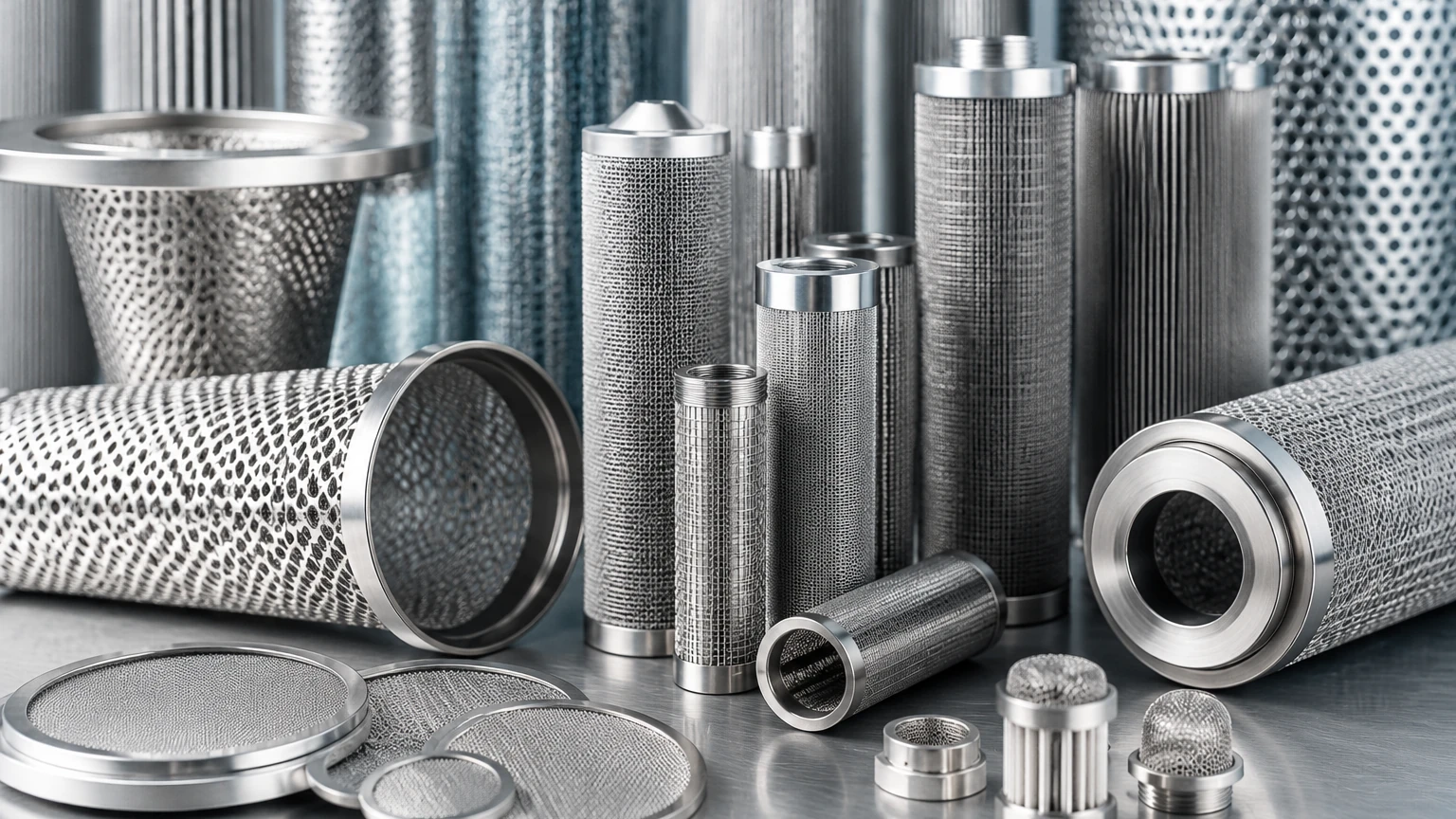
Sintering is a process where multiple layers of stainless steel wire mesh are bonded together through heat and pressure without the use of binders. This creates a robust, porous material that combines the fine filtration of thin mesh with the mechanical strength of thicker support layers. Sintered mesh is ideal for high-pressure applications where the filter must maintain its pore geometry under stress.
Pleated Filter Cartridges
To maximize the effective filtration area within a limited footprint, engineers often specify pleated designs. By folding the filter media, the surface area can be increased by several factors compared to a standard cylindrical element. This increased area leads to lower face velocities, reduced pressure drops, and longer service intervals. Pleated stainless steel cartridges are frequently used in the pharmaceutical and food industries where high flow rates and high purity are simultaneous requirements.
Wedge Wire and Perforated Supports
For coarse filtration or as a primary stage in a multi-stage system, wedge wire screens offer exceptional durability. Their V-shaped profile minimizes clogging by providing only two points of contact for particles, allowing for efficient back-washing. Perforated metal tubes often serve as the internal or external support for finer mesh layers, providing the necessary rigidity to withstand hydraulic shocks.
Evaluating Performance: Micron Ratings and Flow Dynamics
When specifying industrial filter systems, technical professionals must look beyond nominal ratings to understand how a filter will perform under actual operating conditions.
Absolute vs. Nominal Filtration
A "nominal" rating refers to the ability of a filter to retain a certain percentage (usually 60% to 90%) of particles of a specific size. In contrast, an "absolute" rating indicates that 99.9% or more of particles above the specified micron size will be captured. For critical applications such as sterile filtration in pharmaceuticals or protecting precision nozzles in chemical spraying, absolute-rated stainless steel filters are mandatory to prevent downstream contamination.
Pressure Drop and Energy Efficiency
The initial pressure drop across a clean filter is a key metric for system design. A high initial $ΔP$ indicates that the pump or compressor must work harder to move fluid through the system, increasing energy costs. Industrial filter systems must be sized correctly to ensure that the fluid velocity does not exceed the media's capabilities, which could lead to particle migration or premature blinding of the filter surface.
Industry-Specific Applications and Standards
Different industries impose unique constraints on filtration technology. A one-size-fits-all approach is rarely successful in high-stakes industrial environments.
Chemical and Petrochemical Processing
In these sectors, the primary challenge is chemical compatibility. Filters must withstand aggressive solvents, acids, and bases. Stainless steel filter systems are often the only viable option for catalyst recovery and the removal of impurities from corrosive process streams. The durability of metal media ensures that the filter does not leach contaminants into the process, which is a common risk with synthetic fibers.
Food and Beverage Production
Filtration in the food industry is governed by sanitary standards. Industrial filter systems must be designed for Clean-in-Place (CIP) or Sterilize-in-Place (SIP) procedures. Stainless steel components from Kaifil are engineered with smooth surface finishes to prevent bacterial growth and are compatible with high-temperature steam sterilization. Common applications include the filtration of cooking oils, syrups, and carbonated beverages.
Hydraulic and Lubrication Systems
Hydraulic systems require extremely high levels of fluid cleanliness to protect sensitive valves and pumps. Metal mesh filters are used to remove metallic wear particles and environmental dust. Because hydraulic systems operate under high pressure, the mechanical fatigue resistance of the filter media is paramount. Stainless steel cartridges provide the necessary reliability to prevent catastrophic component failure.
Maintenance, Cleaning, and Total Cost of Ownership
One of the most significant advantages of stainless steel industrial filter systems is their cleanability. While disposable plastic or paper filters have a lower initial purchase price, their frequent replacement leads to higher long-term costs and increased waste.
Cleaning Methodologies
Stainless steel filters can be restored to near-original performance levels through various cleaning methods:
* Back-flushing: Reversing the flow of fluid to dislodge particles from the surface.
* Ultrasonic Cleaning: Using high-frequency sound waves in a solvent bath to remove fine particles trapped deep within the mesh layers.
* Chemical Cleaning: Using specific solvents or acids to dissolve organic or inorganic deposits.
* Burn-off/Pyrolysis: Heating the filter to high temperatures to carbonize organic contaminants, followed by ultrasonic cleaning.
Determining Replacement Cycles
While metal filters are durable, they are not infinite. Engineers should monitor the "terminal pressure drop"—the point at which the filter is so loaded with contaminants that cleaning is required. Over time, repeated cleaning cycles or exposure to extreme conditions may lead to work hardening or microscopic stress cracks. Regular inspection of the mesh integrity is essential to ensure that the filtration efficiency has not been compromised.
Customization and Technical Support
Off-the-shelf filtration products often fail to meet the specific geometric or performance requirements of specialized industrial machinery. Customization is frequently necessary to optimize the interface between the filter and the housing, or to achieve a specific flow-to-pressure-drop ratio.
Kaifil specializes in the design and manufacture of bespoke filtration components. By collaborating closely with engineering teams, we can adjust weave patterns, layer configurations, and end-cap designs to suit unique applications. Whether it is a specialized wire mesh disc for a pharmaceutical centrifuge or a high-capacity filter cartridge for a water treatment plant, custom engineering ensures that the industrial filter system performs according to the exact specifications required.
For technical teams evaluating new filtration projects or looking to optimize existing processes, it is essential to confirm material certifications, pressure ratings, and filtration efficiency data before procurement. Accessing a reliable technical resource can significantly reduce the risk of system downtime and product loss. To explore the full range of custom stainless steel filtration capabilities and to consult with our engineering team, visit our Main Page.
Conclusion
Industrial filter systems are a cornerstone of process reliability. By selecting high-quality stainless steel media and employing rigorous engineering standards, facilities can achieve superior filtration performance while minimizing environmental impact and operational costs. Understanding the nuances of material selection, structural design, and maintenance protocols allows engineers to implement solutions that not only meet today's production demands but also provide the durability needed for long-term success. As industrial processes become more complex and purity requirements more stringent, the role of precision-engineered metal filtration will only continue to grow in importance.
