


Small Engine Air Filter Foam
In industrial and commercial applications, the reliability of internal combustion engines—ranging from portable generators and pressure washers to specialized agricultural equipment—depends heavily on the quality of air intake. Small engine air filter foam serves as the primary line of defense against airborne contaminants that can cause premature engine wear, reduced fuel efficiency, and catastrophic mechanical failure. For engineers and procurement professionals, understanding the technical specifications and material science behind these filtration components is essential for optimizing equipment uptime and reducing total cost of ownership.
While often perceived as a simple consumable, small engine air filter foam is a precision-engineered material designed to balance high airflow with rigorous particulate capture. In demanding industrial environments, these filters must withstand exposure to hydrocarbons, fluctuating temperatures, and high-vibration conditions without losing structural integrity.
Understanding the Fundamentals of Foam Filtration Media
Small engine air filter foam is typically manufactured from reticulated polyurethane foam. Unlike standard "closed-cell" foams used for insulation or packaging, reticulated foam undergoes a specialized manufacturing process—often involving a controlled thermal explosion or chemical etching—to remove the "windows" or cell membranes. This leaves behind a three-dimensional skeletal structure of dodecahedron-shaped cells.
This open-cell architecture is critical for filtration because it creates a tortuous path for the air. As air passes through the foam, it is forced to change direction repeatedly. Larger particles, unable to navigate these rapid turns due to their inertia, strike the foam strands and become trapped. This mechanism is known as depth filtration, which differs significantly from the surface filtration provided by paper or fine wire mesh. Depth filtration allows the filter to hold a larger volume of contaminants before the pressure drop becomes restrictive, making it ideal for the dusty environments where small engines often operate.
Key Performance Metrics for Small Engine Air Filter Foam
When specifying foam for industrial engine applications, engineers must evaluate several critical performance metrics to ensure the media meets the engine's volumetric efficiency requirements.
Pores Per Inch (PPI)
The most common metric for foam filtration is PPI (Pores Per Inch). This designates the density of the skeletal structure. For small engine air filter foam, the PPI typically ranges from 30 to 80:
* 30–45 PPI: Coarse foam often used as a pre-filter. It captures larger debris like grass clippings and sawdust, preventing the primary filter from clogging prematurely.
* 60–80 PPI: Fine foam used as a primary filtration stage. This density provides a high surface area for capturing fine dust and silica particles that could otherwise score cylinder walls.
Airflow Resistance and Pressure Drop
Every filtration medium introduces a restriction to the intake system. In small engines, excessive pressure drop can lead to a rich fuel-to-air ratio, causing carbon buildup on spark plugs and increased fuel consumption. Industrial-grade foam is engineered to provide a linear relationship between air velocity and pressure drop, ensuring consistent engine performance across its RPM range.
Dust Holding Capacity (DHC)
DHC refers to the total mass of a standardized test dust that the filter can retain before reaching a terminal pressure drop. High-quality reticulated foam offers superior DHC compared to pleated paper of the same surface area because the entire volume of the foam—not just the surface—is utilized for particle storage.
Material Compatibility and Environmental Resistance
In an industrial context, small engine air filter foam is frequently exposed to harsh chemicals and environmental stressors. The longevity of the filter depends on the chemical stability of the polyurethane polymer.
1. Hydrocarbon Resistance: Since these filters are located near carburetors or fuel injectors, they must resist degradation when exposed to gasoline vapors and engine oil. High-quality ester-based or ether-based polyurethanes are selected for their ability to remain flexible and intact despite constant exposure to fuels.
2. Thermal Stability: Engine compartments generate significant radiant heat. Industrial foam must maintain its structural properties at temperatures exceeding 100°C (212°F). Low-quality foams may become brittle or begin to melt, potentially allowing the engine to ingest foam particles.
3. Hydrolysis Resistance: For equipment used in humid or coastal environments, the foam must resist hydrolysis—the chemical breakdown of the polymer due to moisture. Ether-based foams are generally preferred in these applications for their superior moisture resistance.
Industrial Maintenance: The Oil-Wetted Principle
One of the unique characteristics of small engine air filter foam in B2B and industrial sectors is its use as an oil-wetted medium. While the foam structure itself provides mechanical filtration, the addition of a specialized filter oil significantly enhances its performance.
When the foam is lightly coated with high-tack oil, the oil acts as a secondary adhesive. Fine dust particles that might otherwise bounce off the foam strands are instead captured and held by the oil film. This is particularly effective for capturing sub-micron particles that are too small for mechanical impingement alone.
For maintenance teams, this creates a sustainable cycle. Unlike paper filters, which must be discarded when dirty, industrial foam filters can often be cleaned using specialized solvents, dried, re-oiled, and returned to service. This reusability is a key factor in reducing the environmental footprint and operational costs of large equipment fleets.
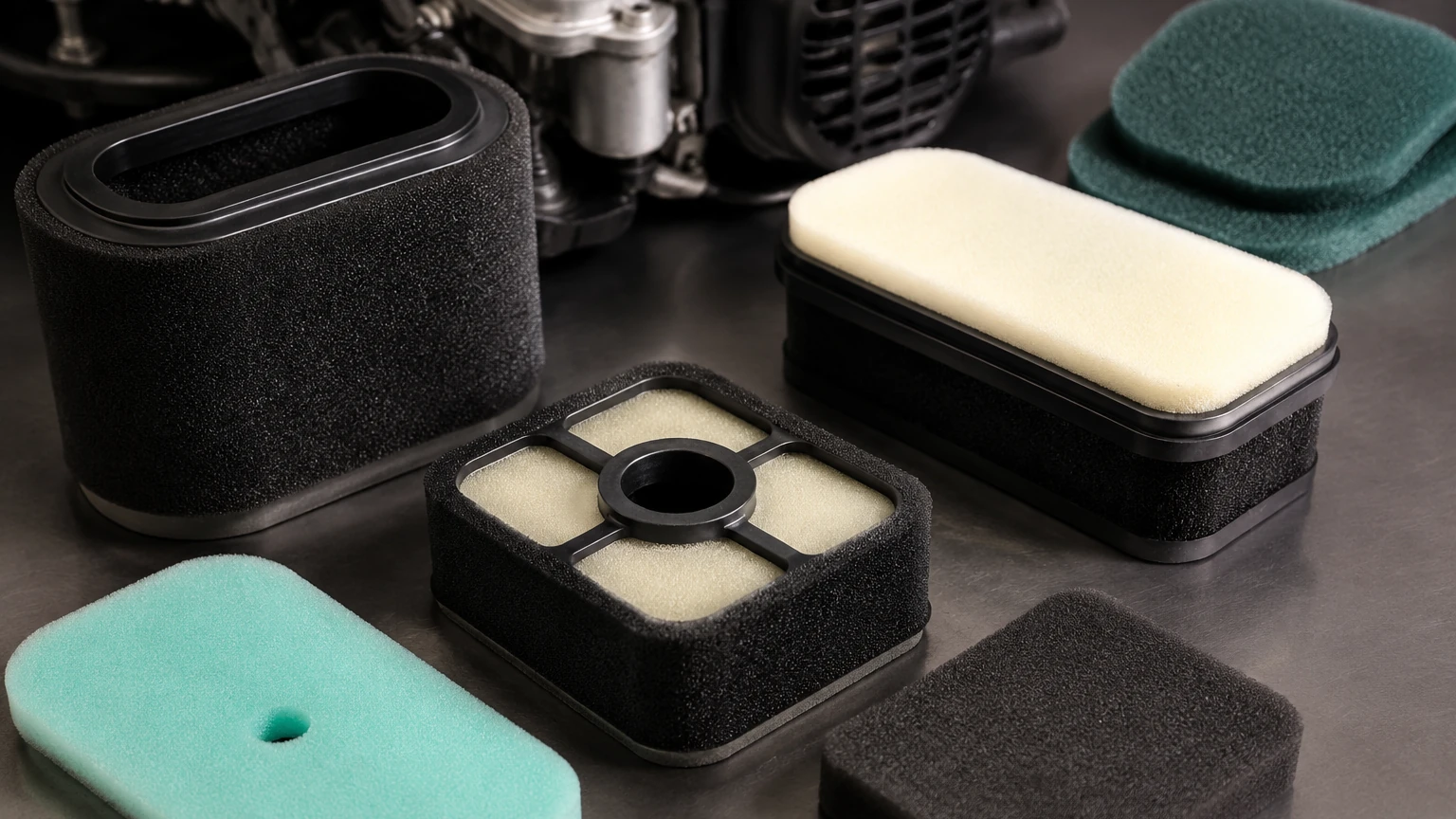
Integrating Foam with Stainless Steel Support Structures
In heavy-duty industrial applications, foam filters are rarely used in isolation. High-vacuum intake systems can cause unreinforced foam to deform or be sucked into the intake manifold. To prevent this, foam is often integrated with rigid support structures.
This is where the expertise of a professional manufacturer like Kaifil becomes critical. By combining small engine air filter foam with custom stainless steel wire mesh or perforated metal cores, manufacturers can create high-performance hybrid filters.
* Structural Integrity: A stainless steel mesh inner core prevents the foam from collapsing under high-load conditions.
* Multi-Stage Filtration: In some designs, a coarse foam outer layer acts as a pre-filter, followed by a fine stainless steel mesh layer, and finally a fine foam inner layer. This gradient density approach maximizes the service life of the filter assembly.
* Durability: Stainless steel components provided by Kaifil ensure that the filter housing and support remain corrosion-resistant, even if the equipment is stored outdoors or used in corrosive chemical processing environments.
For engineers looking to develop custom filtration solutions that incorporate these materials, visiting the Main Page provides insight into the manufacturing capabilities required to produce these complex assemblies.
Procurement Considerations for OEM and Industrial Buyers
When sourcing small engine air filter foam for OEM production or large-scale maintenance contracts, procurement teams should confirm several technical and logistical factors:
Customization and Geometry
Small engine compartments are often cramped, requiring filters with complex geometries. Buyers should ensure their supplier can provide precision die-cutting or CNC foam contouring to meet exact dimensional tolerances. A poor fit can lead to "air bypassing," where unfiltered air enters the engine through gaps around the filter edges.
Quality Assurance and Standards
Industrial filters should be tested according to international standards such as ISO 5011 (Inlet air cleaning equipment for internal combustion engines and compressors). This ensures that the foam meets specific efficiency ratings and that the manufacturer maintains consistent PPI and density across production batches.
Total Cost of Ownership (TCO)
While foam filters may have a higher initial cost than basic paper elements, their durability and reusability often result in a lower TCO. Buyers should evaluate the expected number of cleaning cycles a foam element can withstand before the polymer begins to lose its elasticity. High-quality industrial foam can often survive 20 to 50 cleaning cycles, depending on the severity of the environment.
Conclusion
Small engine air filter foam is a vital component in the protection of industrial machinery. By selecting the correct PPI, ensuring material compatibility with fuels and heat, and utilizing robust support structures like stainless steel mesh, engineers can significantly extend the life of their equipment. As a leader in custom filtration solutions, Kaifil supports the industrial sector by providing the precision-engineered metal components necessary to house and protect these critical foam media. For detailed technical specifications on custom filter cartridges and metal filtration components, please refer to our Main Page.
