


Industrial Hepa Filters
In high-precision manufacturing and processing environments, air purity is not merely a preference but a critical operational requirement. Industrial HEPA filters (High-Efficiency Particulate Air filters) serve as the primary defense against microscopic contaminants that can compromise product integrity, equipment longevity, and personnel safety. For engineers and procurement specialists, understanding the technical nuances of these filtration systems is essential for optimizing performance and managing the total cost of ownership.
While the term "HEPA" is often associated with commercial or residential air purification, industrial-grade applications demand significantly higher standards of structural integrity, chemical resistance, and thermal stability. In sectors such as pharmaceutical manufacturing, semiconductor fabrication, and chemical processing, industrial HEPA filters must operate reliably under high pressure, variable flow rates, and sometimes corrosive atmospheres. This guide explores the engineering considerations, selection criteria, and performance expectations of high-efficiency filtration in industrial contexts.
Technical Standards and Performance Metrics
The performance of industrial HEPA filters is defined by their ability to capture particles at the Most Penetrating Particle Size (MPPS), which is typically around 0.3 micrometers. According to international standards such as EN 1822 and ISO 29463, a filter must achieve a minimum efficiency of 99.97% (for H13 grade) or 99.99% (for H14 grade) at this particle size to be classified as HEPA.
From an engineering perspective, the efficiency of these filters relies on four primary mechanisms:
1. Interception: Particles following a line of flow in the air stream come within one radius of a fiber and adhere to it.
2. Impaction: Larger particles, unable to follow the curving contours of the air stream, collide directly with the fibers due to inertia.
3. Diffusion: Very small particles (typically below 0.1 microns) collide with gas molecules and move erratically (Brownian motion), increasing the likelihood of hitting a fiber.
4. Sieving: The particle is larger than the gap between the fibers.
In industrial settings, the challenge is maintaining these efficiency levels while managing "pressure drop"—the resistance to airflow. A high initial pressure drop requires more energy from the ventilation system to move air, leading to increased operational costs. Therefore, selecting a filter with an optimized pleat geometry and high-quality media is vital for balancing filtration efficiency with energy consumption.
Material Selection and Structural Integrity
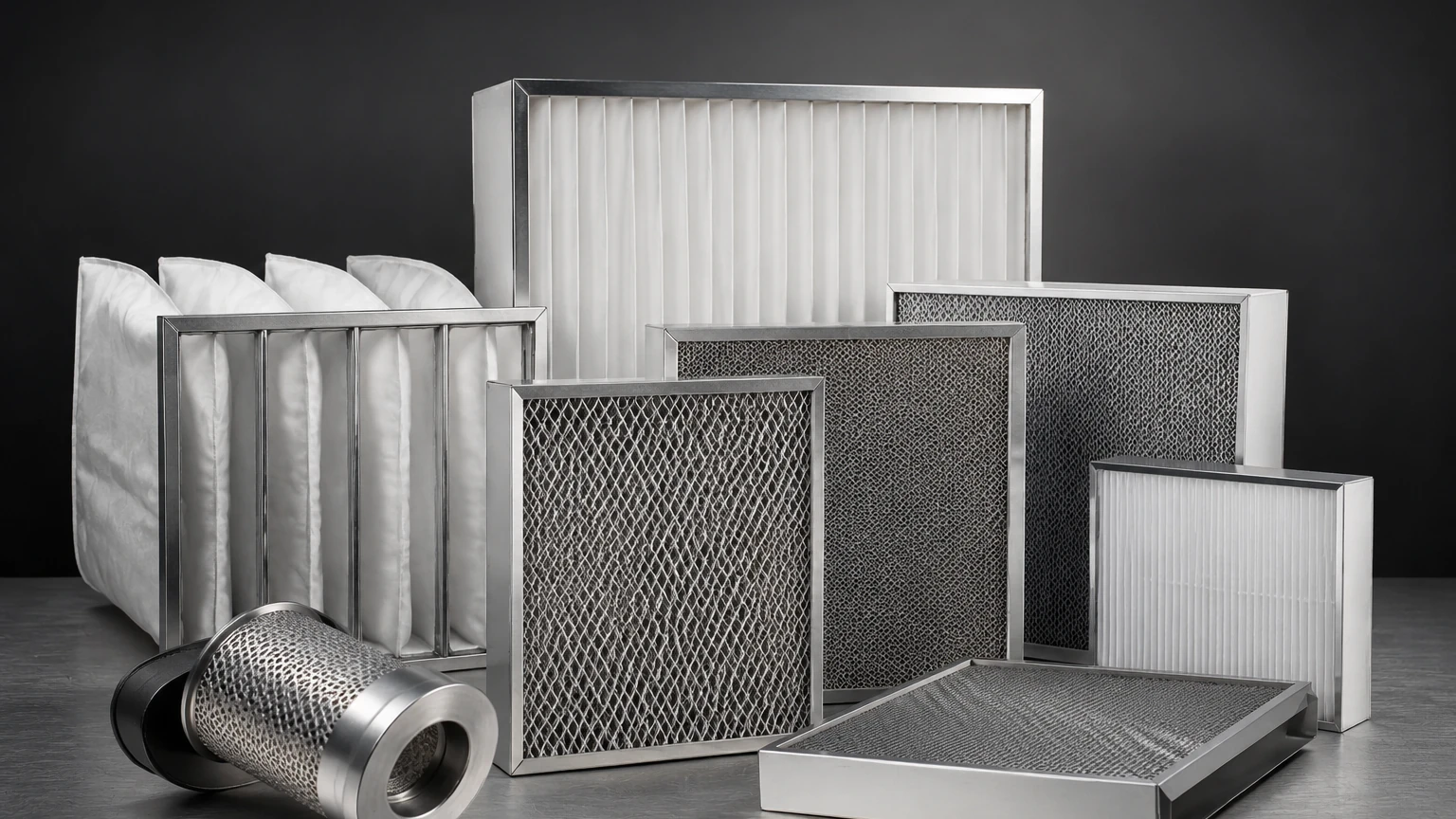
The environment in which industrial HEPA filters operate dictates the materials used for their construction. While the filter media itself is often composed of sub-micron glass fibers, the frame and support structures are where industrial durability is established. For many demanding applications, stainless steel is the material of choice for frames and protective grids.
Stainless Steel Frames and Supports
In industries like food and beverage or pharmaceutical processing, filters are frequently exposed to high humidity, cleaning chemicals, or steam sterilization. Standard galvanized steel or aluminum frames may succumb to corrosion or oxidation over time. Stainless steel (typically Grade 304 or 316L) provides the necessary corrosion resistance and mechanical strength to prevent bypass leakage. If a frame warps or corrodes, the seal between the filter and the housing is compromised, allowing unfiltered air to bypass the media entirely.
Protective Wire Mesh
Industrial HEPA filters often incorporate a precision metal mesh on the upstream or downstream side. This mesh serves as a faceguard, protecting the delicate pleated media from physical damage during installation or maintenance. Furthermore, in high-velocity systems, stainless steel wire mesh provides structural reinforcement, preventing the pleats from fluttering or collapsing under high differential pressure. For more information on specialized metal components for filtration, you can visit the Main Page of Kaifil’s technical resource center.
Key Evaluation Criteria for Procurement
When evaluating industrial HEPA filters for a specific application, engineers should look beyond the efficiency rating and consider the following technical specifications:
Rated Airflow and Face Velocity
Filters are rated for a specific volume of air, usually measured in Cubic Feet per Minute (CFM). Operating a filter above its rated capacity significantly increases the pressure drop and can reduce the capture efficiency, as particles move too quickly for diffusion and interception mechanisms to work effectively. Face velocity—the speed of the air as it hits the filter surface—must be uniform across the entire face to prevent localized clogging.
Temperature and Chemical Compatibility
Standard HEPA filters are often limited to operating temperatures below 80°C (176°F) due to the adhesives and gaskets used. However, industrial processes involving drying ovens or exhaust from chemical reactors may require high-temperature HEPA filters capable of withstanding up to 250°C or higher. In these cases, silicone-free sealants and stainless steel separators are used instead of traditional aluminum or plastic components.
Seal Integrity and Gasket Types
The method by which the filter is sealed into the housing is a common point of failure. There are two primary sealing methods:
* Gasket Seal: A neoprene or EPDM gasket is compressed against the housing frame. This requires a mechanical clamping mechanism to ensure an airtight seal.
* Gel Seal: The filter frame features a channel filled with a specialized silicone or polyurethane gel. A "knife-edge" on the housing sinks into the gel, creating a leak-proof, airtight connection that is often preferred in pharmaceutical cleanrooms where bypass is unacceptable.
Common Risks and Failure Modes
Identifying potential risks before they lead to system failure is a core responsibility of maintenance and engineering teams. Industrial HEPA filters are susceptible to several failure modes that can be mitigated through proper selection and monitoring.
Media Blinding and Clogging
The most common cause of HEPA failure is premature clogging due to inadequate pre-filtration. HEPA filters are designed to capture microscopic particles; if they are exposed to large dust loads or oily mists without a secondary filter (such as a stainless steel wire mesh pre-filter), the media will "blind" quickly. This leads to a rapid spike in differential pressure, necessitating frequent and expensive filter replacements.
Bypass Leakage
Even a pinhole leak in the filter media or a small gap in the gasket seal can allow thousands of particles to pass through, effectively nullifying the HEPA rating. In industrial environments, vibration from heavy machinery can sometimes loosen mechanical clamps, leading to gasket bypass. Regular integrity testing (such as the DOP/PAO smoke test) is required to ensure the system remains within specification.
Structural Collapse
If the differential pressure across the filter exceeds the manufacturer’s recommended limit (often around 500-750 Pa or 2-3 inches of water gauge), the media or the frame may suffer structural failure. This is particularly dangerous as it can release a concentrated burst of contaminants into the clean environment. High-strength stainless steel support grids are an effective countermeasure in systems where pressure surges are possible.
Customization and OEM Considerations
Standard off-the-shelf HEPA filters do not always fit the unique spatial or environmental constraints of specialized industrial machinery. Customization is often required for OEM applications where the filter must integrate seamlessly into a larger piece of equipment, such as a localized exhaust hood or a mobile decontamination unit.
Customization options typically include:
* Non-standard Dimensions: Tailoring the height, width, and depth to fit existing housings without the need for expensive ductwork modifications.
* Material Upgrades: Utilizing 316L stainless steel for extreme chemical resistance or specialized mesh for high-vibration environments.
* Integrated Components: Some industrial applications benefit from filters that include integrated flow sensors or pressure ports for real-time monitoring.
By working with a manufacturer that understands the intersection of metal fabrication and filtration science, engineers can develop solutions that are more durable than standard commercial units. This is especially relevant when designing systems for hydraulic fluids, high-temperature gases, or aggressive chemical vapors where traditional glass-fiber media must be protected or reinforced.
Total Cost of Ownership and Maintenance Cycles
The purchase price of an industrial HEPA filter is only a fraction of its total cost. To accurately assess the value of a filtration solution, one must consider energy costs, labor for replacement, and the cost of potential downtime.
Energy Efficiency
As a filter accumulates dust, the resistance increases, and the fan must work harder to maintain the required airflow. High-capacity HEPA filters, which feature more pleats and a larger surface area, typically have a lower initial pressure drop and a slower rate of pressure increase. While these filters have a higher upfront cost, the energy savings over their service life often result in a lower total cost.
Replacement Cycles
In a well-maintained industrial system with effective pre-filtration, a HEPA filter can last anywhere from 2 to 5 years. However, in heavy industrial applications, this cycle may be shorter. Implementing a staged filtration approach—using washable or easily replaceable stainless steel mesh filters upstream—can extend the life of the expensive HEPA stage by up to 50%.
Monitoring and Documentation
For regulated industries, maintaining a detailed log of differential pressure readings and integrity test results is mandatory. Modern industrial filtration systems often incorporate automated monitoring that alerts operators when the pressure drop reaches a pre-defined limit, allowing for scheduled maintenance rather than reactive emergency shutdowns.
In conclusion, selecting the right industrial HEPA filters requires a deep understanding of the specific environmental challenges and performance requirements of the application. By focusing on structural integrity, material compatibility, and optimized airflow, engineers can ensure high-purity environments that support both operational excellence and long-term cost-efficiency.
