


Industrial Inline Water Filtration
In industrial processing, the integrity of fluid handling systems depends heavily on the efficiency of particulate removal. Industrial inline water filtration serves as a primary defense mechanism, integrated directly into the piping system to capture contaminants without requiring the fluid to be diverted to a separate holding tank or bypass loop. For engineers and facility managers, selecting the correct inline filtration system is not merely a matter of choosing a filter housing; it involves a deep understanding of fluid dynamics, material compatibility, and the specific requirements of downstream equipment.
Effective filtration ensures that sensitive components—such as high-pressure nozzles, heat exchangers, and precision pumps—are protected from abrasion and clogging. This guide examines the technical considerations, material requirements, and engineering benchmarks essential for implementing a robust industrial inline water filtration strategy.
Understanding the Mechanics of Industrial Inline Water Filtration
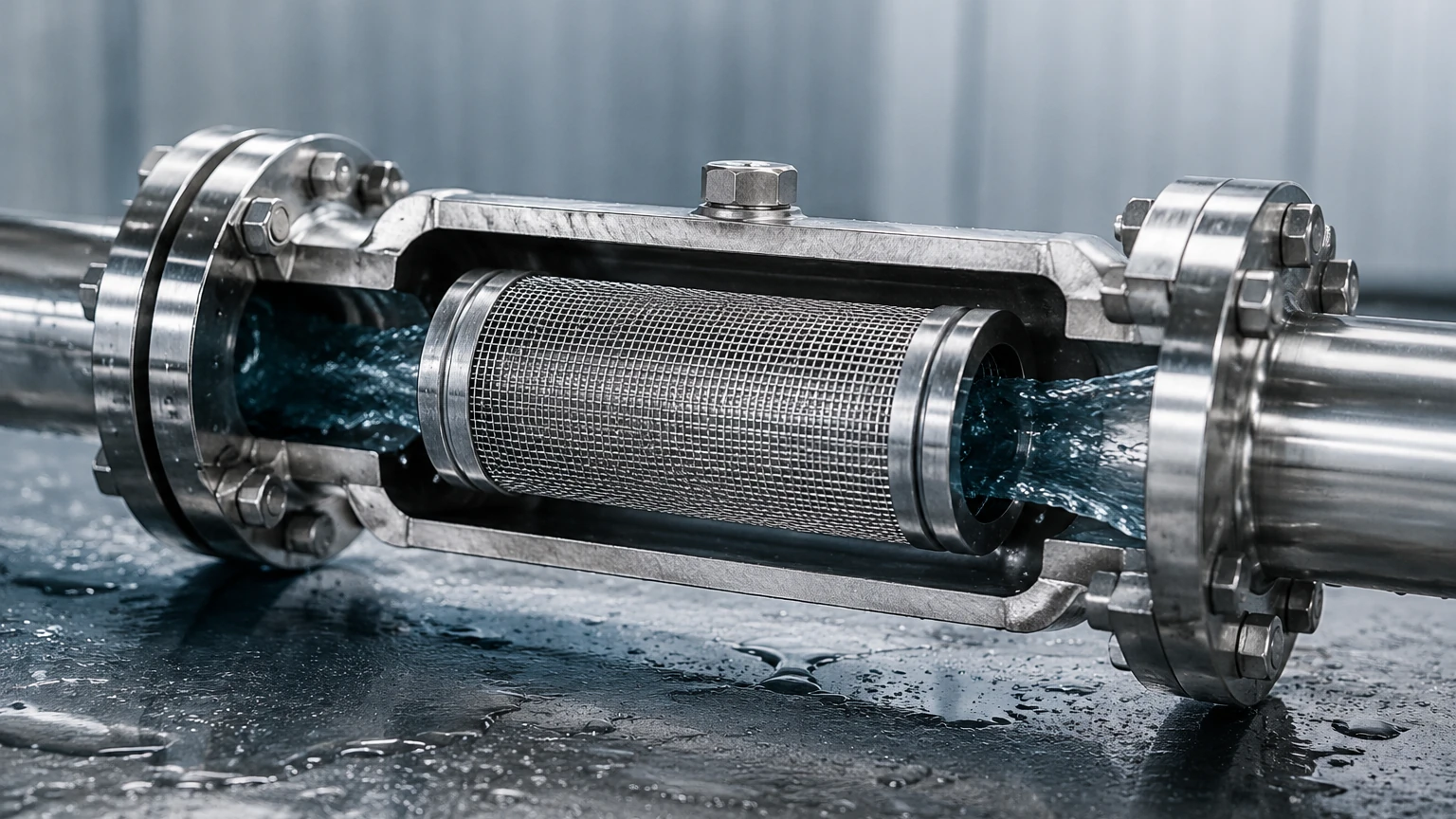
Industrial inline water filtration operates on the principle of direct-flow interception. Unlike cross-flow filtration, where the fluid travels parallel to the filter surface, inline systems typically force the entire volume of the process water through a filter medium. This medium, often a stainless steel wire mesh or a sintered metal cartridge, acts as a physical barrier to suspended solids.
From an engineering perspective, the "inline" aspect is critical because it minimizes the footprint of the filtration stage. These systems are designed to handle high flow rates with minimal pressure drop (differential pressure). The geometry of the filter element—whether it is a cylindrical cartridge, a pleated mesh, or a basket strainer—is engineered to maximize the surface area available for filtration. A higher surface area directly correlates to a longer service life between cleaning cycles and a lower initial resistance to flow.
In many high-demand sectors, such as chemical processing or power generation, these filters must maintain structural integrity under fluctuating pressures. The mechanical strength of the filter element is paramount; it must resist deformation and "media migration," where parts of the filter itself break off and enter the downstream flow.
Material Selection: Why Stainless Steel Dominates Industrial Applications
When specifying components for industrial inline water filtration, material selection is the most significant factor in determining the system's longevity and chemical resistance. While plastic or polymer-based filters may suffice for light commercial use, industrial environments demand the durability of metals.
Stainless Steel 304 and 316L
Stainless steel is the industry standard for inline filtration. Grade 304 provides excellent durability and corrosion resistance for general water treatment applications. However, in environments involving brackish water, chemicals, or high-temperature steam, Grade 316L is preferred. The addition of molybdenum in 316L enhances resistance to pitting and crevice corrosion, particularly in chloride-rich environments.
Wire Mesh vs. Sintered Metal
* Woven Wire Mesh: This is the most versatile medium for industrial inline water filtration. It can be manufactured in various weaves, such as plain, twilled, or Dutch weave, to achieve specific micron ratings. Woven mesh offers high porosity and is easily cleaned through backwashing or ultrasonic methods.
* Sintered Metal: For applications requiring extreme pressure resistance or ultra-fine filtration, multiple layers of wire mesh are sintered (bonded through heat and pressure) together. This creates a rigid, porous structure that can withstand high mechanical stress without shifting the pore size.
By utilizing stainless steel, manufacturers like Kaifil ensure that the filtration components can be sterilized, reused, and subjected to harsh cleaning chemicals without degrading the structural integrity of the filter.
Critical Performance Metrics for System Engineers
Before finalizing a purchase or design for an industrial inline water filtration system, engineers must evaluate several key performance indicators. Failure to account for these variables can lead to premature system failure or excessive operational costs.
1. Micron Rating: Absolute vs. Nominal
A common point of confusion is the distinction between nominal and absolute micron ratings. A nominal rating refers to the filter's ability to retain a major percentage (usually 60% to 90%) of particles of a specific size. An absolute rating, however, implies that 99.9% of particles larger than the specified micron size will be captured. For protecting precision nozzles, an absolute-rated stainless steel cartridge is often mandatory.
2. Clean Pressure Drop ($ΔP$)
The clean pressure drop is the resistance the filter offers to the fluid flow when it is first installed. A high initial $ΔP$ indicates that the filter may be undersized for the application or that the mesh is too fine for the required flow rate. Engineers should aim for a design where the clean pressure drop does not exceed 2-5 PSI, allowing ample room for the pressure to rise as the filter accumulates debris.
3. Dirt Holding Capacity
This metric defines the total mass of contaminants a filter can retain before reaching the maximum allowable differential pressure. In industrial inline water filtration, a higher dirt-holding capacity translates to fewer maintenance interventions. This is often achieved through pleated designs, which significantly increase the effective filtration area compared to standard smooth cylinders.
Common Operational Risks and Failure Modes
Implementing industrial inline water filtration is not without risks. Understanding potential failure modes allows for better system design and the inclusion of necessary safety features.
* Bypass Leakage: If the filter element is not seated correctly within the housing, or if the seals (O-rings) are incompatible with the process fluid, water will take the path of least resistance. This "bypass" allows unfiltered water to reach downstream components, potentially causing catastrophic damage.
* Pressure Spikes: In hydraulic systems or high-pressure water lines, sudden valve closures can cause water hammer. If the filter element is not structurally reinforced, these pressure spikes can collapse the mesh or burst the cartridge.
* Chemical Incompatibility: Even stainless steel has limits. Exposure to highly concentrated acids or specific halogens can lead to rapid corrosion if the wrong grade of steel is selected. Always confirm the chemical composition of the process water, including trace elements and pH fluctuations.
* Biological Fouling: In water treatment applications, biofilm can grow on the surface of the filter mesh. This not only increases the pressure drop but can also contaminate the downstream water. Stainless steel filters are advantageous here because they can be treated with high-temperature steam or biocides that would destroy polymer filters.
Customization: Aligning Filter Design with Specific Process Requirements
Standard, off-the-shelf filtration products often fall short in specialized industrial settings. Customization is frequently required to balance the competing needs of flow rate, filtration fineness, and physical space constraints.
When working with a professional manufacturer, engineers can specify custom dimensions, specialized end-cap fittings (such as NPT, flange, or quick-connect), and reinforced internal cores. For example, a custom-designed wire mesh filter might utilize a multi-layer construction where a fine inner mesh provides the filtration accuracy while a coarse outer mesh provides the necessary mechanical support.
Customization also extends to the filtration media itself. Depending on the particulate shape—whether it is fibrous, granular, or gelatinous—different weave patterns may be employed to prevent "blinding" (the rapid clogging of the mesh surface). By consulting the Main Page of a dedicated filtration manufacturer, procurement teams can identify the specific configurations that align with their unique operational parameters.
Total Cost of Ownership and Maintenance Strategies
The initial purchase price of an industrial inline water filtration system is only one component of the total cost of ownership (TCO). For long-term viability, the focus must shift to maintenance and operational efficiency.
Reusable vs. Disposable
While disposable polymer cartridges have a lower upfront cost, the recurring expense of replacement and the environmental impact of waste can be significant. Stainless steel filtration elements are an investment in sustainability and long-term cost reduction. Because they are cleanable and reusable, the cost per gallon of filtered water drops significantly over the life of the system.
Monitoring and Automation
To optimize the life of an inline filter, many industrial systems incorporate differential pressure sensors. These sensors trigger an alarm or an automatic backwash cycle when the filter reaches a predetermined clogging level. This data-driven approach prevents unnecessary downtime and ensures that the filter is only cleaned when required, preserving the integrity of the mesh.
Conclusion: Pre-Purchase Confirmations
Before moving forward with a new industrial inline water filtration solution, technical professionals should confirm the following details with their supplier:
1. Fluid Characteristics: Confirm the viscosity, temperature, and chemical pH of the water.
2. Particulate Profile: Identify the nature of the solids (size, shape, and concentration) to select the appropriate micron rating and weave type.
3. System Integration: Ensure the housing and filter element dimensions match existing piping and that the flow direction is clearly defined.
4. Compliance Standards: Verify if the materials meet specific industry certifications, such as those required for food-grade or pharmaceutical applications.
By prioritizing technical specifications and material quality, organizations can implement filtration solutions that enhance process reliability and protect their capital equipment. For detailed product specifications and to explore custom engineering options, engineers are encouraged to Review product options and application support to find the ideal match for their industrial requirements.
