


Industrial Oil Filtration
In the modern industrial landscape, the reliability of machinery and the precision of manufacturing processes are inextricably linked to the cleanliness of the fluids powering them. Industrial oil filtration is not merely a maintenance task but a critical engineering requirement for protecting high-value assets, ensuring process continuity, and optimizing the total cost of ownership (TCO). Whether in hydraulic systems, lubrication circuits, or chemical processing lines, the presence of contaminants can lead to catastrophic component failure, unplanned downtime, and significant economic loss.
For engineers and procurement professionals, understanding the technical nuances of oil filtration is essential for selecting the right components. This guide explores the mechanics of filtration, the selection of filter media, and the engineering considerations necessary for effective industrial oil filtration.
The Role of Filtration in Fluid Power and Lubrication
Oil serves multiple functions in industrial systems: it transmits power, reduces friction, cools components, and carries away contaminants. However, as oil circulates, it inevitably becomes contaminated. These contaminants generally fall into three categories:
1. Solid Particulates: Dust, dirt, metal wear particles, and soot. These cause abrasive wear on precision-machined surfaces, such as those found in hydraulic pumps and valves.
2. Liquid Contaminants: Primarily water and occasionally process chemicals. Water promotes oxidation, reduces the oil's lubricating film strength, and can lead to microbial growth.
3. Gaseous Contaminants: Entrained air that can cause cavitation, leading to physical erosion of metal components and erratic system behavior.
Effective industrial oil filtration systems are designed to remove these impurities before they can cause damage. By maintaining oil cleanliness levels—often measured by the ISO 4406 standard—facilities can extend the service life of components by several fold.
Technical Evaluation of Filter Media
The choice of filter media is the most significant factor in determining the performance of an industrial oil filtration system. While disposable cellulose or synthetic fiber elements are common in light-duty applications, demanding industrial environments often require the durability and precision of metal-based solutions.
Stainless Steel Wire Mesh
Stainless steel wire mesh is a primary choice for industrial oil filtration where high temperatures, high pressures, or corrosive environments are present. Unlike organic media, stainless steel does not swell, shed fibers, or degrade when exposed to aggressive chemical additives in industrial oils.
Engineers often specify stainless steel mesh for its "surface filtration" characteristics. It provides a precise pore size, ensuring that particles above a certain micron rating are captured on the surface. This makes the filter elements cleanable and reusable, offering a long-term cost advantage over disposable alternatives. For more information on specialized metal filtration components, professionals can visit the Main Page to explore material specifications.
Sintered Metal Media
Sintered metal filters, including sintered wire mesh and sintered metal felt, offer enhanced structural integrity. Through a process of heat and pressure, multiple layers of mesh are fused together. This creates a porous structure that can withstand extreme differential pressures (Delta P) without deforming. Sintered felt, in particular, provides "depth filtration," where contaminants are trapped within the thickness of the media, allowing for higher dirt-holding capacity compared to simple surface filters.
Engineering Considerations: Micron Ratings and Beta Ratios
When selecting a filter for industrial oil filtration, two metrics are paramount: the micron rating and the Beta ratio (β).
Micron Rating: Nominal vs. Absolute
* Nominal Rating: This is an arbitrary value indicating the filter's ability to capture a percentage of particles of a given size. It is often unreliable for critical systems because it does not guarantee the capture of all particles at that size.
* Absolute Rating: This represents the largest opening in the filter media. An absolute-rated 10-micron filter will theoretically block all particles larger than 10 microns. In industrial applications where clearances in valves or bearings are measured in microns, absolute ratings are the standard for protection.
The Beta Ratio (Efficiency)
The Beta ratio is a measure of a filter’s capture efficiency based on multi-pass testing. It is calculated by dividing the number of particles of a specific size upstream of the filter by the number of particles of the same size downstream. For example, a Beta ratio of 200 (βx = 200) means that for every 200 particles entering the filter, only one passes through, representing 99.5% efficiency. For critical industrial oil filtration, engineers typically look for Beta ratios of 1000 or higher for the target particle size.
Managing Flow Rate and Pressure Drop
A common challenge in industrial oil filtration is the balance between filtration fineness and system flow requirements. Every filter introduces a restriction to the flow, resulting in a pressure drop (ΔP).
Several factors influence the pressure drop in an oil system:
* Oil Viscosity: Higher viscosity oils (common in gearboxes or cold-start conditions) create higher resistance. As temperature increases, viscosity drops, and so does the ΔP.
* Flow Velocity: Higher flow rates through a fixed filter area increase the pressure drop.
* Contaminant Loading: As the filter captures debris, the available flow paths are restricted, causing ΔP to rise over time.
Engineers must size the filter housing and element so that the clean pressure drop does not exceed a small fraction of the system’s total pressure. If the pressure drop becomes too high, it may trigger a bypass valve—allowing unfiltered oil to circulate—or, in the case of high-collapse-strength elements, it could potentially starve downstream components of oil.
Customization and OEM Integration
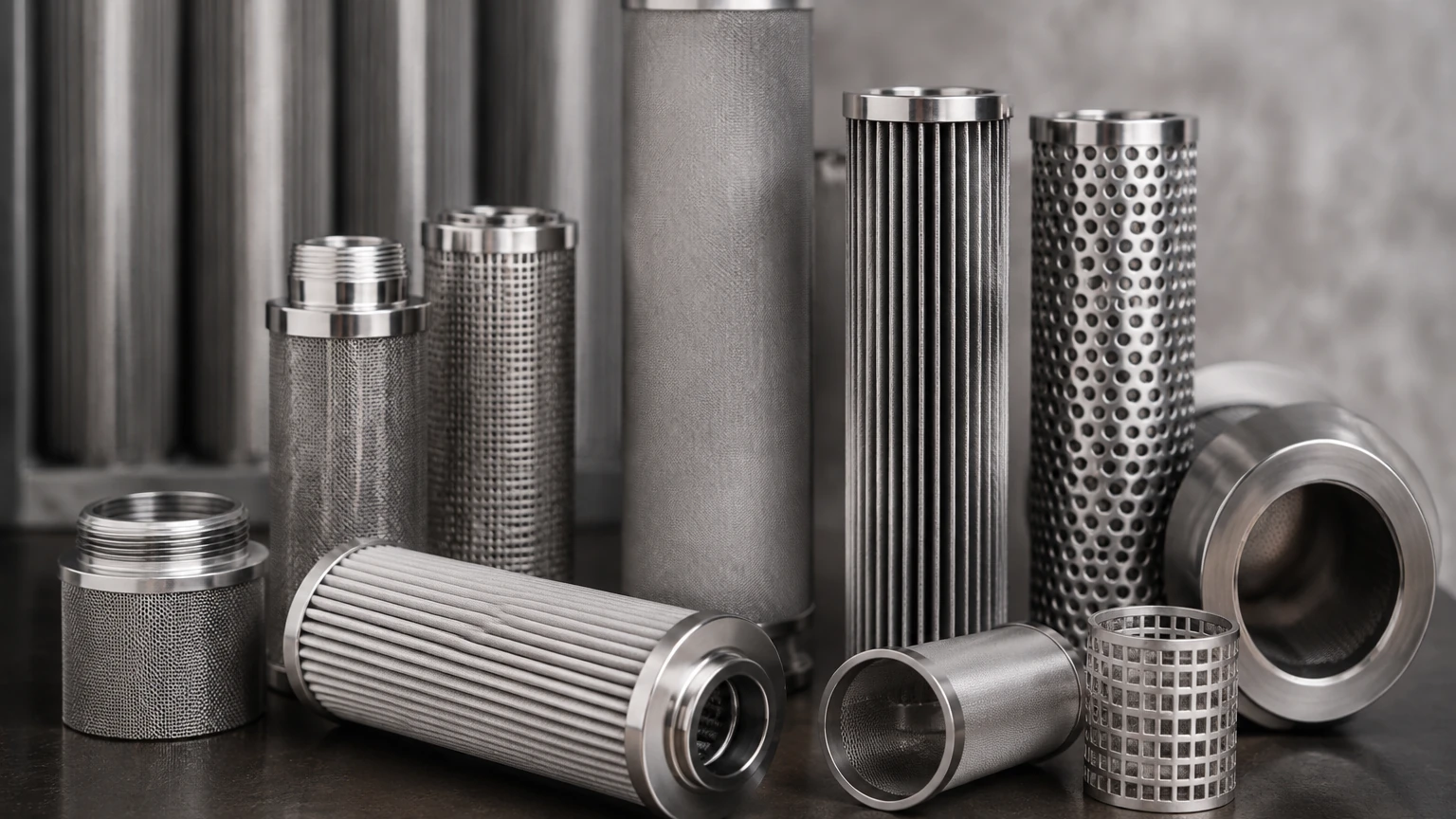
Industrial systems are rarely "one size fits all." Often, standard off-the-shelf filter cartridges do not meet the specific spatial or performance requirements of a custom-built hydraulic power unit or a specialized chemical reactor. This is where custom manufacturing becomes essential.
Customization options for industrial oil filtration components include:
* Material Selection: Utilizing 304, 316, or 316L stainless steel for specific corrosion resistance requirements.
* End Cap Configurations: Designing custom fittings, threads, or flanges to integrate seamlessly with existing machinery.
* Reinforcement: Adding internal support cores or external shrouds to handle high-pressure surges or mechanical vibration.
* Pleating Geometry: Optimizing the number and depth of pleats to maximize the filtration surface area within a confined footprint.
By working with a manufacturer capable of providing OEM solutions, engineering teams can ensure that the filtration component is an optimized part of the system design rather than an afterthought.
Maintenance and Total Cost of Ownership (TCO)
The initial purchase price of a filter element is only a small portion of its total cost. In industrial oil filtration, the TCO includes the cost of replacement elements, labor for change-outs, disposal fees for contaminated filters, and the potential cost of oil loss during changes.
Stainless steel filter elements offer a distinct advantage in TCO for many industrial applications. Because they are cleanable—using ultrasonic baths, back-flushing, or chemical cleaning—the need for frequent replacements is eliminated. This is particularly valuable in remote locations or in processes where the cost of downtime for a filter change is prohibitively high.
Furthermore, high-quality metal filters prevent "media migration." Some lower-quality disposable filters can shed fibers into the oil stream, becoming a source of contamination themselves. A robust stainless steel construction ensures that the filter remains a barrier, not a contributor, to system debris.
Conclusion: Selecting the Right Filtration Partner
Industrial oil filtration is a complex discipline that requires a deep understanding of fluid dynamics, material science, and mechanical engineering. Selecting the right filter involves more than just picking a micron size; it requires a holistic view of the operating environment, the fluid properties, and the long-term maintenance strategy.
For organizations seeking reliable, high-performance filtration components, partnering with a manufacturer that specializes in custom stainless steel solutions is vital. From initial design and material selection to the production of precision-engineered cartridges, a technical approach ensures that the filtration system provides the necessary protection for critical industrial assets. To review product options and application support for your specific filtration needs, please visit the Main Page.
