


Industrielle Staubfilter
In the landscape of modern industrial manufacturing, the management of particulate matter is not merely a matter of environmental compliance but a fundamental requirement for process integrity and equipment longevity. High-performance filtration systems, specifically those utilizing industrielle staubfilter (industrial dust filters), serve as the primary defense against contamination in sectors ranging from chemical processing to pharmaceutical production. For engineers and procurement specialists, selecting the appropriate filtration media requires a deep understanding of material science, fluid dynamics, and the specific mechanical demands of the application environment.
Industrial dust filtration involves the separation of solid particles from gas or air streams. Unlike standard commercial HVAC filters, industrial-grade solutions must withstand extreme temperatures, corrosive chemical vapors, and high-pressure differentials. Stainless steel filtration components have emerged as the industry standard for these demanding roles due to their structural rigidity and resistance to degradation.
Technical Foundations of Metal Mesh Filtration
The efficacy of an industrial dust filter is determined by its ability to capture particles while maintaining a manageable pressure drop. When designing industrielle staubfilter, engineers typically focus on three primary mechanisms of particle capture: physical interception, inertial impaction, and diffusion.
1. Interception: Occurs when a particle follows a gas streamline but comes within one particle radius of a filter fiber or wire, causing it to adhere.
2. Inertial Impaction: Heavy particles with high momentum fail to follow the curving streamlines of the gas as it moves around the filter media, instead striking the media directly.
3. Diffusion: For extremely small particles (typically sub-micron), Brownian motion causes them to deviate from streamlines and collide with the filter structure.
For industrial applications, the choice of weave in a stainless steel wire mesh filter is critical. Plain weaves offer high flow rates and are easy to clean, while Dutch weaves (including reverse and twill variations) provide much finer filtration ratings and higher mechanical strength. By adjusting the wire diameter and the density of the weave, manufacturers can customize the filtration accuracy to meet specific ISO or industry-specific purity standards.
Material Selection: Why Stainless Steel?
While polymer-based filters are common in low-temperature, non-corrosive environments, they often fail in heavy-duty industrial settings. Stainless steel, particularly grades 304 and 316L, provides several technical advantages for industrielle staubfilter:
* Thermal Stability: Stainless steel filters can operate at temperatures exceeding 500°C, where synthetic fibers would melt or lose structural integrity. This is essential for hot gas filtration in chemical reactors or exhaust systems.
* Corrosion Resistance: In environments involving acidic or alkaline vapors, 316L stainless steel offers superior resistance to pitting and stress corrosion cracking.
* Mechanical Strength: High-pressure hydraulic systems or high-velocity gas streams exert significant force on filter media. Metal mesh and sintered metal cartridges maintain their shape under pressure, preventing "media migration"—a common failure where filter fibers break off and contaminate the downstream flow.
* Cleanability: One of the most significant advantages of metal filters is that they are often reusable. Through backwashing, ultrasonic cleaning, or chemical baths, these filters can be restored to near-original performance, significantly reducing the total cost of ownership compared to disposable alternatives.
Design Parameters for High-Performance Filtration
When evaluating industrielle staubfilter for a specific project, engineers must look beyond the nominal micron rating. Several factors influence the long-term performance of a filtration system:
Pore Size and Distribution
The pore size determines the filtration accuracy. However, the distribution of these pores is equally important. A uniform pore structure ensures that the flow is distributed evenly across the entire surface of the filter, preventing localized high-velocity zones that can lead to premature wear or "tunneling," where particles are forced through the media.
Pressure Drop (Delta P)
The initial pressure drop is the resistance the filter offers to the flow of gas or liquid. A high initial Delta P means the system must work harder, increasing energy consumption. Engineers aim for a balance where the filter provides the required capture efficiency with the lowest possible resistance. As the filter collects dust, the pressure drop increases; understanding the "terminal pressure drop"—the point at which the filter must be cleaned or replaced—is vital for system design.
Effective Filtration Area
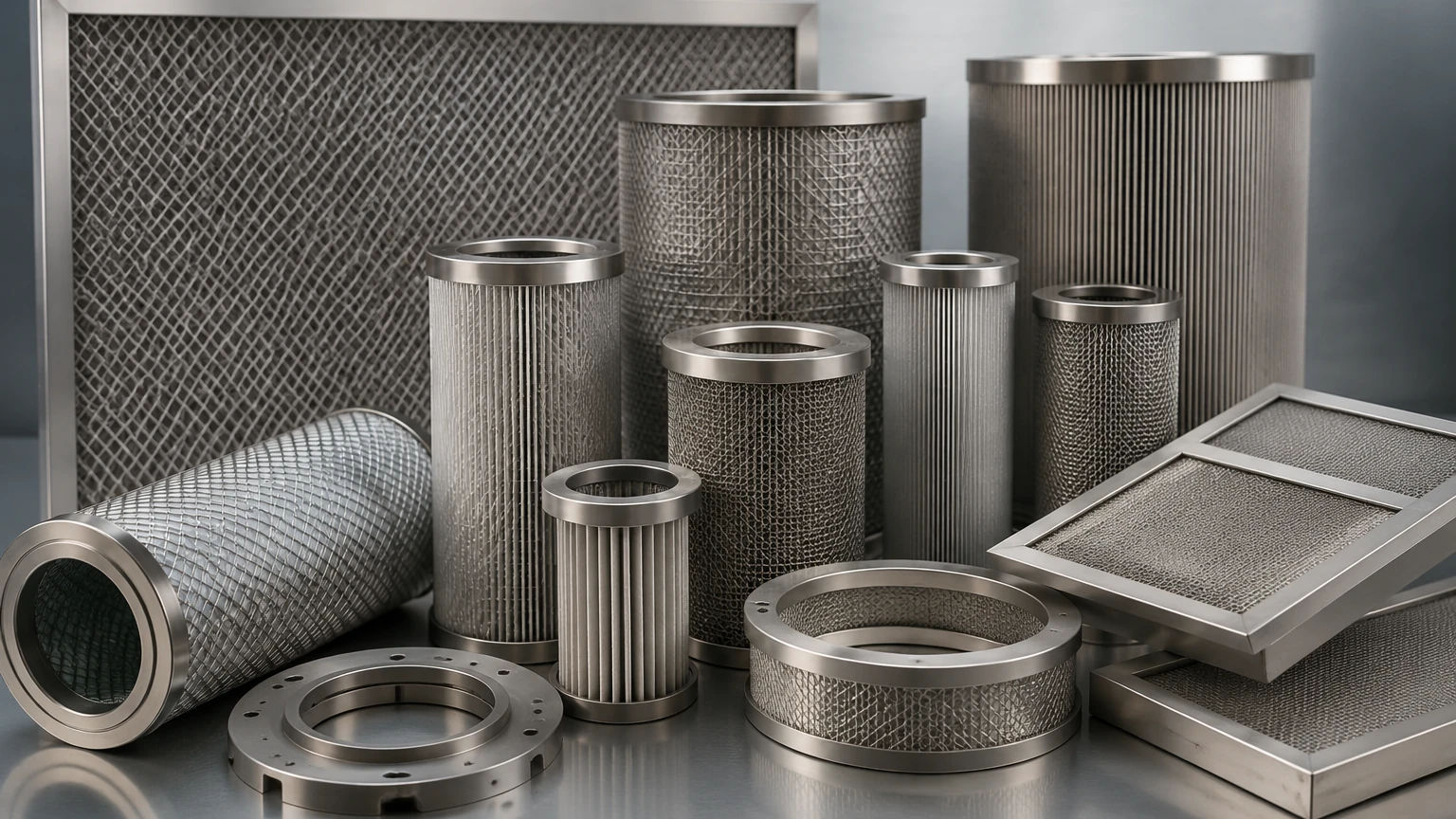
To handle high volumes of dust without frequent clogging, manufacturers often use pleated designs for stainless steel filter cartridges. Pleating significantly increases the surface area within the same footprint, allowing for lower face velocities and longer service intervals. For more information on how these designs are implemented in industrial settings, you can review product options and application support on our Main Page.
Applications Across Key Industries
Industrielle staubfilter are utilized across a broad spectrum of industries, each with unique challenges:
* Chemical Processing: Filters must handle aggressive solvents and catalysts. Stainless steel components are used to recover expensive catalyst particles from gas streams or to protect downstream compressors from fine dust.
* Food and Beverage: In this sector, hygiene is paramount. Stainless steel filters are preferred because they do not shed fibers and can withstand Clean-in-Place (CIP) sterilization processes involving steam and harsh detergents.
* Pharmaceuticals: Precision is the priority here. Sintered metal filters provide the absolute filtration ratings required to ensure product purity and to capture active pharmaceutical ingredients (APIs) during the drying and milling processes.
* Hydraulic Systems: While often associated with liquid, air breathers and reservoir vents utilize dust filtration to prevent atmospheric contaminants from entering the hydraulic fluid, which could otherwise lead to component wear and system failure.
Evaluating Filtration Efficiency and Accuracy
In the context of industrielle staubfilter, it is important to distinguish between nominal and absolute filtration ratings. A nominal rating refers to the filter's ability to retain a major percentage (usually 60% to 90%) of particles of a specific size. An absolute rating, however, indicates that 99.9% or more of particles above a certain size will be captured.
For critical industrial processes, absolute ratings are often required to prevent downstream damage. Engineers must also consider the "Beta Ratio," a standard measure of filtration efficiency. A higher Beta Ratio indicates a more efficient filter. When sourcing components, technical teams should request performance data that reflects the specific flow rates and particle types expected in their facility.
Maintenance, Cleaning, and Longevity
The lifecycle of an industrial dust filter is a major component of the total operational budget. While the initial investment in stainless steel industrielle staubfilter is higher than that of fabric or paper filters, the longevity often justifies the cost.
Maintenance cycles are typically triggered by pressure sensors. Once the pressure drop reaches a predetermined threshold, the filter is removed for cleaning. In many automated systems, a "back-pulse" or "backwash" mechanism is used, where a high-pressure burst of air or fluid is sent through the filter in the reverse direction to dislodge the dust cake.
For deep cleaning, ultrasonic baths are highly effective. The high-frequency sound waves create cavitation bubbles that implode, removing fine particles trapped deep within the wire mesh or sintered structure. This capability makes stainless steel filters an environmentally friendly choice, as it reduces the volume of waste generated by discarded filter elements.
Selecting a Custom Filtration Partner
Standard off-the-shelf filters often fall short in specialized industrial environments. Customization is frequently necessary to accommodate unique housing dimensions, specific alloy requirements, or non-standard flow rates.
When selecting a manufacturer for industrielle staubfilter, engineers should look for partners who offer:
* OEM Capabilities: The ability to manufacture components that integrate seamlessly into existing machinery.
* Material Certification: Verification that the stainless steel used meets the required chemical and mechanical specifications.
* Technical Support: Assistance in calculating the required filtration area and predicting pressure drop based on specific process variables.
By focusing on these technical criteria, purchasing teams can ensure they are acquiring a filtration solution that provides the best balance of performance, durability, and cost-effectiveness. Whether it is for protecting a high-speed turbine from atmospheric dust or ensuring the purity of a chemical batch, the right industrial dust filter is an investment in the reliability of the entire production chain.
For technical professionals seeking to optimize their filtration processes, understanding the nuances of wire mesh and sintered metal components is the first step toward achieving superior operational results. Detailed specifications and engineering guidance for these systems are available via the Main Page, providing the necessary data to make informed procurement decisions.
