


Ink Filter
In the landscape of industrial printing and chemical processing, the precision of fluid delivery systems is a critical factor in determining both product quality and operational efficiency. An ink filter is an essential component designed to remove particulate matter, agglomerates, and contaminants from ink formulations before they reach the print head or application nozzle. For engineers and technical procurement teams, selecting the correct filtration solution is not merely a matter of part replacement; it is a strategic decision that impacts the longevity of expensive equipment and the consistency of the final output.
Industrial inks—whether solvent-based, UV-curable, water-based, or ceramic-based—contain pigments and additives that must remain within a specific particle size distribution. Contaminants, such as dried ink skins, fibers, or metallic debris, can cause catastrophic failure in high-precision nozzles. As a specialized manufacturer of stainless steel filtration solutions, Kaifil provides the technical expertise required to navigate the complexities of fluid dynamics and material compatibility in industrial filtration.
The Engineering Role of an Ink Filter in Fluid Systems
The primary function of an ink filter is to ensure that the fluid remains free of any particles that exceed the maximum allowable size for a specific application. In high-resolution inkjet printing, for example, nozzle diameters may be as small as 20 to 50 microns. A single oversized particle can lead to a "clogged jet," resulting in banding, missed lines, or complete system downtime.
Beyond simple particle removal, the filter must manage the rheological properties of the ink. Many industrial inks are non-Newtonian fluids, meaning their viscosity changes under stress. A poorly designed filter can create excessive shear stress, leading to pigment shearing or premature precipitation of additives. Therefore, the internal geometry of the filter housing and the structure of the filter media must be engineered to minimize pressure drops while maintaining high filtration efficiency.
From a system-wide perspective, the filter also acts as a buffer. It protects downstream components such as pumps, valves, and flow meters from abrasive wear. By capturing debris early in the fluid path, the filter extends the service life of the entire delivery system, reducing the frequency of unplanned maintenance interventions.
Filtration Media and Material Selection
When specifying an ink filter, the choice of material is the most significant factor in determining chemical compatibility and durability. While polymer-based filters are common in low-pressure, disposable applications, stainless steel filtration media offer distinct advantages for demanding industrial environments.
Stainless Steel Wire Mesh
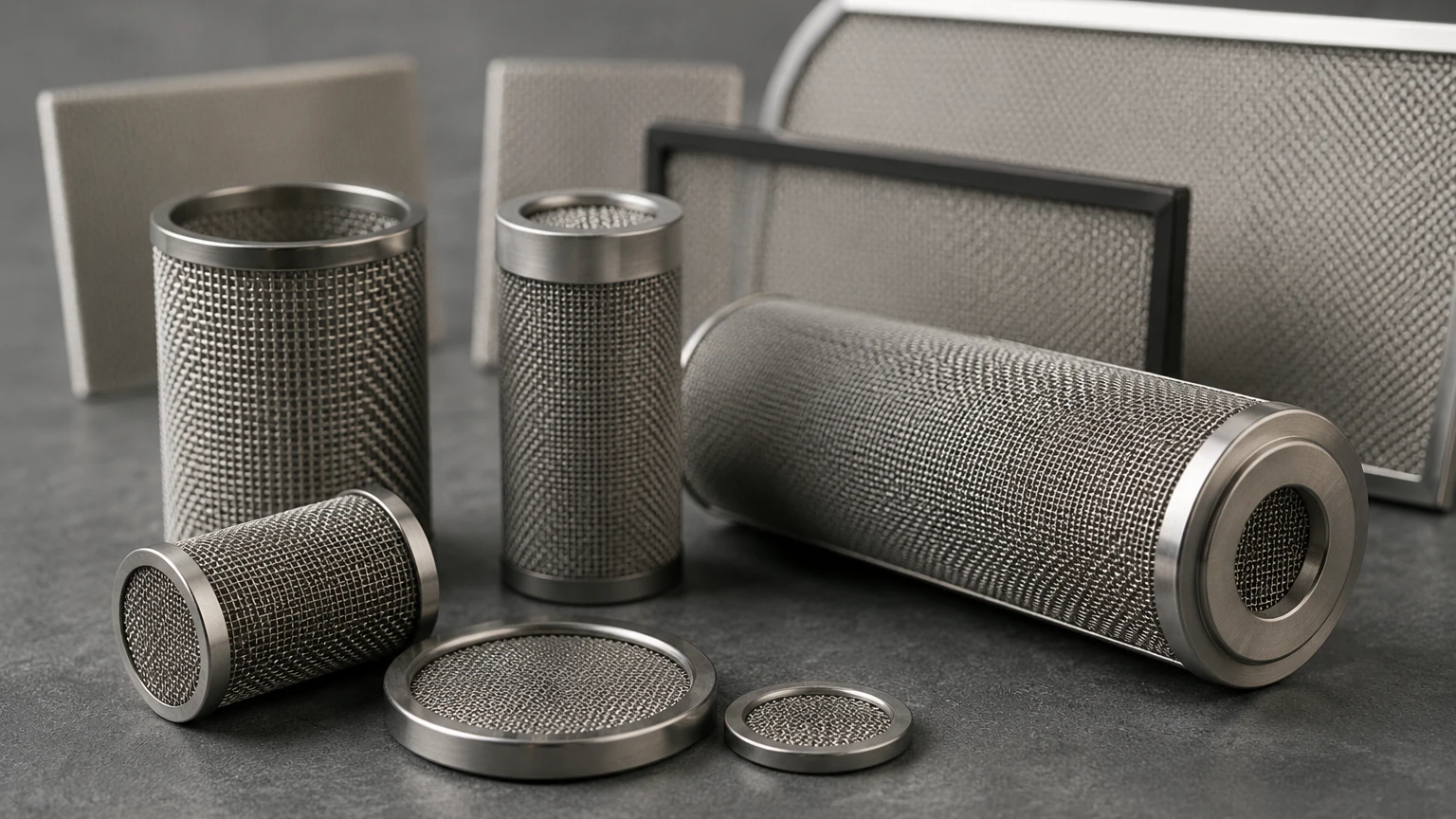
Stainless steel wire mesh is a preferred medium for ink filtration due to its precise pore size and robust mechanical strength. It is typically manufactured from 304 or 316L stainless steel, providing excellent resistance to the aggressive solvents found in many industrial inks. Wire mesh filters can be engineered as single-layer screens or multi-layer sintered structures. Sintering involves bonding multiple layers of mesh through a high-temperature heat treatment process, creating a stable, rigid structure that will not migrate or deform under high pressure.
Depth vs. Surface Filtration
Engineers must choose between surface filtration and depth filtration based on the nature of the contaminants. Surface filtration, provided by wire mesh, captures particles on the plane of the media. This is ideal for applications where particle size distribution is tightly controlled. Depth filtration, often achieved through sintered metal fibers or multi-layered mesh, traps particles within the thickness of the media. This provides a higher dirt-holding capacity, which is beneficial for inks with a higher load of irregular contaminants.
Chemical Compatibility
Chemical resistance is non-negotiable. Many industrial inks contain corrosive solvents or high-pH aqueous bases. Stainless steel is inert to most organic solvents, making it the standard for UV-curable and solvent-based inks. For engineers evaluating options on the Main Page, confirming the specific grade of stainless steel (such as 316L for enhanced pitting resistance) is a vital step in the procurement process.
Key Performance Indicators for Filter Selection
To optimize a filtration system, technical professionals must evaluate several performance metrics. These indicators ensure that the ink filter balances protection with system performance.
1. Micron Rating (Absolute vs. Nominal): An absolute micron rating indicates that the filter will capture 99.9% of particles at that size or larger. A nominal rating is an average and may allow larger particles to pass through. For print head protection, absolute ratings are generally required.
2. Pressure Drop (ΔP): This is the difference in pressure between the inlet and outlet of the filter. A high initial pressure drop indicates that the filter is too restrictive for the pump's capacity, which can lead to cavitation or reduced flow rates.
3. Flow Rate: The filter must be sized to handle the maximum flow rate of the system without exceeding the recommended velocity for the specific ink type. High velocity through the media can cause "particle breakthrough," where pressure forces contaminants through the pores.
4. Dirt Holding Capacity (DHC): This refers to the total amount of contaminant a filter can retain before the pressure drop reaches a critical limit. A higher DHC means longer intervals between filter cleanings or replacements.
Customization and OEM Integration
Industrial printing systems are rarely "one size fits all." Different machine architectures require unique filter configurations to fit within tight spatial constraints or to interface with specific plumbing standards. Customization is a core strength of specialized manufacturers like Kaifil, where filtration components are tailored to meet the exact needs of an OEM (Original Equipment Manufacturer).
Customization options often include:
* End Fittings: Integration of NPT threads, flange mounts, or quick-connect fittings to ensure leak-proof connections.
* Housing Geometry: Designing the filter body to fit within the internal chassis of a printer or chemical processing unit.
* Pleated Designs: For applications requiring high flow rates in a small footprint, pleating the stainless steel mesh significantly increases the effective filtration area without increasing the outer dimensions of the cartridge.
* Reinforced Structures: For high-pressure hydraulic ink systems, filters can be manufactured with internal support cores or external shrouds to prevent collapse or bursting.
By working closely with an engineering-focused supplier, purchasing teams can ensure that the filtration component is not an afterthought but a fully integrated part of the system's design.
Maintenance, Replacement Cycles, and TCO
The Total Cost of Ownership (TCO) of an ink filter involves more than the initial purchase price. It includes the cost of downtime, the labor required for replacement, and the potential cost of damaged downstream components.
Monitoring Filter Health
In sophisticated industrial setups, differential pressure sensors are used to monitor the state of the filter. As the filter captures more debris, the pressure drop increases. Setting a threshold for "filter change-out" prevents the system from reaching a point where flow is restricted enough to affect print quality.
Reusability vs. Disposal
One of the primary advantages of stainless steel ink filters is their cleanability. Unlike polymer filters, which must be discarded once clogged, metal filters can often be cleaned using ultrasonic baths or chemical solvents, depending on the ink type and the nature of the contaminants. This reusability significantly reduces the long-term environmental impact and the recurring costs associated with consumable filters.
Replacement Best Practices
When a filter reaches the end of its life or its cleaning cycle, the replacement process must be handled with care to avoid introducing air or new contaminants into the system. Engineers should look for filter designs that allow for easy venting and minimal fluid loss during the change-over process.
Addressing Common Engineering Questions
Before finalizing a purchase, technical teams often address specific concerns regarding the integration of new filtration components.
Is the filter compatible with UV-curable inks?
Yes, provided the housing and seals are made of materials like stainless steel and EPDM or Viton, which resist the monomers and photoinitiators found in UV inks. Stainless steel is particularly effective here as it does not leach plasticizers into the ink.
How does temperature affect filtration?
Inks used in 3D printing or ceramic applications are often heated to reduce viscosity. Stainless steel filters maintain their structural integrity at elevated temperatures where plastic filters might soften or fail.
What is the expected lifespan?
The lifespan of an ink filter depends entirely on the "cleanliness" of the incoming ink and the volume of fluid processed. In a closed-loop system with high-quality inks, a stainless steel filter can last for several years with periodic cleaning.
Conclusion
The selection of an ink filter is a technical necessity that directly influences the reliability of industrial printing and fluid delivery systems. By focusing on material integrity, precise micron ratings, and robust engineering, manufacturers can protect their equipment and ensure consistent product quality. Stainless steel filtration solutions, such as those provided by Kaifil, offer the durability and chemical resistance required for the most demanding applications.
For engineers and procurement professionals seeking to optimize their filtration processes, understanding the balance between flow dynamics and particle retention is key. Whether you are designing a new OEM system or looking to improve the performance of an existing line, choosing a high-performance metal filter is a proven method for reducing downtime and achieving long-term cost savings. To explore specific configurations and technical specifications for your application, you can Review product options and application support to find a solution that meets your exact industrial requirements.
